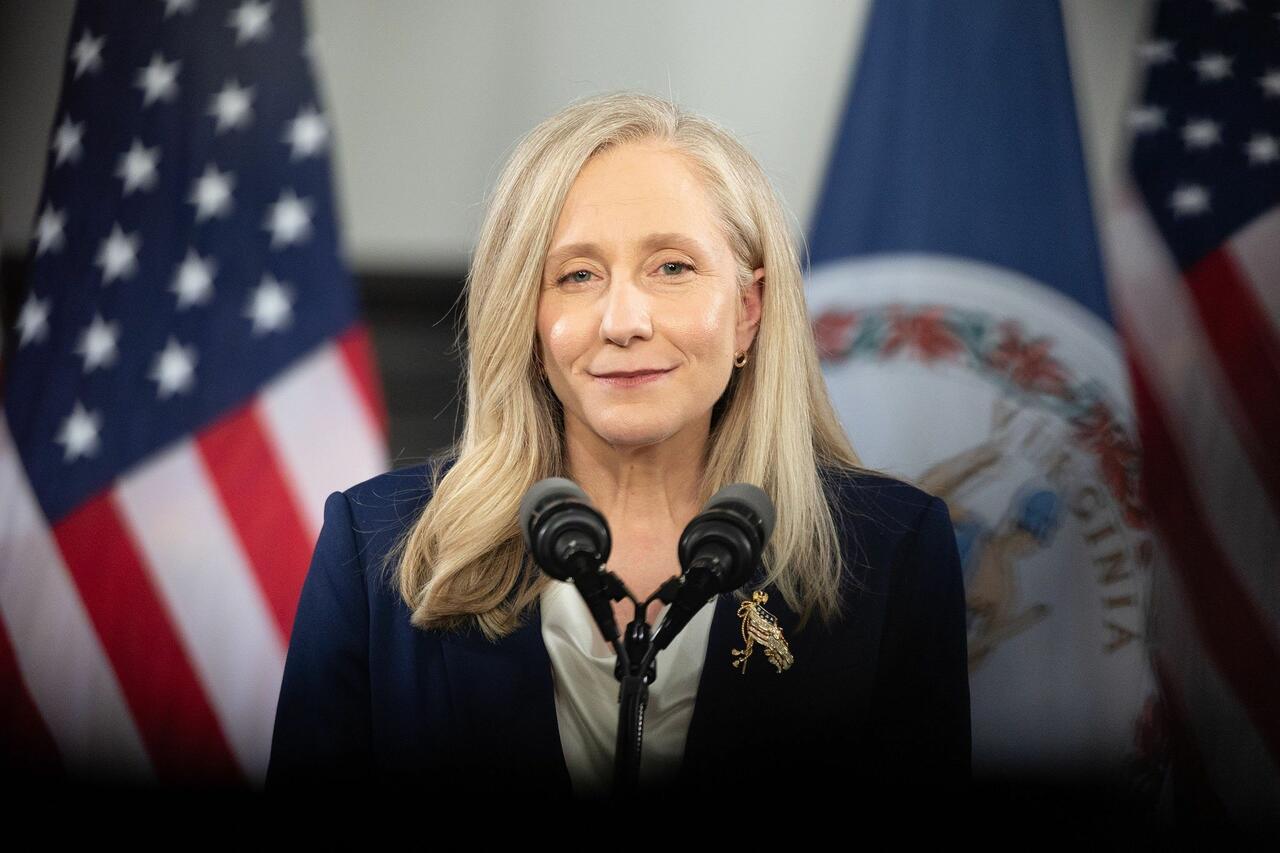
There has been growing criticism (and falling poll numbers) of Virginia Governor Abigail Spanberger after she ran as a moderate and then immediately veered to the far left after her election. Once in power, Spanberger and the Democrats unleashed a slew of tax increases, moved to eliminate all but one Republican district in the purple state, passed an array of anti-gun laws, and enacted other controversial measures. One of these measures is a clearly unconstitutional effort to strip pro-Confederate groups of their tax exemption.

This week, Spanberger signed HB167, the law that eliminated the tax exemption for various confederacy-linked groups, including the Virginia Division of the United Daughters of the Confederacy, the General Organization of the United Daughters of the Confederacy, the Confederate Memorial Literary Society, the Stonewall Jackson Memorial, Incorporated, the Virginia Division, Sons of Confederate Veterans, and the J.E.B. Stuart Birthplace Preservation Trust, Inc.
Notably, as soon as they came into power, Democrats also passed House Bill 1377 to move against the Virginia Military Institute, including appointing a task force that could effectively close the historic school. Many Democrats have previoulsy sought to close VMI despite its unique and inspiring history in training some of our most famous military leaders, including General George Marshall. Liberals want to close the school due to its history from the Civil War.
Spanberger recently expressed support for the effort but returned the bill with suggestions to use the board of directors to carry out the review.
Spanberger’s substitute eliminates that task force entirely and instead directs VMI’s own board of visitors to carry out the review.
The board would be empowered to carry out a fairly hostile and open-ended agenda, including to “distance [VMI] from the Lost Cause narrative, foster an inclusive environment, and address any other concerns.” Spanberger has appointed 27 new board members, including former Gov. Ralph Northam, who is viewed as hostile to VMI.
The New York Times explained that the Democrats wanted to “distance Virginia from its Confederate past.” However, they also want to use a content-based law to discriminate against groups with which they disagree. The law clearly violates the First Amendment, but neither Spanberger nor the Virginia Democrats appear to care.
In Reed v. Town of Gilbert, 576 U.S. 155 (2015), the Court struck down a signage regulation because”restrictions … that apply to any given sign [depend] entirely on the communicative content of the sign.” Likewise, Simon & Schuster, Inc. v. Members of the N.Y. State Crime Victims Bd., 502 U.S. 105, 116 (1991), the Court stressed that the government’s ability to impose content-based burdens on speech raises the specter that the government may effectively drive certain ideas or viewpoints from the marketplace.
From taxes to trademarks, content-based discrimination runs afoul of our free speech values. In Matal v. Tam, 582 U.S. 218 (2017), the Court cited Justice Oliver Wendell Holmes decision in United States v. Schwimmer, 279 U. S. 644, 655 (1929), that “the proudest boast of our free speech jurisprudence is that we protect the freedom to express ‘the thought that we hate.'”
Over 30 years ago, I wrote about the collision between anti-discrimination laws and the free exercise of religion. I have been critical of the use of the tax code to effectively punish organizations that do not comport with the IRS’s view of good public policy.
That prior work was critical of the 1982 decision involving Bob Jones University, in which the Supreme Court upheld the denial of tax-exempt status. In the case of Bob Jones, the university was engaged in reprehensible racial discrimination. However, I wrote how the actual standard is far more vague and could potentially be used more broadly.
Virginia is an example of precisely that problem in the use of tax exemptions to engage in viewpoint discrimination.
I have opposed such moves with a variety of organizations with which I have long-standing objections. That includes the Administration’s threat to revoke Harvard University’s tax-exempt status.
Tax exemption should not be a status bestowed upon those adhering to the demands of whatever party is in power. Free speech and associational rights are fostered by granting this status.
Virginia will now spend additional money to defend this unconstitutional action and fight for the right to discriminate against those who have opposing views in the state.
Jonathan Turley is a law professor and the best-selling author of “Rage and the Republic: The Unfinished Story of the American Revolution.”