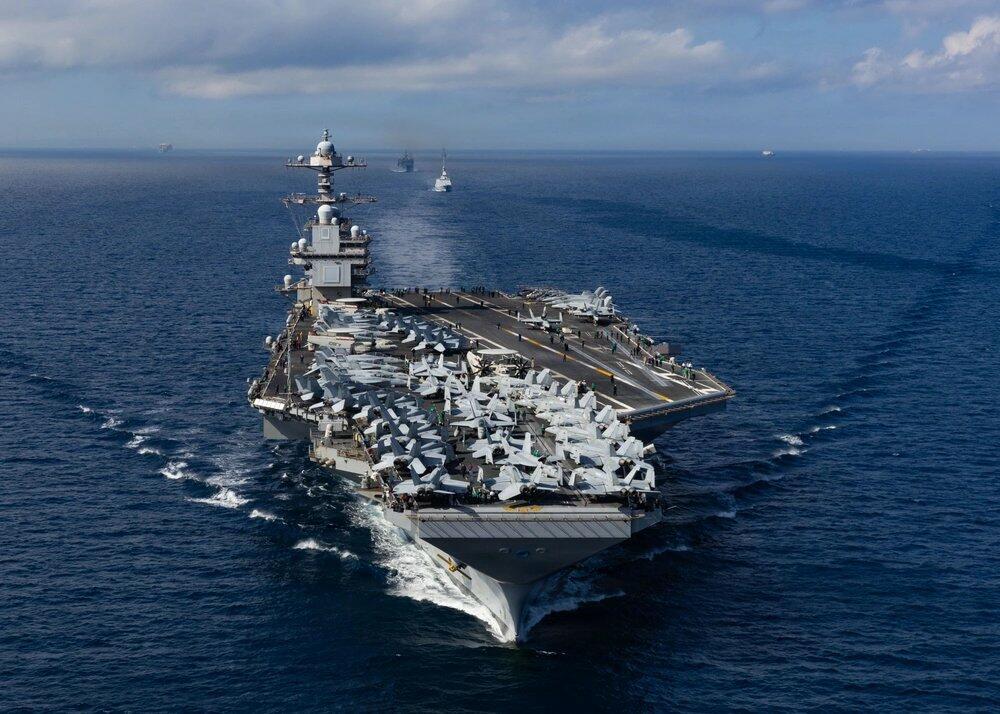
Over the weekend it was confirmed by Pentagon statements that the USS Gerald R. Ford aircraft carrier strike group has belatedly redeployed to the Middle East after a month in port for repairs following a fire aboard the ship.
The world's largest aircraft carrier returned to operations after what's been officially described as a blaze in its laundry area, which headlines have presented as accidental. The incident injured sailors and forced significant maintenance work, and ever since it happened on March 12, there's been an avalanche of public speculation that Iranian forces my have hit it in a missile or drone attack.

However, US and military officials have repeatedly rejected that the Ford was damaged as a result of Iranian attack, as Tehran has claimed.
The carrier is rejoining an expanding US military buildup in the region - with the USS Abraham Lincoln strike group already deployed, and the USS George H.W. Bush expected to soon join, which would bring the number of US carriers in the Middle East to three.
By comparison, the 2003 US invasion of Iraq was supported by a total of five US Navy aircraft carriers, with some in the Persian Gulf and some in the Mediterranean.
The Ford had been operating in the eastern Mediterranean when the US and Israel launched military operations against Iran. While transiting the Red Sea last month, a fire allegedly broke out in the ship's main laundry facility, triggering a major damage-control response and forcing the vessel to divert for repairs.
After completing maintenance, the bulk of which was done at the Croatian port town and Split, the carrier has returned to active duty.
Before earlier this year returning to the Middle East, the Ford operated in the Caribbean, including missions targeting suspected drug trafficking, and it was heavily involved in the controversial US operation against Venezuelan leader Nicolás Maduro.
As a reminder on the Bush carrier's route:
During its extended deployment, the carrier has also been subjecting of widespread reports of technical problems, including plumbing failures that caused sewage system backups, adding to the overall strain of its lengthy, extended deployment.