Authored by Mrigakshi Dixit via Interesting Engineering,
Researchers at Harvard have developed a fleet of robotic ants that mimic the self-organizing behavior of social insects to build and dismantle structures without blueprints or central leadership.
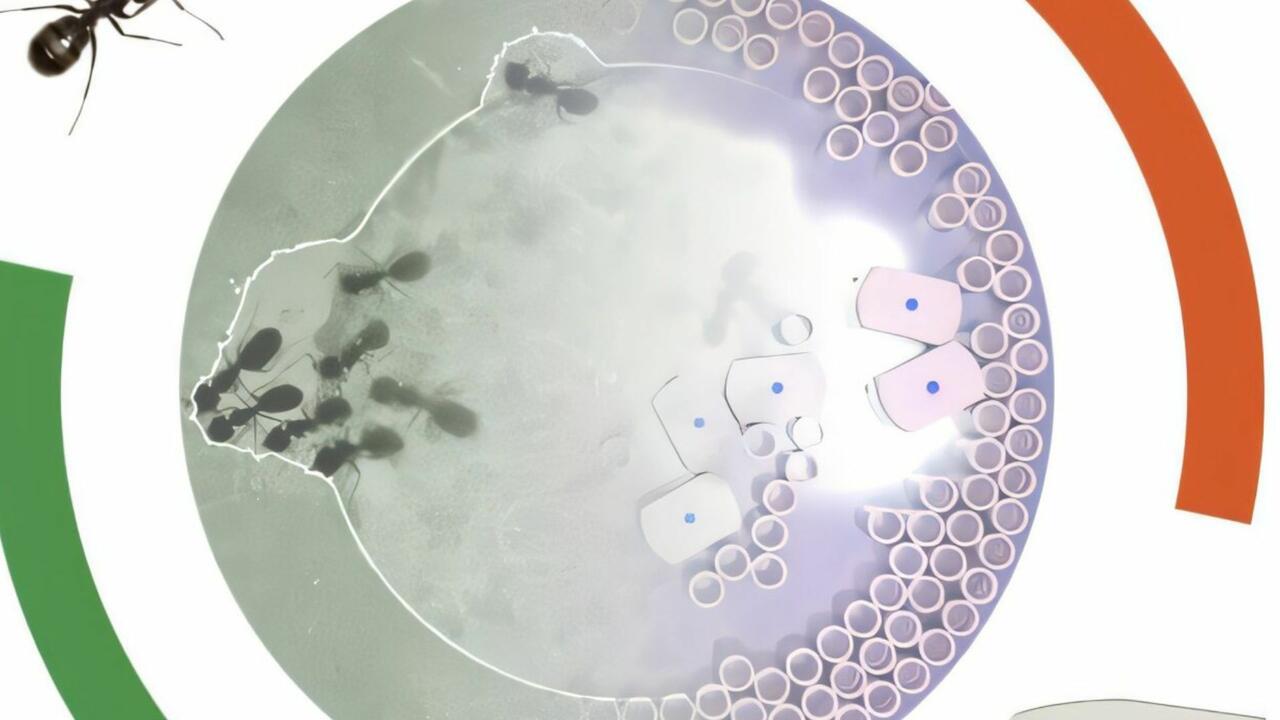
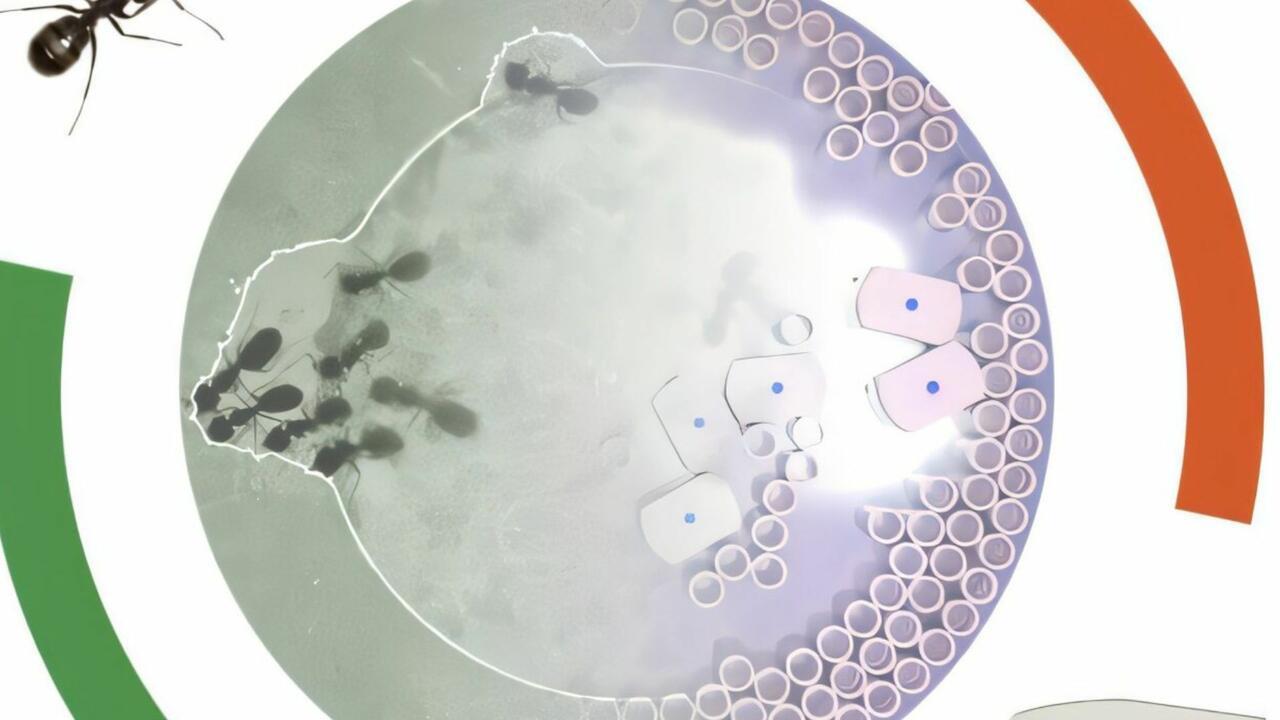
Dubbed “RAnts”, these robotic ants have been designed by researchers from the John A. Paulson School of Engineering and Applied Sciences (SEAS).
These are simple, decentralized robots that can spontaneously organize to build — and just as easily destroy — complex structures.
Instead of chemical pheromones, these robots use light fields (photormones) to communicate.
“Our new study shows how simple, local rules can lead to the emergence of complex task completion that is self-organized and thus robust and adaptive,” said Professor L. Mahadevan, the Lola England de Valpine Professor of Applied Mathematics, Organismic and Evolutionary Biology, and Physics at SEAS and FAS.
“We also introduce the concept of exbodied intelligence, where collective cognition arises not solely from individual agents, but from their ongoing interaction with an evolving environment,” Mahadevan added.
Digital pheromones
Ants prove that you don’t need a big brain to be a great builder. All that is needed is a great team. Without blueprints or supervisors, these tiny creatures construct some of nature’s most complex habitats.
And now, experts are taking this cue. In recent years, AI development has obsessed over faster chips and bigger digital brains.
But Professor L. Mahadevan and his team looked elsewhere, particularly exbodied intelligence.
In this model, the smart systems aren’t located inside the robot’s hardware. Rather, the intelligence emerges from the interaction between the robot and its surroundings.
This study demonstrates that decentralized agents can achieve complex goals by following minimal physical rules and responding to environmental cues.
In the wild, ants communicate via pheromones — chemical breadcrumbs that signal where to walk or where to dig. To replicate this, the Harvard team used photormones.
Using a biological concept called stigmergy, in which individuals respond to environmental changes made by others, the team created “RAnts” that communicate through light fields known as photormones.
These digital signals act as a substitute for natural pheromones, allowing the robots to coordinate their actions by sensing and modifying their surroundings in a continuous feedback loop.
Diverse use
Following simple gradients in a “photormone” light field, these robots create a feedback loop that coordinates the entire swarm.
These operate on just a few basic rules, like tracking signals, transporting blocks, and depositing them at specific thresholds.
The beauty of the system lies in its simplicity. Interestingly, the swarm can switch roles instantly by adjusting just two parameters: the intensity of the light-following behavior and the setting for dropping or picking up blocks.
One minute, the robots are a construction crew, and the next, a demolition team.
This development offers a new model for autonomous robotics, proving that sophisticated, large-scale tasks can be managed through simple, self-organizing interactions.
It suggests that collective intelligence isn’t just in the robots’ brains, but arises from the constant interaction between the agents and their evolving environment.
These findings pave the way for diverse applications, ranging from autonomous construction in hazardous zones and planetary exploration to the creation of advanced experimental models for analyzing animal behavior.
The study findings were detailed in the journal PRX Life.