It's not just us sounding the alarm about severe drought conditions hitting America's breadbasket as spring plantings ramp up, or warning about the second- and third-order effects that could push food prices higher later this year.
UBS analysts, led by Jonathan Pingle, told clients on Thursday morning that drought conditions across the US agricultural belt rank among the worst in more than 130 years:
The National Oceanic and Atmospheric Administration's Palmer Drought Severity Index hit its highest level for March since records started in 1895, and March was the third driest month recorded, regardless of time of year, behind only the famed 1930s Dust Bowl": July and August 1934. Water levels on the Mississippi look fine, the seasonal lows are typically in the fall, but river levels in Memphis sit 24 feet below this time last year.
The primary effect of drought conditions on farmland is a direct hit to production: reduced soil moisture, weaker germination, lower yields, poorer crop quality, reduced pasture and forage, and greater stress on the nation's cattle herd (already seen with soaring beef prices).
USDA says drought can slash planted or harvested acreage, reduce livestock productivity, and raise feed and irrigation costs; it can also reduce crop yields and quality, with some perennial crops taking years to recover.
Then the third-order effects emerge: lower farm output and higher production costs (diesel and fertilizer), which can be transmitted through food supply chains into higher retail food prices, tighter supplies for processors, and pressure on food security.
Pingle continued:
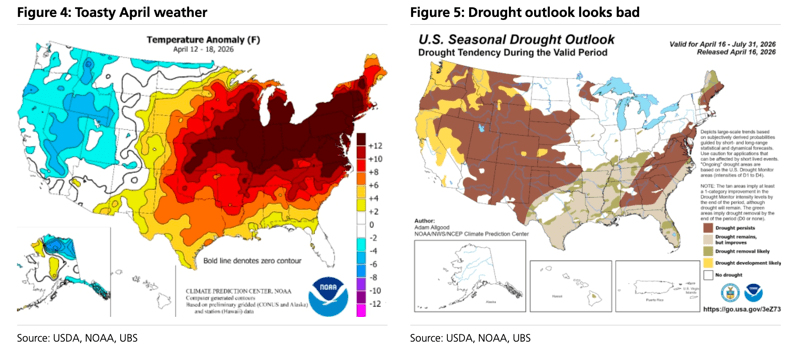
Drought severity sees much of the country; April very warm The USDA Weekly Weather and Crop Report highlights the unusual warmth during the April employment report survey reference period, which should be on net supportive of the data this month, and potentially postpone pull forward from March until May or June. The pay period including the 12th of the month is the payroll survey point and the week including the 12th of the month is the survey reference for the household survey, where the unemployment rate is estimated. In figure 4 below we show the deviation from normal temperature, and the populated east saw very warm weather highs in Concordia, KS (91°F), and Lincoln, NE (90°F). Warmth covered much of the Midwest on April 14, when daily-record highs soared to 88°F in Des Moines, IA, and Cape Girardeau, MO. By mid-week, some of the earliest 90-degree heat on record affected the middle Atlantic States. With a high of 90°F on April 15, Georgetown, DE, set a record for its earliest-ever high of 90°F or greater (previously, 94°F on April 17, 2002). Wilmington, DE (90°F on April 15), experienced its second-earliest 90-degree reading, behind only April 10, 2013. Similarly, Atlantic City, NJ (90°F on April 15) tied 1967 for its second-earliest 90-degree temperature, behind April 7, 2010," said the report.
"However, extremely dry conditions persisted Plains, with cascading impacts on rangeland, pastures, and winter wheat. Notably, jointing wheat in eastern Colorado, western Kansas, and southwestern Nebraska that has been greatly stressed by persistent dryness and periods of record-setting warmth experienced another setback at week's end, when hard freezes occurred. Drought also continued to worsen in much of the South, particularly across the southern Atlantic States," said the report.
Worth watching, the drought could lead to supply pressure and price pressure from the agricultural sector, on top of other pressures of concern at the moment. Last week, the USDA wrote in the Weekly Weather and Crop Report "Most immediately, portions of the South had little moisture for pastures, winter grains, and the germination and establishment of spring-sown crops. Despite patchy precipitation on the Plains, a significant portion of the winter wheat crop continued to exhibit drought stress, with the crop heading ahead of schedule as far north as Oklahoma. By April 12, roughly one-half of the winter wheat was rated in very poor to poor condition in Texas (54 percent), Oklahoma (48 percent), Nebraska (47 percent), and Colorado (44 percent)."


Our reporting:
Chart of the day:

Let's not forget that with fertilizer and diesel prices elevated, this only suggests the FAO Global Food Index is set to move higher later this year.

Pingle warned, "All eyes have been focused on the Middle East but another supply shock may be unfolding in US agricultural production."
Professional subscribers can read the full UBS drought note here at our new Marketdesk.ai portal.