As of early 2026, Sega Retro has more than 300 pages about Unreleased Saturn games. There’s one game that doesn’t have a page, however: Pyramid.
What’s Pyramid? That’s what we wondered when we came across this disc:
The disc’s owner wasn’t able to provide many details. Our best guess was that it was a version of Pyramid no Nazo: Ankh 2, an unreleased Saturn FMV game.
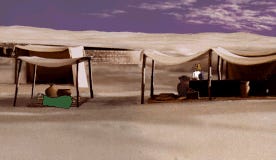
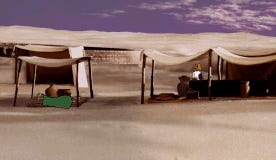
Thankfully, the CD-R managed to survive for 29 years perfectly intact – it booted right up and greeted us with this screen:
This didn’t match with our guess at all, but it was enough of a clue to ID the game.
Comparing the scene above to images associated with PC games that had “Pyramid” in the title revealed that it’s from Pyramid: Challenge of the Pharaoh’s Dream.
Pyramid was developed by Knowledge Adventure and published by McGraw Hill Home Interactive. It was an edutainment title, the sort of thing you might have played in your elementary school’s computer lab in the mid-1990s. And indeed, YouTube videos and Reddit threads have comments from people who remember experiencing it that way.
The premise of the game is that you’re an archaeologist who gets transported back in time to ancient Egypt. You witness various scenes related to the building of a great pyramid. In the process, you hopefully learn something about the past – or are at least occupied long enough to let your teacher catch up on grading.
The Saturn version seems to be a tech demo. These controls are implemented:
Move the pointer around with the D-pad.
Pick up and put down objects with the Z button.
Scroll left with L and right with R.
Play a voice clip with A.
If you scroll over to the right, there are three guys standing around. They move around on their own, but you can’t really interact with them.
According to the HINT_1.TXT file on the disc for the PC version, this scene is called Leveling the Foundation. You’re meant to show the objects to the workers. They’re supposed to tell you what each one is and whether it’s needed for this part of the pyramid’s construction.
This is the full walkthrough from that file:
1.  Click on the various tools and hand them to the workers for clues.
2.  You can also click on the journal at the top left of the screen
    for details about the tools.
3.  Click on the bucket.
4.  Then click on the Cistern to pour water into the bucket.
5.  Place the bucket full of water on the left side of the Tool Mat.
6.  Next pick up the scoring tool and place it next to the bucket.
7.  Then pick up the chisel and place it next to the scoring tool.
8.  Lastly, pick up the hammer and place it at the right side of the mat.
You can’t do all of that in the Saturn version, alas – the cistern doesn’t work, so you can’t fill the bucket with water. This video of the PC version (h/t Andrea Pannocchia) shows how things are supposed to go:
The Saturn disc has two files:
The first is called
0, and it’s the main game executable. It’s dated 1997-03-24.The second is called
TEST.MME, and it’s some type of custom archive. It’s dated 1997-03-23.
The primary game loop in the executable file is pretty easy to understand. Here’s some of the control code – labels have been added to Ghidra’s decompilation:
We made some progress in understanding the archive file. It’s got the background images, sprites, and probably the sound clip.

Even after going through all of the game data, we still didn’t have any solid idea about who made it. There are no credits, no build strings, no hints.
Did you notice that the disc is signed?
We scoured MobyGames for names that resembled the signature and came upon Alexander Ehrath’s profile.
He turned out to have a YouTube channel with a series on his time as a game developer. And wouldn’t you know, one of the videos mentions porting “some educational Egyptian thing” to the Sega Saturn:
We got in touch, and Alexander kindly agreed to sit in for a podcast interview.
Regarding Pyramid, Alexander confirmed what we suspected: A publisher was exploring doing console ports of education games and hired him to work on a Saturn version. The project didn’t progress much further than the tech demo stage – alas.
Alexander mentioned that he saved the tools he developed while working on Pyramid and shopped them around to other publishers who were looking to do console ports of their games. None of those made it into released games, however.
The whole interview is well worth listening to. Alexander goes into detail on a number of topics, including:
How he came to be credited as The Man in the Nintendo 64 port of Resident Evil 2.
Several sports titles that he worked on that ultimately got canceled.
The technical challenge of rendering water realistically on GameCube.
Our mystery is solved. Here’s a video of Pyramid in action on the Saturn:
To experience the demo for yourself, check it out on Hidden Palace.
Thanks to Cerbero, Wesker, fafling, and Tongara for their help in preserving this historical artifact! Thanks also to Alexander Ehrath for sitting in for the podcast interview and regaling us with his development war stories.
Rings of Saturn will be back this weekend with more digital archaeology. Subscribe here on Substack to get the next edition as soon as it’s published.