
Authored 'No1' via Gold and Geopolitics substack,
Three people sent me Richard Medhurst’s petrogas-dollar piece this week. I read it. Twice even.
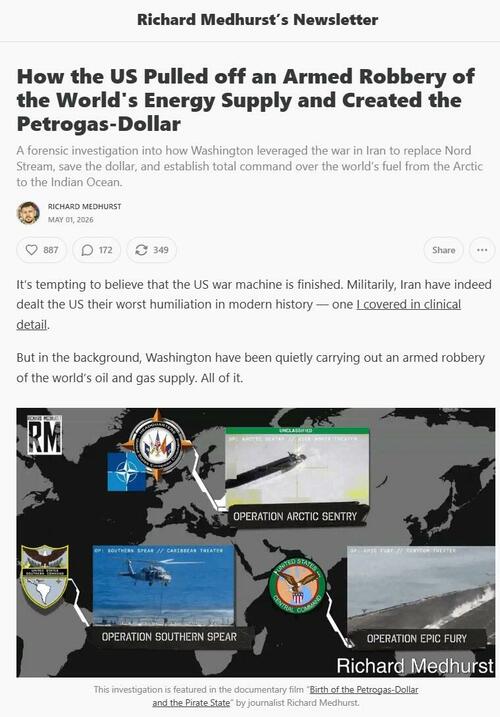
There’s a lot in there that I feel is correct.
The chronology of the Levantine Basin deals.
Cheney’s 2001 National Energy Policy.
The roughly $35 billion of Chevron contracts signed across Israel, Syria, Greece, and Cyprus in the past six months.
None of that is in dispute.
The piece is, on the facts, broadly accurate.
What I think though is that the reading of those facts is faulty.
Some history.
In 1944 Bretton Woods pegged the dollar to gold and made it the world’s reserve currency. In 1971 Nixon unpegged it. Three years later, Kissinger negotiated the Saudi arrangement that pegged it to something else - oil. The petrodollar was born. Everyone needed oil, oil was priced in dollars, thus everyone needed dollars.
Medhurst’s thesis is that the same trick is being repeated, with gas as the new anchor.
The Petrogas-Dollar. Same architecture, new commodity.
But gas isn’t oil.
Oil is fungible at planetary scale. One global market, one rough price band with quality differentials. Tankers go anywhere where there’s a port and a refinery. Every country needs it. Every industry uses it. Almost every modality of transport runs on it.
But gas is regional. LNG requires specialised liquefaction terminals on the export side, cryogenic tankers in transit, and regasification infrastructure on the import side. Each piece takes years and billions to build. Pipeline gas is captive to the geography of the pipe. Henry Hub, TTF, and JKM regularly trade at multiples of each other for what is nominally the same molecule. In 2022, European gas hit roughly 25x the US price - that’s the market telling you that there is no single global gas market, just regional ones tethered by expensive bottlenecks.
Anchoring a settlement currency to gas isn’t a step up from oil in my opinion.
It’s a step down.
Less universal demand, less liquid market, more infrastructure dependency, narrower counterparty base. If oil was the commodity that justified the petrodollar’s reach, gas cannot replace it without shrinking the regime it’s supposed to anchor.
Then there’s what’s been happening to the dollar itself. The moment Western powers froze $300 billion of Russian central bank reserves in 2022, every neutral reserve manager on earth received an unscheduled lesson in what “safe” actually meant in practice.
That lesson is still being absorbed, and the absorption is showing up in central bank gold buying at multi-decade highs, parallel payment rails being onboarded, sovereign Treasury holdings declining year over year.
None of it is dramatic. But all of it is compounding.
So the actual picture Medhurst is painting: a fading anchor (oil-and-dollar) being half-replaced by a structurally narrower one (gas-and-dollar), sitting on top of a settlement currency that’s slowly losing the trust required to function as one in the first place.
That’s a regression on two axes at the same time. Not a strategic plan.
The successor isn’t oil-and-dollar. It sure as ain’t a gas-and-dollar. By elimination of every other alternative, it will come back to gold.
Let’s start with Russia.
That’s where his documentary opens.
“The most severe logistical disruption in modern Russian history”. 40% of seaborne export capacity disabled. Production cuts of 300,000 to 400,000 barrels per day in April. (Not an interpretation, those numbers come from OPEC’s monthly report).
The Sirius Report, which tracks vessel movements rather than quotas, has Russian seaborne crude exports flat at 3.5 million barrels per day in April. The Pacific terminals that got hit in the spring strikes are fully recovered by now. The Baltic ports? Kept on loading. Whatever the bombing campaign was supposed to accomplish, it has accidentally functioned as a renovation programme.
The 300-400k figure measures voluntary discipline within the OPEC+ quota framework. It is not a damage assessment. Russia produced slightly less in April because the cartel asked them to, not because there’s a NATO destroyer parked outside Murmansk.
What did happen is that Europe outsourced the demand. They sanctioned Russia. For the 20th time now I guess, because the previous 19 were so successful.
But because even Europe still needs oil, they then turned around and bought the exact same molecules via Indian and Chinese refineries. Who bought it from Russia. At a discount. And mostly in local currencies.
Plus, they sold it at a premium. To Europe. That sanctioned that exact same oil. Great job virtue signaling.
Iran tells a similar story. The piece argues the blockade is starving China of its third-largest oil supplier. TankerTrackers reported on April 24 that Iran exported more oil in the first three weeks of April than in the entire month of March. The blockade has tightened since. WSJ documented loadings dropping in the second half of April, and Project Freedom only formally launched at CENTCOM this morning with 15,000 personnel and over 100 aircraft. The screws are turning, real consequences are landing. (� sidenote: I only hear crickets… � Still waiting for what news will turn up… �)
But Iran went into this war producing 1.1 million barrels per day at $47 a barrel. Through most of it, production has run around 1.5 million at $110.
I think Trump is pissed right now that he did not receive a “thank you” card yet…
Another argument landed on Saturday - which is after Medhurst’s piece landed. But it doesn’t fit the frame of the article, so I doubt it’ll be added.
US Treasury sanctioned Hengli Petrochemical and four Chinese teapot refineries on Friday over Iranian crude purchases.
Hengli isn’t just a teapot. It’s strategic national infrastructure. 280 billion RMB was invested with a 20 million tons annual refining capacity. It’s one of China’s seven major petrochemical bases. Plus the non-sanctioned parent group is the world’s largest shipbuilder.
Now on Saturday, China’s Ministry of Commerce activated the 2021 Blocking Statute. For the first time ever. Chinese firms and individuals are now legally prohibited from recognizing, implementing, or complying with the US sanctions.
Compliance has been removed as a choice.
“Rock, meet hard place” or something like that?
I doubt this will feature in Medhurst’s 25-year plan any time soon.
To me this looks like a reactive escalation against the Treasury announcement.
And THAT is the recurring shape of this whole thing. Every sanction tightens the parallel system. Every escalation removes another counterparty from the dollar rails. This theory isn’t some 5D strategic genius.
It’s an adaptation. Metabolic. Washington swings at whatever part it wants today… And that system adapts.
Bank of Kunlun was sanctioned by the US Treasury in 2012 for its Iran-related dealings, in what must have seemed like a good idea at the time. The sanctioning was the strategic move. The consequence - as it so often is - was unintended. By cutting Kunlun out of the dollar system, Treasury also cut its remaining dollar exposure to zero, making it the perfect institutional vehicle for yuan-denominated Iran trade.
For thirteen years now, Iranian oil has flowed to Chinese teapot refineries through Kunlun, settled in RMB, entirely outside SWIFT. Iran can’t easily spend the accumulated yuan in dollars, so it likely converts the surplus to physical gold via the Shanghai Gold Exchange.
Iranian oil → yuan → gold. The loop has been running since the year Obama was re-elected. It is now formally protected, on the Chinese side, by a Blocking Statute.
The PBOC has bought gold for seventeen consecutive months. Official reserves are over 74 million troy ounces. The unofficial figure is widely assumed to be substantially higher, given that Chinese domestic mine production since 2000 alone (around 8,150 tonnes) exceeds the entire stated US Treasury holding. China’s US Treasury exposure has fallen from a 2013 peak of $1.32 trillion to $693 billion in February 2026.
Spot is around $4,800 an ounce. Shanghai still trades at consistent premiums to London and COMEX. Chinese banks are rationing 600 kilograms of bullion per bank per day, and every allocation evaporates in under a minute.
While we’re on the subject. The US Treasury carries its own gold holdings on the books at $42.2222 per troy ounce, a statutory price last revised in 1973. Spot is $4,800. The mark-to-market gap is roughly $1.25 trillion. Or said differently: about 3% of its national debt. Or even more differently: if they sell everything, they can run the US government for about a week and a half.
Every $100 that gold rises does add ~$25 billion. I have no idea whether anyone in Treasury has noticed, but I’ve heard a lot of chatter over the years about re-valuating this gold hoard.
The mechanism that I envision instead of a “gas-4-a-dolla’” (not an official US Treasury term… yet) is as I said many times (mainly in comments): internally in a country, the currencies stay fiat. We - the plebs - don’t get to transact in gold and spend 0.03 gram of gold on a gallon of petrol or so. Would be nice, but that’s a pipe-dream in my opinion.
Whatever your local denomination is, be it euro, lira, franc, pound, … Whatever local political pressure or tax laws or domestic monetary systems you have. They’re all localised.
However, cross-border settlement will likely migrate to gold. Not by design. By necessity. By elimination of all worse alternatives.
Every other settlement layer has been politically weaponized over the past six years. The dollar. The euro. SWIFT. CHIPS. Sovereign Treasury holdings. Real estate held in foreign jurisdictions. Central bank reserves. Venezuelan gold seized at the Bank of England in 2019. Russian reserves frozen in 2022. Afghan central bank assets held by the New York Fed since 2021. And Saturday extended the template from sovereign assets to private industrial enterprises.
Gold is the only major asset whose ownership cannot be cancelled by a remote click. It clears bilaterally. It doesn’t care whose face is on the coin. It survives the political weaponisation of every other settlement layer because the weaponisation is the entire reason central banks moved away from it in the first place.
No1 is publishing a roadmap.
There’s no public announcement.
It’s a destination by exclusion - the asset everyone ends up at after the others have been removed.
The petrogas-dollar framing fails on its own terms.
A new monetary regime needs a stable, durable, broadly-accepted anchor. The thesis says the anchor is American gas plus Western Hemisphere oil. The largest LNG producer on earth is already at full export capacity. Henry Hub is at multi-year highs because domestic supply can’t keep up with what’s already been promised. The captured Western Hemisphere reserves require Chevron to actually extract them rather than sign contracts for them. The Levantine Basin gas fields are still in the ground, five months after the deals were inked.
A monetary regime also needs counterparties willing to use it. The petrogas-dollar thesis describes a world where Europe and Asia have no choice but to buy American. In the actual world, the UAE quit OPEC effective May 1 after threatening yuan-denominated oil sales. Saudi Arabia gave 12 million of its citizens access to China’s CIPS payment network the day after that. Iran’s parliament codified yuan and Tether settlement at Hormuz - they’re still deciding on Tether after it got frozen (link). China activated the Blocking Statute on Saturday.
The monetary system is moving.
But it’s not moving to Washington.
The third variable is Trump. The thesis requires you to believe that the same administration that fired its own Navy Secretary three weeks ago for not building ships fast enough is, simultaneously, executing a coherent 25-year plan to reorganize global energy markets and replace fifty years of monetary architecture. Trump and 25-year strategic patience are two phrases that have, to my knowledge, never previously occupied the same sentence before.
Don’t get me wrong. The petrodollar won’t be dying tomorrow.
The US still has the world’s deepest capital markets, the most-traded currency, and the only Treasury market with anywhere near the absorption capacity to hold global savings. Reserve currency status takes decades to erode. The Bank of England held that status for over a century before the dollar took it, and at no point during the slide did anyone in London publish a piece announcing the handover.
Medhurst is right that there’s a transformation under way.
But I strongly believe that he has the direction wrong.
All this chaos ain’t producing a stronger empire.
It’s producing a more fragmented monetary architecture, and gold is starting to fill the gaps the dollar used to fill.