I resisted the siren song of Costco for much of my adult life. This has increasingly made me feel like an anomaly: it is the third-largest retailer in the world, with an estimated 30% of Americans over the age of 18 holding membership cards. And this cultural penetration is amplified in certain regions. The Pacific Northwest is Costco country. The city of Kirkland, Washington, of Kirkland Signature brand fame, is around half an hour from my hometown of Tacoma, and there are no fewer than eight Costco locations within a short drive of the city of Portland, Oregon, where I live now. Maybe it was turning 40, or buying a house, or doing any number of the rites of middle-life passage (microdosing psychedelics, getting into jam bands, establishing a primary care physician) that have marched me inexorably toward the great parking lot of dreams. I am now, for the first time in my life, a card-carrying, dues-paying Costco member. There’s no distance left to run.
But my acquiesce wasn’t without at least some resistance. Something about the whole thing always registered to me as, like, lame—too normcore, too boring, perhaps even too cheugy to an informed and taste-driven millennial ur-consumer like me. The kinds of brands I like to buy aren’t what they sell at Costco, or at least that’s how my thinking went before piloting my first oversize shopping cart. And yet there’s nothing quite like staring down a little jar of tinned fish whose price has been marked up at the local curated mercantile to break you of this cognitive pattern. It is a jarring thoughtscape, remarkably compelling and nondiscursive and utterly hard to shake. You know the one—that sinking moment, the one that comes with the same lurching inevitability as death and taxes. I’m pretty sure they sell these same Fishwife spicy tuna tins for half the price at Costco!
Embracing the Costco lifestyle means accepting the fact that I am, in many ways, becoming my father. This is an old idea, both Freudian and Kierkegaardian—the belief that we are all destined to embody learned characteristics and habits passed down from parent to child. I remember my father’s Costco order from the ’90s perfectly, because it made up the regular contents of our kitchen growing up. The blueberry, poppy seed, and chocolate muffin multipack, the white chocolate macadamia nut cookies, the bulk powdered superjar of Gatorade concentrate. But I can recall almost nothing about actually visiting the place with him. My dad loved Costco so much that I think he liked to keep the act of visiting as a pleasure solely for himself.
You shift into Costco mode somewhere at the ten-minute driving mark. They’re always in far-off places, and so the last ten or twenty minutes of the drive feel like a rush, like how people talk about getting high on the way to the drug dealer or getting off the plane in Vegas to the ding-ding-ding of the Buffalo Gold machines. The bakery muffins really are smaller now than I remember them being as a kid, but those white chocolate macadamia nut cookies are still exactly the same. And so is the building, an aircraft hangar–size warehouse spectacle operated very much in line with casino design: a place with no outside source of light, randomized reward experiences (part of what’s termed “variable reward frequency,” a central tenet of gambling psychology), and an internal sense of economics that makes it startlingly easy to lose track of money.
Like a lot of married couples, my wife and I maintain a regularly updated shared Google doc for Costco shopping as a form of domestic ritual. Anecdotally, it’s my belief that every Costco shopper has a certain item or two they’re compelled to purchase on each visit—I think it’s very likely you, while reading this, are nodding your head and thinking about your own nonnegotiable Costco pickup right now. Here are ours: the five-pound brick of Tillamook cheddar cheese (my daughter will consume the entirety of this over the course of one month), the large tray of cocktail shrimp (I will personally consume the entirety of this in around 48 hours), a flat of assorted LaCroix or Polar Seltzer or mineral water (my tax guy says I can write this off as a work expense), and a pack of turkey and Swiss cheese pinwheels (my wife’s favorite).
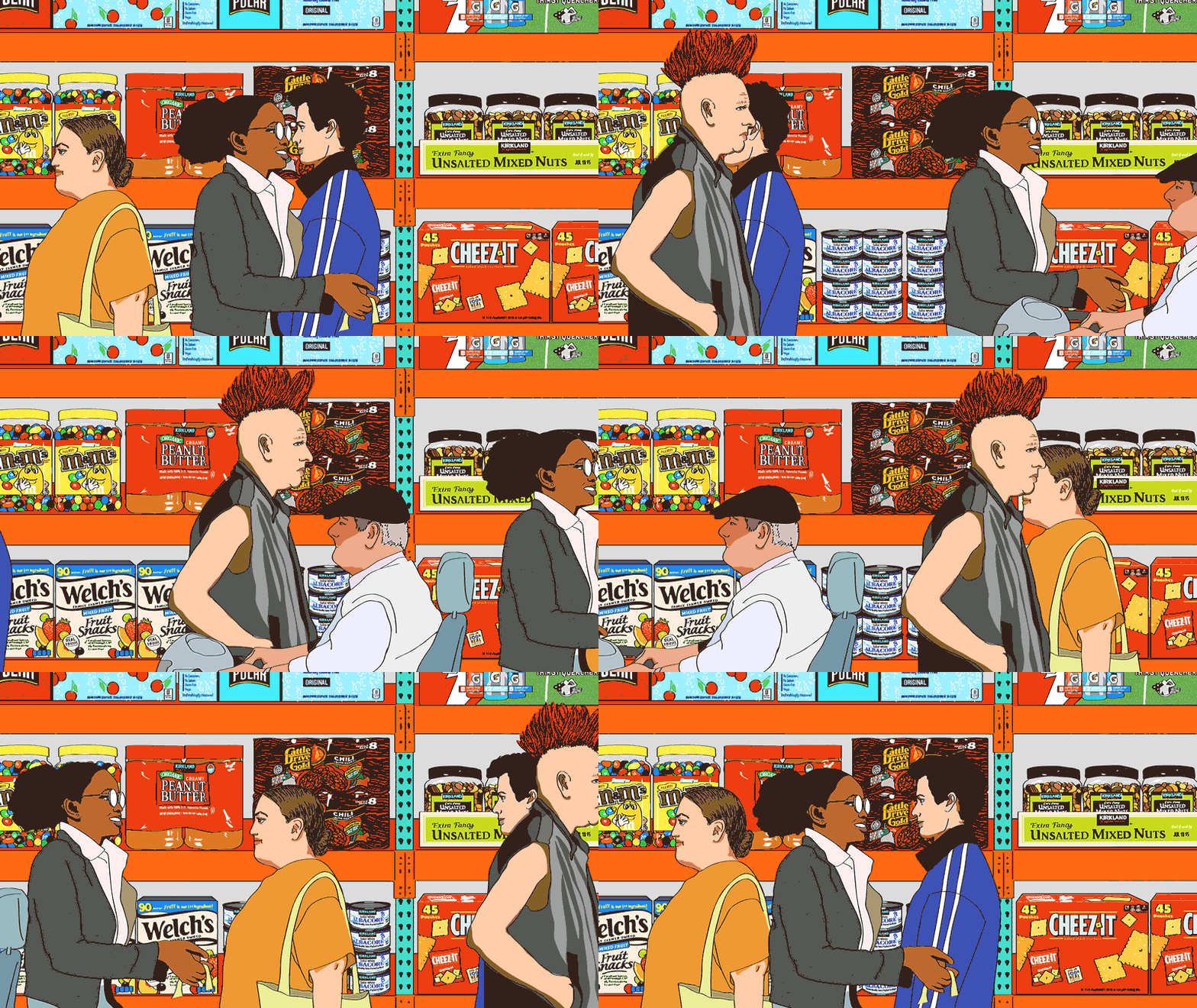
One encounters a thousand and one stories observing the swath of humanity at the Costco, amongst the realm of the Costco people, doing whatever Costco people do. Here we find the well-to-do and the hoi polloi, kings and paupers, the nearly dead and the very recently born. It starts in the parking lot—there’s a man rolling his cart with a single bottle of margarita mix in the child seat—and continues through the membership-gated doors. Here’s a young couple playing house; here’s a pack of families with unruly kids. There’s a man wearing a US Air Force Vietnam Veteran hat; a man wearing a hoodie that says “Moral Monkey”; a man in a full Adidas tracksuit in the style of Christopher Moltisanti.
I observe a woman so lost in the allure of the frozen food aisle that she crashes her cart into the side of a warehouse concrete pole, laughs, and apologizes to no one in particular. We see the elderly, the bent over and infirm, the drywall hanger and HVAC installer types wearing their full-sunblock Ray-Bans indoors. I begin counting how many different languages I hear on this visit; the final count is something like eight, depending on whether the last one was Ukrainian or a Russian dialect I’m unfamiliar with.
Every phase of life can be shopped for at Costco. Where else can you purchase a wedding ring, a baby carrier, and a casket? It follows your own life story—one does not experience Costco the same way before and after owning a home, or before and after having a child. My wife and I recently purchased our first house, and never could I have imagined feeling so drawn toward the allure of outdoor furniture: palapas apropos, gazebos akimbo.
The stores are also intensely localized, as reported previously in these pages by Priya Krishna. Here in Portland, that means products for the upwardly mobile and extremely online: an endcap dedicated to Graza olive oil, Vital Proteins collagen peptides, myriad formulations of imported ramen and cult Korean skincare products. Truly every health halo, diet trend, and burgeoning eating disorder can be shopped for here, and sometimes these products even sit across from one another in stark post-ironic relief, the double box of Cheez-Its staring down a 4.25-pound bag of whey protein isolate, locked in an eternal battle for health-and-wellness mindshare.
Contrapuntal to the list of things we must buy on each visit, there is perhaps a more controversial list, which is the inventory of items I will never purchase at Costco. Maybe this is a hangover from my younger, more disdainful days; this is my list and mine alone, and while you can make determinations about my character from it, I ask that you please do not judge me. I will never buy Costco coffee—I know too much about coffee, and my allegiance to a coterie of indie micro roasters (Yes Plz subscription for life) and esoteric brewing methods has ruined me for life from enjoying the simple pleasures of a Kirkland Signature K-Cup pod.
I will never purchase Costco clothing, flowers, or wine, even though I’m well aware there are some deals to be had ($219 for a bottle of Dom ain’t bad). I don’t like the chicken—buying expensive farm-raised chickens long ago reset my palate—and I don’t like the prepared taco dinners, which I did buy once and swore to never do again. Yes, this makes me a snob; even within the vast democratization of Costco, there are snobs. I also think there are certain items that make no sense in large formats. I love Adams crunchy peanut butter, but an 82-ounce jar is so massive and petroliferous with oil that you’d need a paint mixer to properly incorporate it all.
I observe a woman so lost in the allure of the frozen food aisle that she crashes her cart into the side of a warehouse concrete pole, laughs, and apologizes to no one in particular.
The scale of items at Costco sometimes demands we answer questions beyond easy comprehension. Do I *need* a 300-gram bag of premium orange chicken puffs? What the hell even are premium orange chicken puffs? (They are a “premium rice and potato flour” snack, flavored in the style of an orange chicken entrée.) I’m open to the concept of a yuzu citrus snack nut mix, perhaps to enjoy beneath my new Costco palapa, but do I desire three whole pounds of it? Every time I go to Costco, I stop and look at the 62 ounces of peanut M&M’s, and I think of my father, who loved to purchase this snack in bulk. I do not purchase the M&M’s for myself, but I do often take a picture—sometimes to text my mom, so we can remember Dad together for a moment, and sometimes just to keep for myself.
I wonder about everyone else in Costco, and if they’re having moments like this as they shop. The guy in the army fatigue pants and the Premium Landscapers hoodie, the mom wearing a pair of worn-out On Clouds, the solo adult men with AirPods in (also sold at Costco), listening to God knows what podcast: Are they thinking about a dead relative’s favorite Costco items, too? Some of us are crying in H Mart; some of us are mourning in Costco.
Employees typically leave you alone at Costco, which is appreciated in moments like these. There are, of course, the friendly free-sample elders serving bites of gyoza and apple chicken sausage, and the teenage staffers symbiotically clearing their trash of little paper cups, but otherwise you are rarely confronted by the staff here, and I like that.
It’s getting near closing time, and I notice a young woman and a young man in their Costco employee hats sharing a moment together on the patio, or rather, in the patio furniture section. She’s reading a novel; he’s scrolling on his phone; they look radiant together there beneath the dim halogen glow.
Every cycle of life takes place in Costco, so why couldn’t you fall in love? I’m sure it’s happened. Love finds a way. I walk past them once, trying to figure out what she’s reading for reportorial purposes. Maybe it’s a great novel. Maybe some philosophy. I pass again, trying to be low-key about it, peeking at the top of the page. They used to sell novels here, but the books section at Costco was shelved in early 2025 (limited availability has returned to some stores). It’s a novel called A Voice in the Wind by Francine Rivers, which the internet tells me has never been sold at Costco retailers. She must have brought it from home.
It’s the last call for samples, the last call for audiology appointments. A growing number of Americans satisfy some portion of their critical health care needs right here at Costco, including my mother, who went in for a hearing exam at her local Costco a few weeks back. I snag a final plastic cup of Welch’s gummy fruit snacks. They’re shutting down the ravioli morsels. Sunrise, sunset, but the lighting never changes inside Costco. I make one last pass through the produce room, which is chilled to a degree that becomes uncomfortable after a few minutes but then makes the rest of the store feel downright pleasant the moment you exit. I’m checking the last few things off my list; so are the blue-haired punks and the skinny dude in a Rick and Morty T-shirt and the driven grandpa on his mobility scooter, charging past me in the direction of the paper products.
I stop at a large endcap display proffering huge tubs of cabbage kimchi next to huge tubs of sauerkraut. No matter who we are or where we’re from, at Costco, we’re more alike than we are different. There’s no such thing as the real America, but if there were, you’d find it here. And you’ll find me here, too, for I have become the Costco person I was always destined to be, preordained by geography and epigenetics, nature and nurture. Yes, I’d like a box to take my groceries to the car. I’m pretty sure all this stuff will fit.