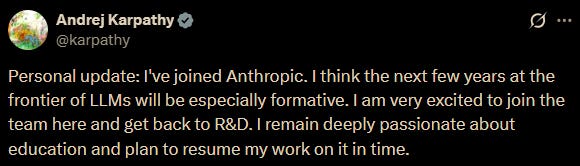
This morning, Andrej Karpathy posted a tweet that the entire AI industry stopped to read:
Karpathy started this week at Anthropic working on pre-training under team lead Nick Joseph, and will build a new team focused on using Claude to accelerate pre-training research itself.
Read that last part carefully. Using Claude to make Claude better. That is a recursive bet on the most consequential problem in AI right now, placed by the person most qualified to work on it.
The resume behind that announcement is unlike anyone else active in the field today:
▫️ 2015 — Google, working alongside DeepMind
▫️ 2016 — OpenAI founding member
▫️ 2017 to 2022 — Tesla, Senior Director of AI, built Autopilot from scratch
▫️ 2022 to 2024 — Back at OpenAI
▫️ 2024 to 2026 — Eureka Labs, his AI education startup
▫️ May 19, 2026 — Anthropic
Karpathy is also the person who coined the term “vibe coding” in early 2025, using it on X to describe programming where developers specify intent in natural language and AI agents generate most of the code.
The entire vibe coding ecosystem, from Cursor to Lovable to Replit, traces back to a term he put into the world. Now he is going to work on the foundation underneath all of it.
The Karpathy announcement is the headline. The pattern underneath it is the more interesting story.
CTOs of billion-dollar companies have been quitting to take individual contributor roles at Anthropic. Not to lead divisions. To do research.
▫️ Workday CTO → Member of Technical Staff (March 2026)
▫️ You.com CTO → Member of Technical Staff (March 2026)
▫️ Instagram CTO → Member of Technical Staff (January 2026)
▫️ Box CTO → Member of Technical Staff (December 2025)
▫️ Super.com CTO → Member of Technical Staff (July 2025)
▫️ Adept AI CTO → Member of Technical Staff (January 2025)
The AI race is often framed around massive funding rounds and scarce computing power. Just as important is the fierce competition for the small pool of researchers capable of advancing the frontier.
In investing, the most reliable signal is where people put their time and willingness to absorb personal cost. These are experienced operators voluntarily stepping off leadership tracks, taking significant title and likely compensation reductions, to go do research at one specific lab. That kind of revealed preference is worth more than any press release or benchmark result.
The talent story connects directly to the business story.
Anthropic crossed $30B ARR in early 2026, surpassing OpenAI in revenue growth velocity after sitting at $1B ARR just fifteen months prior. Anthropic is now poised to surpass OpenAI’s private market valuation as the intensifying battle for elite AI talent accelerates.
Anthropic is closing in on a $1 trillion valuation. Dario Amodei built the thesis in 2017 that reads like a map of today. The 2026 scorecard is starting to reflect that thesis in every measurable dimension.
The three inputs that determine who wins a frontier AI race are compute, data, and talent. Anthropic has been accumulating all three simultaneously:
▫️ Compute: A partnership with SpaceX to rent capacity at xAI’s Colossus 1 data center in Memphis, which doubled Claude Code’s rate limits
▫️ Revenue: $30B ARR, surpassing OpenAI in growth velocity
▫️ Talent: Karpathy plus a steady pipeline of senior technical people choosing research over leadership elsewhere
The Dario Amodei long game has always been to win on safety and capability simultaneously. The 2026 numbers are validating that strategy.
Pre-training is responsible for the large-scale training runs that give Claude its core knowledge and capabilities, and it is one of the most expensive, compute-intensive phases of building a frontier model.
Karpathy’s team will focus on using Claude to accelerate pre-training research itself, pushing Anthropic toward the broader AI research goal of recursive self-improvement, where AI becomes capable of training its successors with progressively less human intervention.
This is the work that Sam Altman pointed to at Stripe Sessions as the most consequential long-term contribution of AI: scientific and research acceleration. Most investor attention concentrates on apps and agents. The civilizational leverage sits in the research layer. Karpathy working on pre-training is about as close to that layer as anyone can get.
He is one of the few researchers who can bridge the gap between LLM theory and large-scale training practice. His autoresearch work already demonstrated what happens when you give an AI agent genuine latitude to improve its own code over two days. It found 20 things human review missed. That same instinct, applied to pre-training at a frontier lab with serious compute, is a qualitatively different kind of research program.
If you are using Claude as part of your daily workflow, the foundation underneath those tools is about to improve through a research program run by someone who has spent his career understanding exactly how these models acquire their capabilities.
The Claude Code system that replaces a 5-person team already operates as a system that dispatches parallel agents before you wake up. Claude Skills turned institutional knowledge into reusable workflows that load on demand. 25 Claude Skills that give your startup a marketing team it cannot afford yet shows exactly what that looks like in practice. Prompts are dead and Skills are the new moat explains why the entire industry converged on this format in six months.
Beyond coding and content, building your own stock analyst with Claude using 12 copy-paste prompts shows how far the capability already extends into professional domains. Claude just launched for small business with 15 ready-to-run workflows connecting directly to QuickBooks, PayPal, HubSpot, and Canva. The Anthropic jobs report quantifies what this looks like at the workforce level: 75% of programming tasks already AI-assisted.
All of this runs on a model that Karpathy is now working to make fundamentally more capable at the pre-training level.
Context engineering is the discipline that makes current Claude perform at its ceiling. Karpathy raising that ceiling is what happens next.
Sam Altman’s framework applies directly: build on the side of hoping AI gets smarter. Every product decision premised on capability staying flat is a bet running counter to what the people who understand this technology most deeply have decided to spend their careers on.
Karpathy had a running startup. He had a platform with millions of followers. He had the credibility to raise capital, advise anyone, or join any lab at a senior level.
He chose to take a research role at Anthropic.
The CTOs taking IC positions at Anthropic had comparable options. Senior leadership at well-funded companies, equity worth preserving, comfortable trajectories.
They made the same choice.
When the people who understand this technology with the most depth and the most context consistently converge on the same organization, the right response from founders and investors is to take that signal seriously and update accordingly.
The Q1 2026 fundraising data already shows $80B deployed in one quarter, concentrated heavily in AI infrastructure. The VCs betting on AI in 2026 are mostly concentrated in the application layer. The talent data is now pointing at the infrastructure and research layer.
The AI race is not over. The scoreboard just got more legible.
Go deeper:
▫️ Everything Claude shipped in 2026
▫️ The Claude Code system that replaces a 5-person team
▫️ Claude Skills: the complete guide
▫️ 25 Claude Skills for startup marketing
▫️ Prompts are dead. Skills are the new moat.
▫️ Build your own stock analyst with Claude
▫️ Claude just launched for small business
▫️ Karpathy’s autoresearch findings
▫️ Anthropic is closing in on a $1 trillion valuation
▫️ Anthropic passed OpenAI in revenue
▫️ Dario Amodei and the long game of safe AI
▫️ Sam Altman’s 10 rules for the AI era
▫️ Context engineering guide 2026