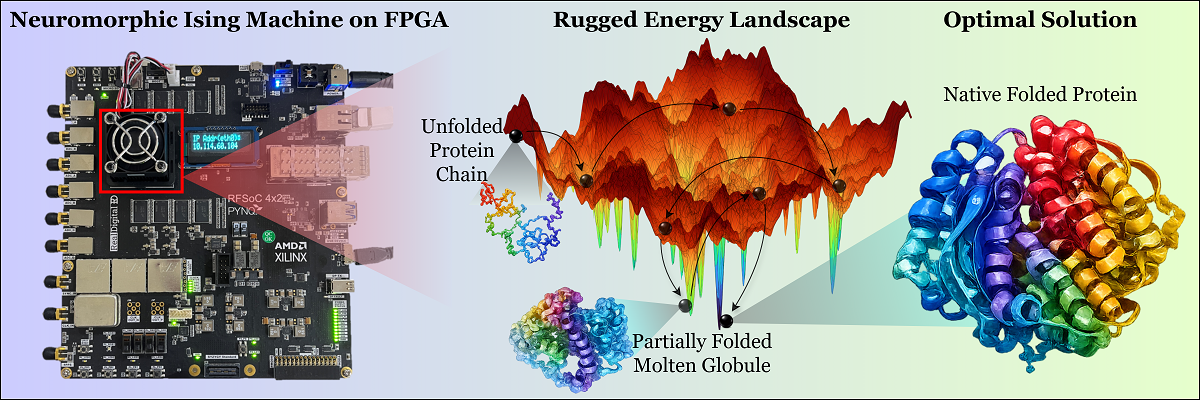

Neuromorphic Ising machine implemented on an FPGA board rapidly explores rugged energy landscapes with exponentially many competing possibilities, enabling fast discovery of near-optimal solutions for complex optimisation problems such as protein folding, where the search evolves from an unfolded chain through intermediate molten-globule states toward the most stable folded structure.
The hardest computational problems are not waiting for faster chips – they are waiting for machines that compute in a fundamentally different way.
A multi-institution team, emerging from the Telluride Neuromorphic and Cognition Engineering workshop in Colorado, and the Bangalore Neuromorphic Engineering Workshop (BNEW) at IISc, has built a neuromorphic computer that combines quantum-tunnelling physics with a brain-inspired architecture to find solutions to hard mathematical problems. Published in Nature Communications, the work introduces a new direction in quantum-inspired computing built on CMOS technology.
Today, AI models may have the capability to write novels and even steer a spacecraft. But give them a logistics network, a microchip to route, or a cryptographic lock, and they stall. These are combinatorial problems – among the most consequential unsolved frontiers in computing. The new study suggests that a neuromorphic autoencoder with a Fowler-Nordheim annealer can solve these problems at scale, with a guarantee of asymptotic convergence to the optimal solution.
Such an autoencoder does not simply compute a solution – it searches for one, the way natural processes navigate a complex energy landscape to settle into stability.
For decades, Moore’s law delivered the exponential gains that made “buy a faster computer” a viable strategy for tackling complex problems. But that era is approaching its limits. The next order of magnitude will not come from smaller process nodes, rather from architectures that think and compute differently.
The collaborative study was led by Shantanu Chakrabartty, Professor at Washington University in St Louis, whose research group has been investigating Fowler-Nordheim based neuromorphic architectures for many years. The team includes Chetan Singh Thakur, Professor at the Department of Electronic Systems Engineering, IISc. Other institutions involved in this research include Heidelberg University in Germany, The Johns Hopkins University in Baltimore and The University of California in Santa Cruz.
This work therefore represents a community of neuromorphic engineers from around the globe, who regularly meet and brainstorm ideas at the Bangalore Neuromorphic Engineering Workshop in Asia, the Telluride Neuromorphic Engineering Workshop in the Americas, and the CapoCaccia Neuromorphic Workshop in Europe. Together, they are shaping a new generation of machines designed for the hardest problems in computing.
REFERENCE:
Ahsan F, Maiti S, Chen Z, Kaiser J, Nandi A, Srivatsav M, Schemmel J, Andreou AG, Eshraghian J, Thakur CS, Chakrabartty S, Higher-order neuromorphic Ising machines—autoencoders and Fowler-Nordheim annealers are all you need for scalability, Nature Communications (2026).
https://doi.org/10.1038/s41467-026-71937-4
WEBSITE:
https://labs.dese.iisc.ac.in/neuronics/