
MANILA, Philippines – Warner Bros. recently published a two-and-a-half-minute teaser for the final part of Denis Villeneuve’s Dune film trilogy. As a science fiction fan who has read Frank Herbert’s original Dune novel and thoroughly enjoyed the first two parts of the trilogy, I can’t wait to see Paul Atreides as the galaxy’s new emperor this December.
Why is there no AI in Dune?
One thing that sets the world of Herbert’s Dune apart from other sci-fi stories is that he deliberately suppressed the advance of technology in favor of telling a deeply human tale without being bogged down by technical details. Dune’s universe is set in our own, but removed tens of thousands of years in the future. Yet, the books and the movies show a distinct lack of artificial intelligence and sentient robots—things like Star Wars’ C-3PO, Star Trek’s Data, or the genocidal machines of the Terminator movies.
RELATED STORY: AI ethics and the fake Mackenyu interview
Instead of AI, Dune has mentally-advanced humans, like the Bene Gesserit sisterhood with their powers of prescience, the Spacing Guild’s navigators, and Mentat advisors, such as Thufir Hawat of House Atreides (played by Stephen McKinley Henderson) and House Harkonnen’s Piter de Vries (portrayed by David Dastmalchian). Spice melange, which can only be found on the planet Arrakis (aka Dune), is the drug that enables this enhanced mental cognition, thus underpinning the economy and becoming the main source of conflict for the empire.
Herbert explains this lack of AI with the Butlerian Jihad, a hundred-year religious war that erupted around 10,000 years before the events of the films. The end result of this conflict was that “thinking machines” were outlawed and their use made punishable by death. As stated in the Orange Catholic Bible, a piece of religious text written after the Jihad, “thou shalt not make a machine in the likeness of a human mind.”
AI as a means of oppression
The aforementioned Terminator movies provide one cautionary tale for the unregulated rise of AI: that the machines could ultimately decide that humanity must be eliminated.
While the fear of humanity’s demise at the hands of thinking robots is valid, Dune provides a much more realistic take. With the rise of AI came the rise of a technocratic class that created and controlled these machines, leading to oppressive structures over knowledge and the economy. There was also the fear that humanity became overly reliant on thinking machines thereby losing agency and a sense of free will.
We can actually see the beginnings of this eerily prescient Duneian technocratic class in our current world, embodied by the Big Tech companies that have poured hundreds of billions of dollars into data centers and are strongly pushing for the unbridled use of chatbots like ChatGPT, Copilot, and Grok.
Some industry leaders are already envisioning this future explicitly. Heck, OpenAI CEO Sam Altman boldly claimed during an industry summit earlier in March, “we see a future where intelligence is a utility, like electricity or water, and people buy it from us on a meter.” Anybody with any modicum of intelligence can see why this can be a really bad thing.
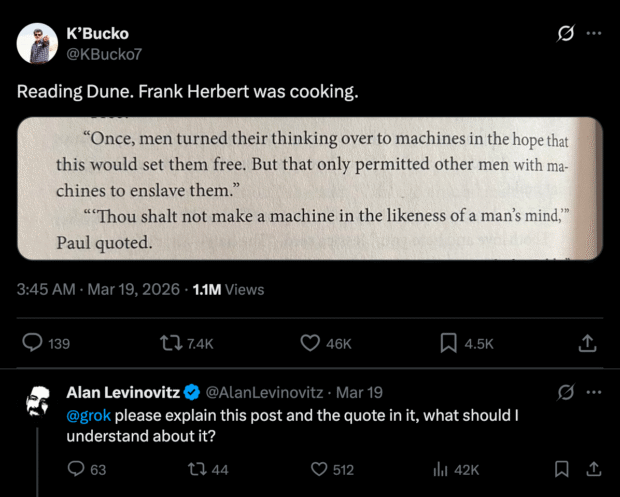
Lots of people are already decrying the unregulated advance of AI and its potential to eliminate jobs, flood our discourse with unwanted slop, and destroy the environment with its insatiable need for water and electricity. While I don’t think we are near the point where humans will rise up and declare jihad against Big Tech, I can’t entirely say that it’s unlikely to happen within this century.
Science fiction provides us a mirror
Artificial intelligence and machine learning are wonderful pieces of technology and there is no question that we ought to develop them to benefit mankind. I, for one, would love to see trained neural networks discover the cure for cancer or analyze solutions to climate change. But am deeply skeptical of how AI is currently being pushed by Big Tech, which has led to widespread talk of an AI bubble.
RELATED STORY: The new AI revolution – and what you’re missing
We’ve seen technology pose a risk to people. Atomic and nuclear bombs made mutually assured destruction possible. Chlorofluorocarbons damaged our ozone layer. And social media fueled a lot of our misanthropic behaviors like disinformation and political polarization.
AI is one of those technological marvels that is neither inherently beneficial nor harmful. But it’s ultimately up to us whether we reject it as in Herbert’s Dune, or shape it into something closer to Gene Roddenberry’s Star Trek.