If you liked this piece, you should subscribe to my premium newsletter. It’s $70 a year, or $7 a month, and in return you get a weekly newsletter that’s usually anywhere from 5,000 to 18,000 words, including vast, detailed analyses of NVIDIA, Anthropic and OpenAI’s finances, and the AI bubble writ large. My Hater's Guides To the SaaSpocalypse, Private Credit and Private Equity are essential to understanding our current financial system, and my guide to how OpenAI Kills Oracle pairs nicely with my Hater's Guide To Oracle.
Over the last three weeks, I’ve published an exhaustive three-part guide to how the AI bubble might collapse, the events that might trigger it, and the consequences.
Subscribing to premium is both great value and makes it possible to write these large, deeply-researched free pieces every week.
Something changed in the last week.
Shortly after Uber COO Andrew Macdonald said that it was “getting harder to justify” spending money on AI as it was “very hard to draw a line” from that spend to useful consumer features (after its CTO said Uber burned its entire annual token budget in four months), Axios’ Madison Mills reported that one company had accidentally spent $500 million in the space of a month on Anthropic’s models after failing to set spend limits. A few days later, Mills would report that other companies were now looking for ways to reduce their AI spend.
That’s because, as I’ve said before, nobody can actually measure the ROI of AI, or even create a standard measurement of the cost of a task thanks to the inevitable hallucination-prone nature of LLMs and the ever-growing list of different harnesses and “agentic” (sigh) interfaces. Every different prompt and project and interaction can go wrong in a way that is hard to predict or plan for other than having an eternal vigilance that the supposed “intelligence” doesn’t do something catastrophically stupid, because LLMs have no thoughts, consciousness or ability to learn outside of pre and post-training.
If you can’t measure how good something is, how much it might cost, or what your return on investment might be, it’s fair to ask why you’re even paying for it in the first place.
People are (reasonably!) harping on about the ROI problem, but I think the “can’t really measure the cost” part is an even bigger problem.
Yesterday, Microsoft’s GitHub Copilot moved all customers to token-based billing from a premium request model (as I reported a week before everyone) as users had been allowed to burn thousands of dollars of tokens on a $39-a-month subscription.
Customers are irate. One burned through 50% of their monthly credits in a single prompt, another burned 60% in the space of a few hours, another 31% in a single prompt, another estimated that they’d burn their monthly credits in the space of a single five hour session, another burned nearly half of their credits in eight prompts, another around 14% of their credits in two prompts, and another lamented that GitHub Copilot had gone from their favorite subscription to their most-stressful overnight after burning 33% of their monthly balance in a few hours.
And, to be clear, this is during a promotional period where you get $11 or $21 in free monthly credits:
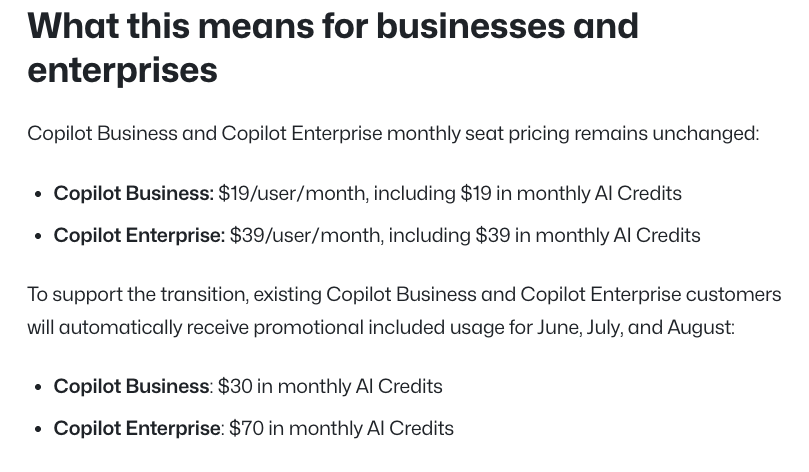
These users — much like the users of effectively every subsidized AI subscription — never really knew how much anything they did cost, because Microsoft intentionally hid the actual cost of prompts and allowed users to spend obscene amounts as a way of boosting growth for GitHub Copilot.
This problem is industry-wide.
Every single user of every single AI subscription service is having their tokens subsidized and the actual cost of AI obfuscated. As a result, every frothy, fluffy hype-piece about Claude Code or AI in general is a kalopsia — the belief that something is more beautiful than it really is.
Educational Sidebar! While many of you may know this, for those just joining me, let me break down how the average AI subscription works. You pay a monthly subscription to, say, Anthropic or OpenAI’s services, and get to use these services as much as you’d like subject to both daily and weekly “rate limits.” None of these companies ever really explain what that rate limit might be, giving users instead a vague percentage gauge and leaving them to work it out on their own.When you use an AI model, you feed information into it via input tokens (a token is about ¾ of a word) and receive outputs via output tokens, and companies bill on a per-million token basis. While models can “cache” information as a means of avoiding having to read or write it again, every single interaction costs money, regardless of its success or efficacy. This is why every AI startup is inherently unprofitable — they’re literally sending every penny of their venture capital money directly to Anthropic and OpenAI to power their unprofitable services. AI labs may be able to run their own infrastructure and save some costs, but we have no evidence that this makes anything “profitable.”
For example, Anthropic lets you burn anywhere from $8 to $13.50 in tokens for every dollar of subscription cost, and while AI boosters will say that Anthropic is “profitable on inference,” nobody actually has proof outside of theoretical scenarios posed by CEO Dario Amodei.
Think of it like this: if you’re using an AI subscription with rate limits but no actual costs, any mistakes a model makes — such as getting stuck in a loop or just doing the wrong thing — can be dismissed as the troubled nature of early-stage technology, because the “cost” was $20, $100, or $200 for the entire month. Anthropic, OpenAI and every other AI company deliberately obfuscated these costs because they knew that the second a user actually had to pay for the fuckups of an AI model they’d scream like they were being stung to death by bees.
This issue bubbled to the surface in the last few months because Anthropic and OpenAI both quietly moved all of their enterprise customers to token-based billing in Q1 2026, and because these enterprise customers are run by Business Idiots with no connection to actual work, CEOs encouraged (or actively incentivized) their workers to use AI as much as possible, in some cases even making one’s AI use a KPI that could cost them their job.
These same workers were conditioned — through their use of AI subscription products that hide the true costs — to use them as if they cost nothing, all while being screamed at by useless middle managers to “make sure to adopt AI at scale,” all while never, ever having any awareness of what a particular unit of work cost.
This was always a recipe for destruction. The overwhelming majority of AI users are completely divorced from and actively trained to ignore the true cost of AI tokens, which means they naturally use these services in a way that’s actively uneconomical. Every frothy hype-piece you’ve read has been written by somebody who has been conned into ignoring the true cost of AI, all in service of spreading a technology that’s unreliable, inconsistent and expensive at its core, and never, ever seems to get cheaper.
Sidenote: Even with the “cost of intelligence” (the per-million token cost) of models coming down, models are using far, far more tokens for the same task, ultimately raising the cost of inference. Put another way, imagine if the cost of gas got cheaper but the distance between you and your destination kept getting longer.
OpenAI, Anthropic and other AI companies have actively conspired to mislead the world about the true costs of AI, and it was working great right up until they decided to try charging what it actually cost. Less than a quarter into the shift to token-based billing, enterprises are freaking the fuck out, with Walmart setting token limits on its internal “Code Puppy” AI coding tool, with a spokesperson saying that it “wanted employees to apply AI in ways that create value” mere days after Amazon SVP Dave Treadwell told employees to “not use AI just for the sake of using AI.”
The last few years of AI hype have been built on lies. Every company has conspired to make you think that AI is affordable and sustainable, that profitability was possible, that hallucinations were fixable, and that any problems you faced today were a result of being in “the early innings.” In reality, the AI industry has absorbed over a trillion dollars, effectively all tech talent, the majority of startup funding, the majority of media coverage, the art and work of millions of people, and been given chance after chance after chance to fix the obvious, glaring issues.
Every time a skeptic dared to stand out and say that none of this made sense, they were told that it was just like Uber (it’s not) or that Amazon Web Services cost a lot of money (it cost $52 billion over the course of 14 years and was cash-flow positive in nine), that “costs always come down,” and that everything would magically be alright as long as they were patient for an indeterminate amount of time.
Four years and a trillion dollars in, AI is more expensive, its companies more cash-intensive, its products just as unreliable, and its boosters more desperate than ever to make you ignore reality as a means of empowering one of a few ultra-rich oafs. Products from OpenAI and Anthropic are built to ingratiate and coddle losers while creating work-shaped outputs that are good enough to impress braindead executives, imbeciles and middle management hall monitors that don’t do any real work, and the reason it’s worked this long is that both companies intentionally misled everybody about how much the real costs were.
I must repeat myself: AI is more expensive today than it was three years ago, and it is not getting cheaper. Sam Altman’s comments about “intelligence too cheap to meter” were lies. NVIDIA’s Blackwell GPUs didn’t make it cheaper, and its Vera Rubin GPUs won’t either. Google’s TPUs won’t do it, Amazon’s Trainium or Inferentia chips won’t do it, Vera Rubin CPUs won’t do it, OpenAI’s chips won’t do it, and no, DeepSeek won’t do it either.
People chose — and still choose — to believe that AI would get cheaper because they think things got cheaper over time in the past, which is sort of true but not remotely similar in any way, because the cost of running and training AI models comes from using the hardware as well as its upfront cost. Large Language Models require expensive GPUs thanks to their reliance on power-intensive parallel processing, and larger, more-complex models in turn require more GPUs to both train and run inference with.
And three generations in, NVIDIA GPUs don’t appear to be bringing the cost down at all, which heavily-suggests that the inherent business model of generative AI is broken.
People love to compare AI to the Dot Com Bubble (AI is far, far worse) because it’s much easier to rationalize bad behavior than accept that we’re facing the largest misallocation of capital of all time.
The Dot Com Bubble was really two bubbles — one around eCommerce and internet startups, and one around telecommunications infrastructure.
Per Justin Kollar, the telecommunications bubble grew because of a fundamental misunderstanding of demand:
This continental rewiring was also justified by another powerful myth—that internet traffic was doubling every 90 days. The claim spread through analyst reports, earnings calls, and investor presentations like a particularly virulent meme. If true, it meant that demand was growing exponentially, far outpacing any conceivable supply, and that every new trench of fiber would soon pay for itself many times over.But the mathematics were fiction. Network researchers like Andrew Odlyzko (at AT&T), looking at actual traffic data, found that U.S. backbone traffic was doubling roughly once a year—rapid growth, certainly, but nowhere near the purported 90-day cycle. Meanwhile, advances in fiber technology were making each strand exponentially more powerful. Dense wavelength-division multiplexing allowed dozens of signals to travel simultaneously down the same line at different wavelengths of light, like multiple conversations happening in different colors.
As a result, infrastructure was built far in excess of what demand existed, because most people weren’t online, and those who were had very slow internet connections. Per me:
The similarity everybody points to is that “people doubted the internet at the time,” and people really need to remember their fucking history. In 2000, only 52% of American adults were using the internet, and by 2003, that number had only increased to 61%. Per the World Bank, in 2005 only 16% of the world used the internet, and in 2024, that number had increased to 71%.Yet the real difference is the access to high speed internet. When the internet was connected to via a 56k modem, access was either charged-by-the-minute or much, much slower. While we’re used to connecting at speeds that make using a web-based app near-indistinguishable from one run on our computer, back in 2000, 2001, or 2002, the average US internet speed was, at best, 400 Kilobits/s, or roughly 50 kilobytes a second, compared to the average US internet speed of over 200Megabits per second, or 25 megabytes a second.
In simpler terms, a website took time to load in a way that feels almost impossible to conceive if you didn’t experience it at the time. We’ve also had dramatic improvements in web design and accessibility, the advent of mobile browsing, and the proliferation of widespread mobile and desktop internet access. In the 2000s, we were at the very early days of eCommerce, and the weird irony of the dot com bubble is that it was actually pretty useful to lay millions of miles of fiber optic.
Here’s a critical difference between AI and the Dot Com Bubble: when people actually lit up the dark fiber, the underlying internet service was faster, better and cheaper than a dial-up connection. Services like TheGlobe, WebVan, and Pets Dot Com ran businesses that lost incredible sums of money did so not because of the costs associated with accessing their services, but the unrealistic and unsustainable business models themselves.
Their eventual functional forms — Facebook, Instacart, and Chewy — didn’t require fundamental scientific breakthroughs in how goods were delivered or internet services were accessed. Their failures were a result of poorly run businesses that lost money by expanding too rapidly or spending $400 to acquire each customer.
Dell and CoreWeave just turned on the first Vera Rubin GPUs, and you’ll notice nobody is saying the words “profitable” or “sustainable,” because NVIDIA is not interested in making stuff more efficient rather than more expensive.
According to CEO Jensen Huang, AI data centers — which currently cost somewhere in the region of $50 billion per gigawatt — will now cost between $80 billion and $100 billion per gigawatt in the future. Does this sound like it’s getting cheaper to you? Even if said data center packs theoretically more “power,” what does that “power” do for the customer running compute on it? Is it cheaper? More efficient? How do we not have these answers?
All of this is to say that the Dot Com Bubble happened due to irrational exuberance and growth lust, and what was recovered at the end came not from scientific breakthroughs but the fact that the useful infrastructure existed and could be adapted and used to make things cheaper and more efficient.
That isn’t the case with AI data centers, AI startups or anything else to do with the AI Bubble.
Every few days somebody makes a post like this suggesting that “the internet didn’t go away” and “railways didn’t go away” when their bubbles popped, but I think this is a fundamental misunderstanding of what AI is.
An AI data center full of AI GPUs is useful for AI and very little else. There are GPU-powered analytics tools, GPU-powered modeling and scientific applications, but the nature of GPUs — good at doing the same thing across big data sets in parallel, but bad at handling many little independent tasks — makes them impractical for most of what modern computing demands.
The entire Dot Com Redemption storyline comes from the idea that it “left behind useful infrastructure,” by which they mean “cabling that allowed hundreds of millions of people to use the internet.” While there was some amount of further construction and capex to handle, the end result was useful fiber that connected people with a faster connection at a lower cost.
No such story exists for AI.
AI data centers are ruinously expensive, requiring billions in upfront funding with operating costs so high that they, at best, run at a loss for the first five or six years of service, if they ever recover their original costs at all. A rack of Vera Rubin or Blackwell GPUs will cost as much to run in five years as they do today, as will an incomplete data center cost just as much to finish construction, connect to the grid or acquire behind-the-meter (IE: generators) power for.
In the aftermath of the Dot Com Bubble, dead startups flooded the market with cheap server and office gear, which allowed plucky founders to cobble together their own services. A single Sun Microsystems Ultra Enterprise 3000 cost $43,000 ($89,000 in today’s money) and had a power draw of between 1,200W and 1,500W, but could run an entire company’s infrastructure. A single B200 Blackwell GPU uses 1,200W, and more-complex AI coding tasks can take up four to twelve of them for a single user’s output. Put simply, you can’t really do very much with a few of these GPUs, and what you can do isn’t profitable, scaleable or valuable.
Similarly, dark fiber could be lit up with the right transceivers and networking gear to create internet access. AI data centers are effectively large boxes with custom cooling built for a very limited subset of chips. Adapting them to other uses would require gutting the data center, which would mean that the vast majority of the capital expenditures were wasted.
Even if you were able to buy a hundred Blackwell GPUs from a dead neocloud, you, as a regular person, couldn’t do anything with them. In fact, nobody really could, because you’d still need a physical data center and bespoke cooling, which means that even if the chips were free, the associated construction capex or, at the very least, physical colocation space would still cost a great deal of money
The internet and railways didn’t go away because their up front costs were the only real costs that mattered.
Even if somebody were able to pick up a cheap AI data center full of the latest generations of GPUs, the underlying operating expenses are awful, and the only way to make them even close to generating a profit is to have consistent use of all your GPUs. There’s a cost to having them sit idle — both in electricity and personnel — and unless the plan is to have them sit in a data center turned off until you can find somebody else to sell them to, you’ll have to come up with a business model for your AI services that actually makes a profit…which nobody appears to have done, even with unlimited capital and the entire focus of the tech industry.
Then there’s the issue of training, which is entirely made up of opex. If you want to train a new model, you’ll likely need thousands — or even tens of thousands — of H100 or H200 GPUs, and they’ll cost just as much electricity whether or not you make anything useful. A failed or unhelpful training run could cost tens of millions or hundreds of millions of dollars, and that will require financial backing that won’t exist.
While there could be a theoretical future of LLMs run at their true cost (IE: unaffordable for most) as I covered in last week’s premium newsletter, that would require demand, and as I’ve discussed above, the demand for AI services is a mirage built on subsidized subscriptions, and companies paying the actual costs are already screaming for mercy.
Once the bubble bursts, any excitement for AI — and by extension excitement to spend money on AI — goes out the window. AI startups won’t get funded. AI token budgets won’t get greenlit. AI data centers won’t be able to raise debt.
Every part of this bubble relies upon the momentum of hype to substantiate every link in the chain. Hype must exist around the nebulous concept of an “AI factory” to raise debt to buy NVIDIA GPUs and build data centers, hype must exist around AI software to convince enterprises to keep buying services from OpenAI and Anthropic, hype must exist around theoretical demand and outcomes from AI services to fund AI startups, and hype must exist perpetually in the media to make everybody ignore AI’s ruinous costs.
This hype was unsustainable without buckets of lies, misinformation and a captured tech and business media. The value of AI has been inflated by the vagueness of how it’s discussed. For example, major media outlets will gladly write that “AI can build software,” but said sentence suggests that you can just type “build me Slack 2” into Claude and have it fart out a fully-functional, production-ready piece of software, rather than a quasi-functional mound of code-slop that can do enough to trick a business idiot or lazy journalist, but little else.
Said vagueness created a society-wide gravitational pull of consensus that you needed to be behind AI now, because it’s just like the new internet, except bigger, and if you say it’s not you’re going to be really embarrassed.
Creating this pressure was necessary, because without a society-wide aggression against those who didn’t adopt these tools, AI might have actually had to stand on its own merits. That fact AI companies backed by the full manufactured consent of the markets and most of the economy still had to subsidize their products shows exactly how flimsy their value truly is.
The only way to inflate the AI bubble both on a hardware and software level was to mislead the general public and investors on the costs and efficacy of AI models.
Now that organizations are having to pay the actual cost of AI, suddenly they’re concerned about its outcomes, and everybody has become a little hysterical.
Nobody Can Measure AI’s Return On Investment Because It Doesn’t Have One
Late last week, SemiAnalysis wrote one of the most insane articles I’ve ever read — AI Dark Output: The Visible Cost of Invisible Output — saying that “AI output will be real before it is measurable,” and, well, whatever the fuck this is:
We are at risk of having an event on the scale of the Industrial Revolution where most of the new output is invisible even as businesses spend increasingly large amounts on AI services.
SemiAnalysis is a semiconductor analyst firm with an obvious reason to keep the AI bubble inflated, and if they’re writing a piece that amounts to “AI has a return on investment, you just can’t see it,” things are getting desperate. Here’s how they define “Dark Output”:
Dark output is AI-enabled economic value that exists but is not visible, or is badly distorted, in GDP, prices, labor statistics, or industry accounts. We categorize this into two buckets:1. Substitution dark output is work that was previously done by humans and is now done by AI. In our Dark Output Monitor we have identified roughly $1.5T in tasks that current generation AI could substantially augment or automate.
2. New dark output is new work done by AI that wasn’t previously being done by humans (probably because it was too expensive to do until AI made it cheap). In the long run this is likely to be much larger than the substitution side.
That “substitution dark output” is explained using a theoretical example of “...a simple legal document which in theoretical GDP should have the same inflation adjusted value to a user whether a lawyer drafts it or AI drafts it,” which is nonsense.
When you pay a lawyer, you don’t pay them to “create an output,” you buy their experience and time and ability to find and adapt case law to reach an outcome, such as in the process of filing stuff, avoiding or actively participating in litigation. Just because AI can fart out an approximation of what a human output may look like — likely riddled with hallucinations — doesn’t mean that said output was created with any “experience.” Models don’t think, they have no experiences, and even if a lawyer is prompting them, that doesn’t mean that the lawyer’s discernment or taste is reflected in the final output.
Then there’s this bit:
When AI takes over the task, the receipts vanish as the cost is absorbed in tokens, and when government officials survey lawyers on the cost of services they may find that the average price has gone up, as the simplest documents are now completed by AI and not lawyers. From the perspective of GDP, the transaction has effectively vanished except for a few dollars of tokens sitting in an unrelated sector of the economy.
We’re four fucking years into it but we’re still using hypotheticals. Are “...the simplest documents now completed by AI and not lawyers”? You don’t get a lawyer to write a document because they’re the only ones who can write it — you get it to mitigate the risk using the experience of the law firm, both in the associate drafting the document and the partner overseeing it.
This flimsy, half-assed logic is how the AI bubble got inflated in the first place. Supposedly smart people continually show a total lack of awareness of how jobs work at basically every level, and in this case — where it should be theoretically possible to find and talk to a lawyer doing this — the supposed “dark output” includes “the research done to complete this article.”
You may be wondering what that “new work done by AI that wasn’t previously being done by humans because AI made it cheap” is, and the answer is “literature reviews” and “summarizing the last six months of email,” and I wish I was kidding. But don’t worry, “...there are anecdotal signs that a large fraction of current token spend is for new work that wasn’t previously paid for rather than replacing existing work.”
If AI Had ROI, AI Job Loss Would Be Impossible To Ignore
Have you ever noticed that every story about AI job loss reads like it was written by The Riddler?
For example, last year a ton of outlets reported that “Oxford Economics had proven that entry-level workers were being replaced with AI,” but in reality, the study said that “...there are signs that entry-level positions are being displaced by artificial intelligence at higher rates” with no actual data beyond post-2022 employment declines in some fields that AI might be able to do.
Similarly, CNBC’s brainless headline that an MIT study found that AI “could already replace 11.7% of the US workforce” was entirely based on a labor simulation tool rather than any economic analysis of the actual shit AI can do and what it’s doing in the real world.
That’s because AI job loss is a fucking myth. Every company laying off people because of “the power of AI” is doing so because their shareholders are mad and because they know they’ll get headlines.
And if it were actually happening there’d be fucking riots in the streets! Unemployment would be spiking! Things would be burning!
The thing that everybody wants you to avoid thinking about is that if AI worked as advertised, there would be obvious, impossible-to-ignore economic signs:
- The foundation of software would be destroyed, as literally anyone could create and maintain any software they desired. Literally nobody would buy any software because they’d just type “computer make me a Slack clone for my organization” and it would magically appear on AWS.
- The SaaSpocalypse (see my premium here) is a media and market-based hallucination where the collapsing growth of software companies is being explained as “AI taking their business” versus “private equity and venture capital overvalued software companies between 2018 and 2022 to the point that Apollo’s John Zito said “all the marks are wrong,” which is very bad, but nothing to do with AI.
- Accountancy would completely collapse, as nobody would need anyone but ChatGPT to do their taxes.
- Law schools would collapse, because legal internships would become useless and law firms would no longer have need for the thousands of new associates, because ChatGPT could just draft it all.
- Legal salaries would also dramatically collapse.
- Research in effectively every discipline would collapse, because you could ask for a detailed report and said report would be better than any human being creates.
- The entirety of scientific research would change, because you could now automate many different disciplines out of existence.
For all of these things to happen, AI would have to be both flawless, hallucination free, a completely different product capable of autonomous intelligence and having unique ideas.
The reason that we can’t measure “AI job loss” is because AI can’t do jobs. It can be used to replace some specific contract positions with extremely shitty versions that don’t scale, but it does not replace jobs because it is incapable of human work. It cannot speak to colleagues, it cannot accrue experience, it does not have instincts or culture or taste or anything other than whatever training data has been crammed up its ass or through endless post-training.
Nevertheless, the threat of AI job loss has been enough to allow both Sam Altman and Dario Amodei to raise hundreds of billions of dollars lying about it, and now that both of them have walked back their job loss scare-propaganda, every oaf and moron that believed them without actually checking should be booted out of their representative industries. It’s fucking embarrassing! You should all be ashamed of yourselves!
If AI Had ROI, We Wouldn’t Be Discussing Its Potential or Have To Reassure People That It Was “Real”
As I said above, the ROI of AI should be really easy to measure if it actually existed.
If AI was magically able to build and maintain software, we’d have small companies that could build and deploy at the scale of a hyperscaler, and hyperscalers would, in theory, be expanding their margins so aggressively that it would create a new golden age of software revenues…or they’d become entirely infrastructure providers, as anybody else could compete on software.
But on a far-simpler level, it would be extremely obvious.
Anybody can access ChatGPT, Claude or Gemini, effectively anywhere in the world. The theoretical “power” of AI is that it “just does stuff,” and the proliferation of LLMs would mean that somebody would’ve “done” some “stuff” that we could point at with exceptional ease. Random guys in the midwest would be pumping out profitable, functional, and feature-rich software. Lawsuits would be won by pro se plaintiffs with incredible counsel from a theoretical “country of geniuses in a data center.”
Four years in, we’d have one major AI-powered company demolishing the competition in any industry, or every industry would become so prevalent with (powerful) AI that it would effectively reduce the cost of the service to nothing.
We’d be able to point to companies that adopted AI and then completely fucking exploded. We’d be able to point to useless coworkers who were now doing impressive, meaningful work.
There would be widespread economic upheaval, as the concept of a “large company” would lose meaning, because those theoretical “geniuses in the data center” would be automating all the work.”
There also wouldn’t be so many pieces insisting that AI is super powerful and so many quotes from Business Idiots saying it’s “real.” We wouldn’t talk about what AI could do at all. We wouldn’t need Anthropic to lie that Mythos was too powerful to release only to release it several months later.
We wouldn’t have to talk about the fucking potential at all because we’d be able to point to what was going on because it would be obvious!
Whenever Someone Tries To Measure AI’s ROI They Have To Admit It Doesn’t Exist
Last week, Bain & Co. released a study of 951 executives from companies with more than $100 million in revenue, and unsurprisingly, the data did not declaratively explain what the ROI of AI was:
In an April survey of 951 respondents from companies with more than $100 million in revenue, Bain found that 37% said they experienced cost reductions of between 10% and 20%, but a larger 40% saw improvements of 10% or less. Only 4% of global respondents achieved AI-related savings of more than 30%, the survey, shared exclusively with Bloomberg, found.
10% of…what? What’s the cost you saved on? 10% of $10 million is a lot for a company with $100 million in revenue, but 10% of $1000 isn’t, much like 20% or 30% isn’t either! Yet there are two punchlines to come:
Here’s the part that Bain found the most troubling: 44% of large companies that are funding their next wave of AI spending are basing those investments on the last round of savings — savings that haven’t yet materialized for some of them.
This also assumes that those savings are enough to warrant future spending, which…this data does not actually prove.
Thankfully, Bain did manage to publish one of the single-funniest quotes of the AI bubble:
“The technology worked. The value didn’t arrive,” Bain concluded in the report. “Self-funding the next wave from past returns sounds like discipline. In reality, it is a circular bet with a structural leak,” the firm cautioned.
Put another way, the technology “worked (?),” but did not provide value in doing so. Sounds like it didn’t fuckin’ work to me!
Bain had one other crucial bit of advice:
“Companies that don’t validate their reinvestment math against what automation actually returned, rather than what it was supposed to return,” the report concluded, “are compounding risk rather than managing it.”
Just so we’re clear, Bain & Co, a management consultancy with billions in annual revenue, is advising its clients that they should make sure that they’re getting some sort of return on their investment? And that reinvesting in something that doesn’t have a return on investment would be bad?
If AI was real, these fucknuts would be replaced first! They’d replace everybody who wrote this report! You don’t need somebody to tell you this, and if you do you’re a fucking moron!
Thankfully, the AI industry is saved, as Sam Altman had the following to say about AI’s remarkable costs:
FABER: And you think the compute, you know, the last week I was hearing about compute, for example, companies starting to wonder, well, what are we spending it on? Our bills are going through the roof, and it’s not clear to us exactly what – you know, in other words, I know a lot of my spend is going well, but I don’t know which part of it.ALTMAN: So I think this is the most fair contribution – criticism right now of AI, which is, you hear companies saying, I am spending a ton of money on AI. And I know some great stuff is happening, but I know there’s a ton of waste, and you know, when – how long do I have to wait for it to really show up in revenue, and how long do I have to wait to really get the costs under control? And I assume that the industry will figure that out pretty quickly, but I think that is a fair, a fair issue.
Motherfucker you are the industry! You are the one that has to work this out! OpenAI is the AI industry! You are OpenAI’s CEO! You lazy, ignorant, dog-brained loser!
This was an opportunity for “journalist” David Faber to push back, and here’s how that went:
FABER: You do.ALTMAN: Yeah.
FABER: Quickly being –
ALTMAN: I would bet that by another year or two from now, there is a much better rationalization of companies’ spend relative to outcomes.
FABER: And finally, Sam, are we ever going to see things like this up in space?
This is how the AI bubble inflated! This is how it happened! It happened every time a journalist asked a meaningful question and then immediately diverted to a totally different imaginary topic that made the subject feel good! David Faber, resign and give your job to somebody who has an iota of courage or pride in their work! Unbelievable!
Sam Altman is worth billions of dollars, and OpenAI is allegedly worth $852 billion too, and the best he can give us is “teehee, someone else will work it out,” because Sam Altman is a loser that ingrates other losers empowered by losers to sell loser technology to other losers, and the only way that he’s been able to do this is because the people that should know better are sitting around their thumbs up their asses asking him whether there will be data centers in space.
If AI had ROI, we wouldn’t be debating whether it had ROI. We wouldn’t discuss its potential, or whether it could, theoretically, under different circumstances, in the future, in a way that nobody can describe be super powerful and do all of the stuff it can’t do today.
LLM Users Are The Victims Of A Con
If AI had ROI, we’d be able to point with specificity to inarguable examples of economic impacts. AI boosters can jerk their binguses all they like about how Spotify’s CEO said its best engineers don’t write any code anymore. What does that mean? Is Spotify shipping better features, and are those features launching at a rapid clip? Is the software more secure, or stable? Spotify’s design still looks like absolute dogshit! Most software is worse! Things keep breaking everywhere, and in many cases it’s because of AI coding tools!
In fact, I’d be willing to believe that AI had a negative economic impact, increasing operating expenses across the board and giving some software engineers prompt-based concussions by automating some coding in a way that makes them lazy and bad at writing software by speeding up the process of writing code with so much of it that it’s impossible to review it all (see Mo Bitar’s video). LLMs appear to be able to write some code sometimes and do so at high speed, and ingratiates software engineers that don’t really care about writing software by making them feel like they wrote it.
While it might allow some things to go theoretically faster, the overall economic impact of AI-generated code appears to be worse code, worse software, and massive, multi-million dollar bills from Anthropic and Cursor. I will concede that some software engineers seem to like these things, and that many software engineers appear to be using them, but I am yet to see a single one who obsessively posts about their token spend create anything of note or worth, and none of these people appear to be able to point to the actual ROI of all that AI they’re using.
I realize I’m painting with a broad brush, so let me get a broader one: I believe anyone who relies on LLMs for anything is a mark.
I don’t give a shit if you use them to spit out a script or do some simple sideline part of your job, or transcribe or dictate into them, or if you’ve used them as a search engine (and even then, you best check every source!), but the moment you rely on and run your entire process on these things, I immediately doubt your ability to do anything, or at the very least wonder how gullible you truly are when somebody ingratiates you enough.
Why? Because every single “AI setup” I’ve seen anyone ever use involves a rube goldberg machine of bullshit deterministic scripts to try and bring the hallucination-guaranteed nature of LLMs to heel, usually to the point that you’re doing more work making the LLM work than you did before they existed, and you’re only proud of it because you feel like you’re special.
Sidenote: If you’re normal about LLMs I have no beef with you – but something about this technology makes people act irrationally and aggressively to skeptics in a way that requires them to debase themselves. This is a product, and if you feel the need to defend a product you are the victim of a con.
There are, of course, exceptions. I’ve talked to a few people who describe LLMs normally, without hype, who tell very specific stories of very specific outcomes that save indeterminate amounts of time. There are some that have used LLMs to create python scripts to search and organize data, to which I say “you’re impressed with Python, not LLMs.”
If all we’re left with from this era is the ability for some people to write Python scripts without learning Python, this is still an egregious and horrifying waste of capital.
Remember: what you are using is the end result of over a trillion dollars of investment. It is only made possible through manufactured consent that actively misinforms people about the current and future capabilities of LLMs. They didn’t raise hundreds of billions of dollars by talking about any product currently on the market, and that’s because the current products are not very good products.
You are all the victims of a con. No matter how “well” your Breakfast Machine of different API calls and if-this-then-that automations may or may not function, you have been sold a bill of goods for “artificial intelligence” that is impossibly stupid. When some of you are pushed to prove the ROI of AI, you immediately return to boring talking points about Uber, or the Dot Com Bubble, or some other slop fed to you by people actively conning you at this very moment.
I mean this with as much empathy as I can muster: if you’re a huge AI booster, why do you defend this so vociferously? What is it about my criticism that hurts? Is it that I’m yucking your yum? Is it that I don’t immediately ingest and regurgitate the theoretical idea that the thing you’re using all the time is or may become sentient? Is it because I’m not impressed?
I think it’s far more likely that people are angry that I’m asking simple questions that should have — and don’t — have satisfying answers. I’m also fundamentally unimpressed with anything I’ve seen an LLM do, because my requirement for software or hardware is that it works as advertised, and the very fundament of the AI con is that LLMs are sold based on their theoretical capabilities.
The reason nobody can show you the ROI from AI is that AI does not have a return on investment. Large Language Models can speed up some things in a way that becomes increasingly less-valuable and accurate with the complexity of the task, and more investment in AI data centers does not appear to do anything other than expand the number of tasks that an LLM can attempt.
While some people have been able to get something out of generative AI, that something never seems to be a tangible or impressive achievement. Every “successful” AI story is a result of either ignoring the obvious problems with LLMs or mitigating them at a great cost for an aggressively expensive and mediocre result.
LLMs are sold as “AI,” a technology best-known for automating things, yet they can’t be trusted to run anything on their own.
Instead, they manipulate the user into covering up their errors, explaining away their failures, coddling their meager returns and crediting them with the actual labor that LLMs are meant to automate away.
They do so by their investors and executives conning the media and the markets with outright lies and half-truths that exploit society’s weak points. The media and markets are informed by people that neither understand technology nor history, and Business Idiots that have reached the heights of their careers through diplomacy and ratfucking that care only about attention and adulation for things that other people do.
LLMs coddle the easily-led and narcissistic into believing that the model is doing the work as the human being has to constantly cater to the model’s inefficiencies and inabilities, using more energy and resources than any technology ever made.
And yet with all the money, all the attention, all the resources, all the land, all the power, all the affordances and excuses and endless fucking applause for mediocrity, nobody can actually point to the ROI of AI, because it doesn’t exist outside of it burping out stolen content and enriching and ingratiating billionaire dullards. Even at a hundredth of the price I’d be dismissive, because everything I’ve seen is so decidedly unexceptional.
I realize that some will say I’m dismissive of LLMs’ capabilities, and I’m sorry — I’m just not impressed. You spent a trillion dollars to make it somewhat easier to code some things sometimes but not in such a way that it actually results in anything, research reports that nobody will read, shitty powerpoint decks and excel spreadsheets, and art that looks like stock images because that’s exactly what it was trained on.
This shit needs to work every time without fail and be absolutely flawless and autonomous.
You are paying for a tool. You are paying for software. You are a customer. Your job is not to explain to others why this is exciting, nor is it your job to cover up for its mistakes. If you truly love this stuff you should be either secure enough in doing so that you don’t feel compelled to defend it or be demeaning to those that disagree.
The fact that I have to write that sentence is proof that something is very, very wrong with the AI industry, and that LLMs are about far more than software.
If you liked this piece, you should subscribe to my premium newsletter. It’s $70 a year, or $7 a month, and in return you get a weekly newsletter that’s usually anywhere from 10,000 to 18,000 words, including vast, detailed analyses of the biggest events and companies in the AI bubble.