Our 64-bit Intel and AMD processors have evolved over decades. When you compile a Go program for a 64-bit Intel or AMD processor, the compiler targets, by default, a nearly 20-year-old instruction set. The binary that comes out runs on essentially any x64 chip, but it also leaves on the table every instruction that was added since 2003.
We often refer to microarchitecture levels. Each level bundles a set of instruction-set extensions that you can assume are present:
| Level | Adds (roughly) |
|---|---|
| v1 | the original AMD64 baseline (SSE2) |
| v2 | popcnt, SSE4.2 |
| v3 | AVX2 |
| v4 | AVX-512 (F/BW/DQ/VL) |
In my view, this ladder is already slightly obsolete. It was frozen around 2020, and the hardware has moved on. We would need to add the latest AVX-512 sub-extensions (VBMI, VBMI2, VNNI, BF16, FP16, VPOPCNTDQ, and so on), which recent server and consumer chips support but which v4 does not require. While v1 through v4 are a useful common language, a realistic “use everything this CPU offers” target today would need at least a v5, and arguably the whole scheme should be replaced by finer-grained feature detection.
In any case, the Go toolchain exposes this v1 through v4 ladder via the GOAMD64 environment variable. Setting GOAMD64=v3 tells the compiler it may use everything up to and including AVX2. The default is v1, the lowest common denominator.
This raises an obvious question. If I take a real, performance-sensitive library and recompile it at each level, how much do I actually gain? I picked Roaring Bitmaps, a compressed bitset data structure used in databases and search engines.
A Roaring Bitmap stores a set of 32-bit integers. It splits the 32-bit space into chunks of 65,536 values, keyed by the high 16 bits, and stores each chunk in a container that holds only the low 16 bits. A container comes in one of three shapes, and the library always keeps whichever is smallest:
- an array container: a sorted list of 16-bit values, used when the chunk is sparse (a few thousand elements at most);
- a bitmap container: a flat 8 KB bit vector (65,536 bits, one per possible value), used when the chunk is dense;
- a run container: a list of
[start, length]intervals, used when the set bits cluster into consecutive runs.
I fetched the latest release of the library, then ran its own benchmark suite four times, once per level, collecting eight samples each. I did this on a single Intel Xeon Gold 6548N (Emerald Rapids, which supports all four levels, including AVX-512) under Go 1.26.2 and Roaring v2.18.2.
A population count (or popcount, also called the Hamming weight) is simply the number of bits set to 1 in a machine word. Roaring leans on it constantly: the cardinality of a bitmap container, how many values it holds, is the sum of the population counts of its 1024 64-bit words. Modern x86 chips have a dedicated popcnt instruction that does this in a single operation, but it only became available at the v2 level (SSE4.2, 2008). Without it, the compiler has to fall back to a multi-instruction bit-twiddling sequence.
The clearest single result is population count: counting the number of set bits in a bitmap container. The v1 baseline cannot use the popcnt instruction, so Go emits a software fallback. The moment we move to v2, popcnt becomes available and the time is cut almost in half: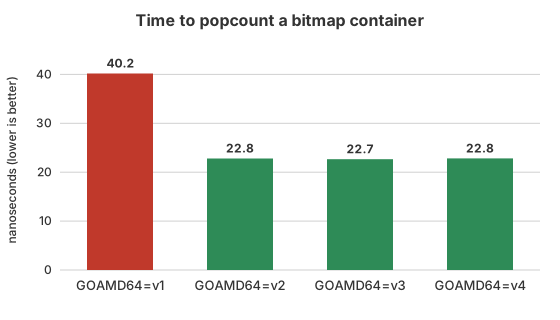
That is a 43% reduction, and it is free: no source change, just a compiler flag. Notice, though, that v3 and v4 do nothing more. A single popcnt instruction is already optimal; as far as the Go compiler is concerned, AVX2 and AVX-512 have nothing to add.
Population count is the easy win. What about the rest of the library?
Another clear win is building a container from a dense bitmap. The FromDense array benchmark takes a raw 8 KB bit vector and constructs the most compact container for it: it popcounts every word to learn the cardinality, then scans out the positions of the set bits. That word-at-a-time popcount-and-scan loop is exactly what the compiler can auto-vectorize once 256-bit registers are available, so the gains keep coming past v2:

v2 already cuts 21% by using scalar popcnt/tzcnt instructions, and v3 (AVX2) nearly doubles that to a 38% reduction. As with popcount, v4 adds nothing.
Set operations show the same pattern. The IntersectionCardinality benchmark counts how many values two bitmaps have in common: for bitmap containers, it ANDs the words pairwise and population-counts the result, without ever materializing the intersection. Here v2 does essentially nothing (the scalar popcnt is already in the inner loop), but v3 lets the compiler widen the AND-and-count loop to 256-bit registers, cutting the time by 22%:
Takeaways:
- On modern hardware, everyone should be using
v2or better. The resulting binary will run in any data center and on any non-ancient laptop. - The
v3level might be worth investigating. - The
v4level should have helped in some of my benchmarks, but it did not. I suspect that the Go compiler is just not great at it.
(Obviously: run your own benchmarks.)
`; modal.addEventListener('click', function(e) { if (e.target === modal) modal.close(); }); modal.querySelector('#bibtex-copy-btn').addEventListener('click', function() { const text = modal.querySelector('#bibtex-target').textContent; navigator.clipboard.writeText(text).then(() => { const origText = this.innerText; this.innerText = "Copied!"; setTimeout(() => this.innerText = origText, 1500); }); }); document.body.appendChild(modal); const style = document.createElement('style'); style.innerHTML = `dialog::backdrop { background: rgba(0, 0, 0, 0.5); }`; document.head.appendChild(style); } // 1. Extract the URL const fullLinkHtml = el.dataset.fullLink; const tempDiv = document.createElement('div'); tempDiv.innerHTML = fullLinkHtml; const linkElement = tempDiv.querySelector('a'); const rawUrl = linkElement ? linkElement.href : ''; // 2. Compute the current access date const accessedDate = this.getCurrentAccessedDate(); // 3. --- NEW LOGIC: Extract ONLY the year (YYYY) --- // Gets the full date string, e.g., "November 23, 2025" const fullDateString = el.dataset.year; // Use regex to find the four-digit year at the end of the string const match = fullDateString.match(/(\d{4})$/); const publicationYear = match ? match[0] : '????'; // e.g., '2025' // 4. Generate BibTeX Data with the corrected year const safeTitle = el.dataset.title.replace(/[^a-zA-Z0-9]/g, '').substring(0, 15); // Use the clean year for the BibKey const bibKey = (publicationYear + safeTitle); const content = `@misc{${bibKey}, author = {${el.dataset.author}}, title = {{${el.dataset.title}}}, year = {${publicationYear}}, howpublished = {\\url{${rawUrl}}}, note = {Accessed: ${accessedDate}} }`; // 5. Show Modal document.getElementById('bibtex-target').textContent = content; modal.showModal(); } }; })();