
Earlier today, in a report discussing how "AI bills are out of control", JPMorgan tech guru and TMT salesman, Mark Schilsky wrote that "most of my high level investor discussions focus on one major topic: when will the party end? Put another way, tech investors have made so much money in Semis so quickly that they are looking for potential warning signs that the music is about to stop. Predicting such an end is incredibly difficult. As such, investors are searching for forward-looking indicators that might suggest the AI party is nearing a peak."
Here, the JPM trader highlighted perhaps the clearest indicator that the music was about to stop: "A slowdown in the growth of the annualized run-rate revenues of the major AI labs. If there is any sort of second derivative ‘kink’ in their growth algorithms, that could portend a future problem for the AI trade."
In response to this, we pointed to just such a "slowdown in the run-rate revenues", when we showed that the Silicon Data token price index is down for 7 straight days to a level last seen in mid-January, or long before the current agentic craze started. Almost as if it knew something...
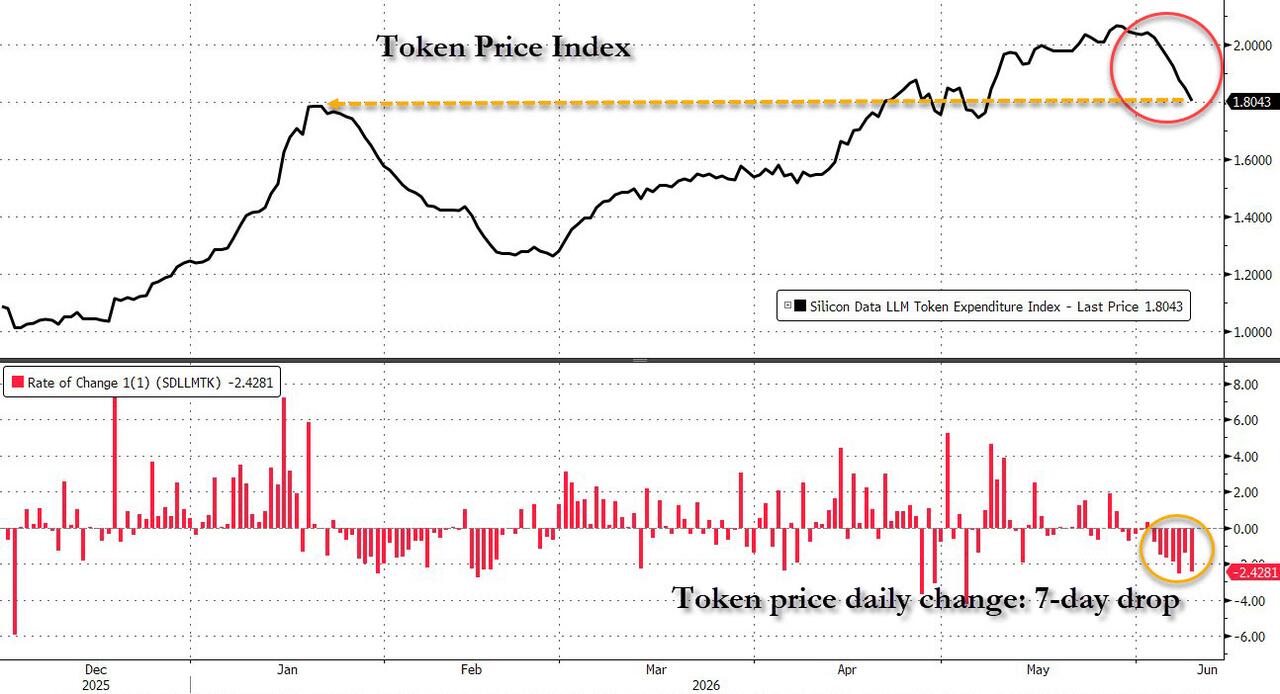
Turns out it did: late on Wednesday, with futures surging and Korean stocks erasing a nearly 5% drop and turning green, and euphoria generally back front and center, the WSJ may have burst the AI bubble when it reported that - contrary to conventional wisdom that token prices will magically go to infinity - OpenAI, which has been badly lagging both the revenue and IPO race with Anthropic in recent months - was considering "drastically lowering the prices it charges users" in a panic scramble to regain market share and win back customers from archrival Anthropic.
And so, at a time when there is suddenly a mass realization that token prices had been soared in recent weeks, a wake-up call which JPM lovingly described as follows: "investors have been discussing the possibility that much of the token spend that corporate America is currently incurring is ‘wasted’. Anecdotes from companies like UBER aren’t helping this narrative", OpenAI is weighing significant cuts to what it charges for tokens. Hilariously, the move would be in anticipation of similar cuts the company expects at Anthropic, which is trying to double how much it charges for its latest model, Fable, which provides at best a very modest modest improvement in performance over Opus 4.8.

In short, we now have a classical deflationary race to the bottom, precisely the opposite of what the profit-strapped industry desperately needs to grow into its gargantuan balance sheets (and massive SPVs); Instead, the AI world is about to get hit with a collapse in both revenues and profit margins, while cash burn goes into full-on incinerator mode.
Warning that "business executives have begun to balk at the high prices for AI usage", the WSJ writes that OpenAI CEO Altman said at a recent event that costs had become “a huge issue.”
“I think we’ll have a lot of ways we can help people get more value for less spend,” he said.
In other words, LLMs tried to push up token prices to and beyond their breaking point... and succeeded.
And now it's time for the brutal drop: a drastic price war will erode the profit margins of both companies, which already lose billions of dollars because of the enormous cost for computing resources needed to run AI systems.
Altman's decision to start a price war was prompted by OpenAI's attempt to catch up with its younger rival in the race to win enterprise customers that are paying large amounts of money for AI tools that can improve workplace productivity. Anthropic’s revenue recently surged
"after its coding tool Claude Code went viral among software engineers, and the five-year-old startup surpassed OpenAI’s valuation for the first time."
Or at least that's the WSJ version of events. In reality what happened is that Anthropic quietly annualized the one-time bumper revenue from Feb-May during the agentic splurge when nobody had any idea what they were paying, to come up with the ludicrous $47BN ARR, which they then actively paraded ahead of their IPO. But let's see what Anthropic's ARR is next month will be after clients finally check their token bills.
Sure enough, as we have been writing repeatedly in recent weeks, "some corporations poured so much money into Anthropic’s products that their leaders are now seeking to rein in spending. Earlier this year, an Uber executive said the company had maxed out its 2026 budget for agentic, or autonomous, AI use, and another company leader said last month that it was difficult to link AI coding productivity improvements to new customer features."
In other words, yet again the age-old question of whether and when AI will have a positive ROI rears its ugly head, and the answer is not any time soon... if ever.
Such comments from many executives have triggered a broader debate within Silicon Valley about so-called “tokenmaxxing,” or the practice of using as many tokens as possible to boost productivity, including in ways that don’t generate returns on investment. That may have worked 6 months ago when LLMs were giving out compute for free to capture market share, but it doesn't work now that all the major AI companies are suddenly charging an arm and a kidney for an "agent" that responds to emails.
As the WSJ concludes, "a price war would be an early test of the strength of both companies’ business models ahead of hotly anticipated public listings." OpenAI and Anthropic have captured the majority of revenue from new AI products, powering their rise. But an underlying risk that investors have long identified is the interchangeability of their products, and the ease with which customers can abandon one for the other.
There is a bigger risk: as we noted one week ago, in the coming price war, neither OpenAI nor Anthropic will win. Instead it will be the country that has made reverse engineering Western technology and then selling it back to the west at 90% off, into an art form. Yes, China is about to enter the chatbot.
