TOC :
Walking with Wallace
I wanted to try a new kind of post, to present Wallace, a 153mm f/2.8 ultra-wide-field telescope that I’ve built last year a bit more, but also try to share the “outdoor” part of astronomy.
I now spend a lot of time outside with running and hiking, and started to wonder how could I share that, the same question that emerged when I started observational astronomy - how can I share the views ? There are people wonderfully skilled at that, with astronomical drawing, like Serge Vieillard and I encourage you to browse his website.
Of course we can’t ever share the visual experience, like we can’t share the sensorial experience of hiking or trail running - but we can try to give a few impressions, and I’ve found myself watching trail running content from Kelp and Fern on YouTube who, in my opinion, is one of the best current outdoor content producer, because he removes himself a lot from the process in appearance, and produces a finely-worked but raw material impression.

So, here is a kind of photo-video dump, with pictures and sounds of the forest, of going to a cliff, setting up Wallace from my backpack, observing for a while, and going back. The fun, and new to me thing, is that I’ve had a lovely evening despite the temperature being in the 36 degrees Celcius, and bearing more hardware than necessary (nearly 3L of water, the telescope, my foldable stool, its 3D printed foldable stool, a DSLR and tripod, batteries, a smartphone tripod) because I wanted to take pictures, and had to concentrate on telling the story of the astronomy-hike I would have done without sharing in mind.
It was enjoyable despite distracting me, and I had the surprise to get “hints” at times of being actually more focused on the environment (wind, insects chirping, sound of my feet on the limestone) because I wanted to actually pay attention to what I should capture. It did not distract me that much though because I already snap a lot of pictures when I go outside, just to sometimes rewind them.
The result is an “ambient impression”. I hope you’ll enjoy it as I did despite not being a capable videographers/photographer. And sorry for the shakiness of the on-the-path videos. It truly makes one appreciate the work of actual videographers.
Technical details
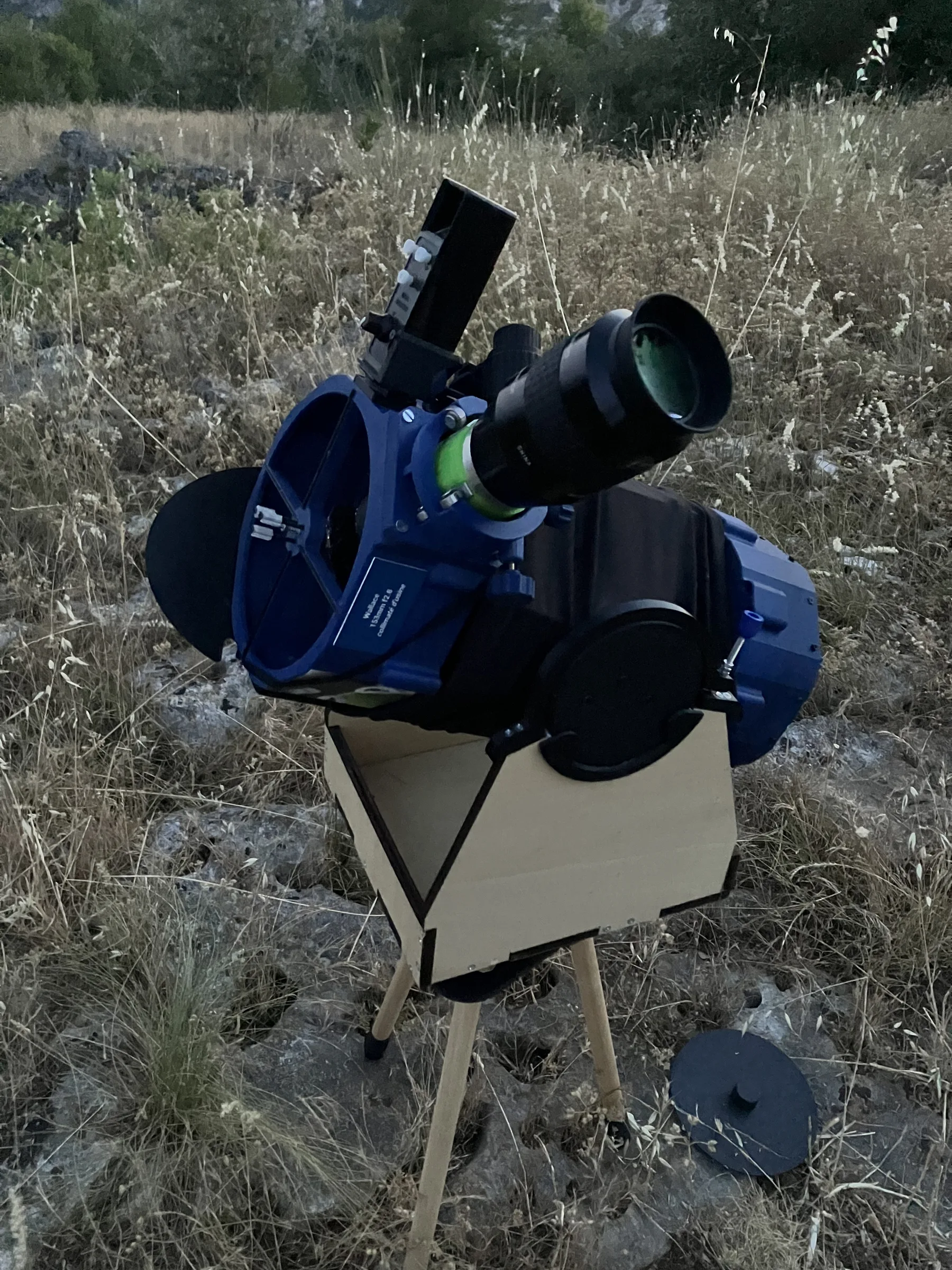
I also realize I didn’t show Wallace in detail on the site yet. It’s my best instrument to date because it has such a well-defined purpose and fulfills it fully, because it doesn’t try to do anything other than ultra-wide deep-sky views, and framing NGC7000 whole in a wide-field eyepiece is something magical.
So here are a few more “technical” pics of Wallace, before it was adapted to take 2” eyepieces.
Wallace has a 153mm primary at f/2.84 but that ultra-fast ratio is a bit of an accident. I was aiming for f/3, but misread the thickness of the shim needed on the sine table where I ground the curve the curve, ended up at nearly f/2.7, and decided to finish it anyway as a challenge, but raises the focal ratio a bit by doing all the fine grinding mirror on top.
The primary mirror took me two attempts, the first ending (detailed in the cloudynights post) when I dug a deep scratch across the face trying to smooth down a central bump. So I went back to fine grinding. The second figure kept a central hole that the 59mm secondary fully masks, which is not a problem. Figuring that fast of an asphere and ending up with a rather smooth figure with a good edge was already a real challenge, and nothing guarantees that I would have ended up with a better figure after raising the central hole again (well at least in a reasonable timeframe). But above all, I was frightened of maybe not having eliminated the source of a scratch. So 0.92 in-instrument it is, and it is quite glorious on the sky.
At f/2.8x, correcting coma is mandatory :p. So I used the 4-element GSO corrector designed by Roger Ceragioli, found on leboncoin for 65 euros. Most people think of this corrector as quite bad because of its low price and wrong-spacing out of the box. Indeed, if you use it as-bought, its backfocus is about 56mm, but its optical design calls for more than 70mm (in Wallace’s case, the best fit determined visually was around 79mm), and it beats my MPCC+hyperbolic formula in K2, while showing a lot less chromatism. There is a lot written on CN about this corrector, and R.Ceragioli confirms the design and spacing needs there. Why it was packaged and sold with the form-factor spacing it wrong, I have no idea.
The two-modules-on-a-dovetail construction is a tribute to the legendary Coulter CT-100, and I printed in deep-blue ASA. In addition to the dovetail, there are six solid 6mm carbon rods. The primary cell is a simple 6-points on three levers cell.
Correction is great over 66% of the field and starts to fall a little at the edge, which isn’t a problem since in a 100 degree eyepiece, this thing shows more than 4 degrees of true field and the outer part is more “context” that you have to turn your head towards to see it.
And of course, files are free and on Printables.
Discussions on:
The next iteration will be a lot harder to pull off, because with a lot of enthusiasm after actually observing with Wallace, we diamond-generated a new blank with a meniscus to make it very light. It is very thin, very sensitive to hand temperature while working, but will cool down very fast in the field, which is nice for a grab-and-go scope. The mirror of the first Wallace needs a good 30 minutes to cool down to ambient, in comparison, before correction settles. And this time, I’ll have a revenge on the center bump/low and won’t settle for less than 0.95 strehl, for the beauty of the craft.