TL;DR: Vite+ is now in beta. It unifies the runtime, package manager, and frontend tools every web project needs behind one fast, consistent workflow. Start a new project with vp create, or adopt it in an existing project with vp migrate.
Today, we are releasing the beta of Vite+, the unified toolchain for the web.
Vite+ is a single entry point to web development. It manages your runtime and package manager and brings Vite, Vitest, Rolldown, tsdown, Oxlint, and Oxfmt together with a built-in task runner — best-in-class tools shipped as one tested stack. It is fully open source under the MIT license and framework-agnostic, working for any kind of web project: from CLIs to libraries to web apps.
Why Vite+?
Vite showed that a tool can be both fast and provide a great developer experience when it is designed around sensible defaults. Vite+ applies the same idea to the rest of the development workflow.
Instead of learning a different combination of tools and commands in every repository, developers can use a consistent workflow:
vp dev— start a development server with hot module replacement, powered by Vite 8.vp check— format your code with Oxfmt, lint it with Oxlint, and type check it at once.vp test— run unit tests powered by Vitest.vp build— build your project for production, powered by Vite 8.vp pack— bundle libraries with best practices baked in, powered by tsdown.vp run— run any npm script or task through the built-in monorepo-aware task runner with intelligent caching.
The benefits become more important as teams and codebases grow:
- Tool versions stay aligned.
- Configuration is easier to share.
- New contributors have fewer setup steps.
- CI runs the same commands developers use locally.
Vite+ is for developers who do not want to assemble their toolchain by hand again and again, and for teams that want a consistent setup across projects without maintaining their own internal platform.
But Vite+ does not replace the Vite ecosystem. Vite plugins remain Vite plugins, and projects can continue using their package manager of choice under the hood. Vite+ provides the integration layer that makes them work as one toolchain.
From alpha to beta
When we announced the Vite+ alpha, we asked developers to help us test it on real projects. Since then, we have released more than a dozen versions and merged over 500 pull requests.
Here are selected highlights from what we shipped so far:
- Smarter caching:
vp runnow combines automatic data tracking with metadata reported by Vite, so builds cache correctly without manually listing inputs, outputs, and environment variables. - Better migrations:
vp migratecan now handle many different app setups and also provides a migration prompt for your agent. - Enterprise features: organization templates standardize setup across teams, and proxy- and custom-CA-aware HTTP lets
vprun behind corporate proxies and firewalls. - Cross-platform: We've hardened
vpto work better on all major operating systems and shells. - Refined and polished: We landed more than 180 fixes and improvements in
vite-plus, sharpening an already solid foundation across the toolchain.
Much of this progress comes from a growing, international core team that builds Vite+ in the open together with the wider community.
You can follow the detailed work in the Vite+ release history.
It all adds up
While we worked on Vite+, the underlying tools have also continued to improve. Without them, Vite+ would not be possible. Here are some highlights from them since the Vite+ alpha:
Real-world adoption
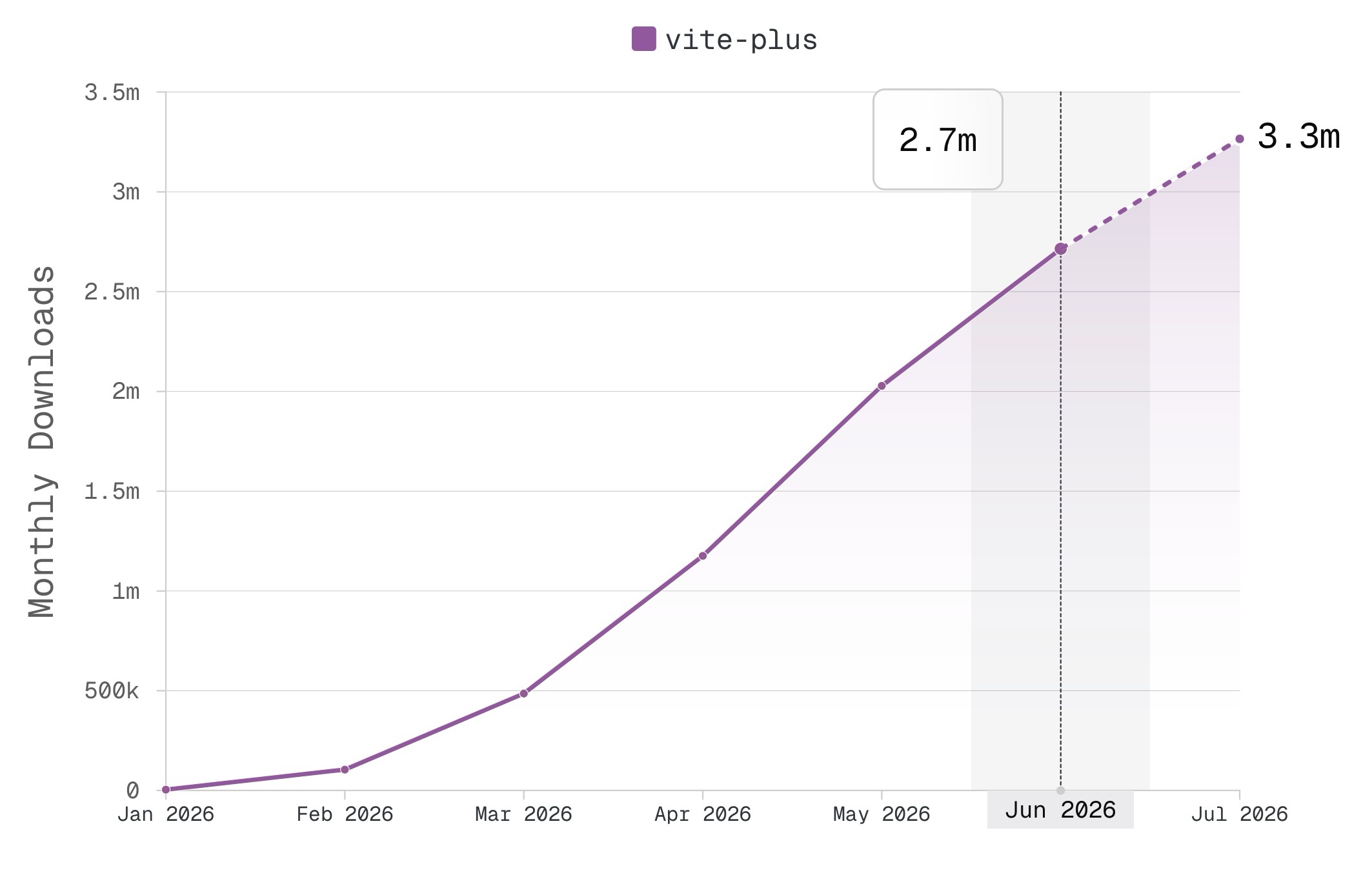
Vite+ is already being adopted beyond our expectations. More than 1,300 public repositories depend on vite-plus, not including private projects and global CLI installations.

Adoption spans the ecosystem across many project types. Notable highlights are:
- Dify: an open-source platform for building LLM apps.
- critical: Addy Osmani's framework-agnostic critical-path CSS tool.
- BlockNote: a block-based, Notion-style rich text editor for React.
- vinext: a drop-in Next.js-compatible framework built on Vite.
- zerobyte: backup automation for self-hosters, built with TanStack and React.
- îles: a partial-hydration islands site generator for Vue.
- agentsview: local-first session search and analytics for coding agents, built with Svelte.
- Inkline: a UI component library that ships across Vue, React, Svelte, Angular, Solid, Qwik, and Astro.
- npmx: an open-source npm registry browser built on Nuxt.
At npmx, we care about every millisecond of performance — in runtime, and in development. Vite+ makes life better for our community by keeping the development experience fast, as well as speeding up CI and the process of review.
— Daniel Roe, npmx
Road to 1.0
Vite+ is stable, but not yet complete. We recommend adopting Vite+ if it covers the features you are looking for in a unified toolchain, and we'll add more features as we work towards Vite+ 1.0. On the way there, we'll focus on:
- Implementing Remote Caching for
vp run(Vite Task) - Introducing
setup-vpfor GitLab CI/CD - Improving compatibility across Vite frameworks and plugins
- Supporting more migration targets
- Adding distribution channels, such as an official Homebrew formula
- Making documentation and diagnostics more clear
Additionally, we'll prioritize feedback from the community to fix any remaining compatibility gaps before releasing a 1.0.
Give Vite+ beta a try
Install the global vp command:
Then create a new project:
Or try Vite+ in an existing Vite project:
Important: The migration command shows what it plans to change, but complex projects may still need manual follow-up. Read the migration guide before adopting Vite+ in a production project.
We are especially interested in feedback from developers migrating existing projects, framework and plugin authors, and teams maintaining large repositories.
Thank you to everyone who tested the alpha, reported issues, and contributed to the project.