Stellar rotation is a crucial aspect of not only stellar evolution but also exoplanet science, and a recent study has built the largest catalog of stellar rotation periods to date.
Stellar Opportunities with TESS
Since its launch in 2018, the Transiting Exoplanet Survey Satellite (TESS) has scoured the sky, searching for the signature recurring dip in starlight caused by planetary companions. While the primary goal of TESS is to discover exoplanets, the satellite’s mapping of the entire sky has created a rich database of high-quality photometry for millions of stars. These observations offer ample opportunity for scientists to study stellar properties and behavior across the Milky Way.
In particular, stellar rotation is a key property that traces a star’s age, magnetic activity, and internal structure. For exoplanet science, stellar rotation is both a help and a hindrance: it allows us to study how exoplanets may evolve over time with their host stars, but stellar activity can mimic or drown out planet signals, making them harder to detect. A few studies have investigated stellar rotation periods with TESS, looking at specific star clusters and known planet hosts. To date, however, no existing study has produced a larger catalog of TESS rotation periods — a product that would provide a wealth of information for both exoplanet and stellar evolution science.
Creating a Catalog
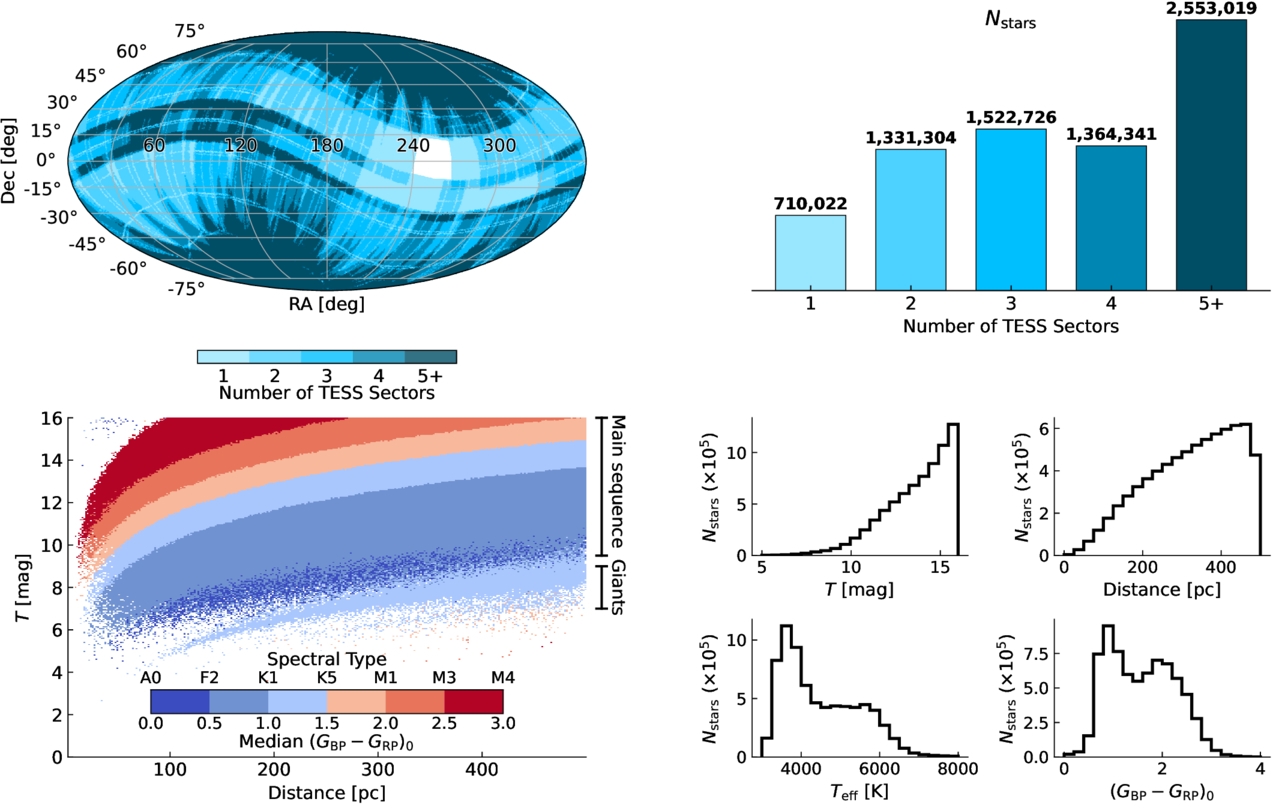
Target sample summary showing the TESS sky coverage (top left), histogram of number of TESS observations per star (top right), TESS magnitude as a function of distance to the star (bottom left), and histograms of magnitude, distance, temperature, and color across the sample (bottom right). Click to enlarge. [Boyle et al 2026]
Not all brightness variations present in a star’s light curve are due to stellar variability — instrumental systematics and artifacts from the spacecraft’s orbital period can produce periodic variability. To combat this, the authors created a classification algorithm to select sources whose periodicity is most likely due to true stellar variability rather than instrumental or observational effects. Pairing this classification with some additional validation criteria, the authors built the TESS All-Sky Rotation Survey (TARS), a catalog of periods for 1,046,317 stars within about 1,600 light-years of our Sun.
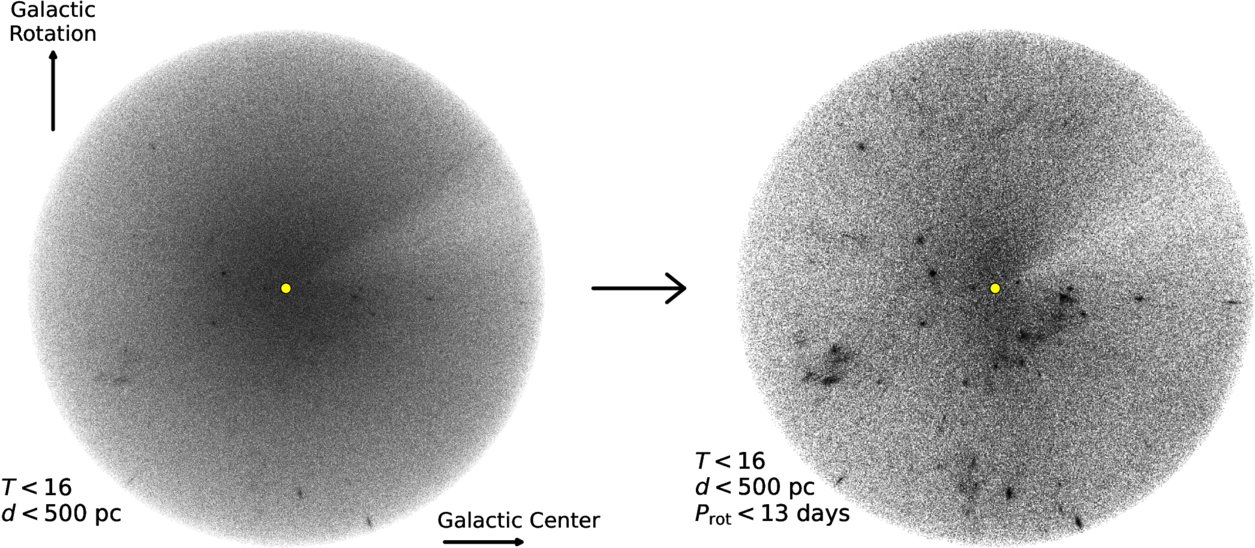
Map of all TARS stars within about 1,600 light-years of the Sun (left) and only the fast-rotating stars in the survey, highlighting clustered populations (right). Click to enlarge. [Boyle et al 2026]
Implications of TARS
Looking more finely at the TARS catalog, the authors provided additional quality cuts to remove other potential sources of stellar variability like binary companions or pulsations. The authors estimated that roughly 93% of their measured periods are due to stellar rotation, which expands the number of stars with known rotation periods by a factor of 2.3 within about 325 light-years and by a factor of 4.0 within about 1,600 light-years. As the largest homogeneous catalog of stellar rotation periods to date, TARS lays the groundwork for studies of stellar evolution, exoplanet discovery and evolution, and even Milky Way structure. For example, the authors found that when mapping the fast-rotating, typically younger stars in TARS, the location of young stellar associations in the local neighborhood became significantly clearer. This underscores the importance of this catalog for a range of science goals, and future work will only improve upon the data provided by TARS.
Citation
“The TESS All-Sky Rotation Survey: Periods for 1,046,317 Stars within 500 pc,” Andrew W. Boyle et al 2026 ApJS 284 75. doi:10.3847/1538-4365/ae6657