You gather your most expensive people into a room to make your most important decisions. Then, somewhere in the second hour, the room quietly gets worse at making them. Not the people. The room.
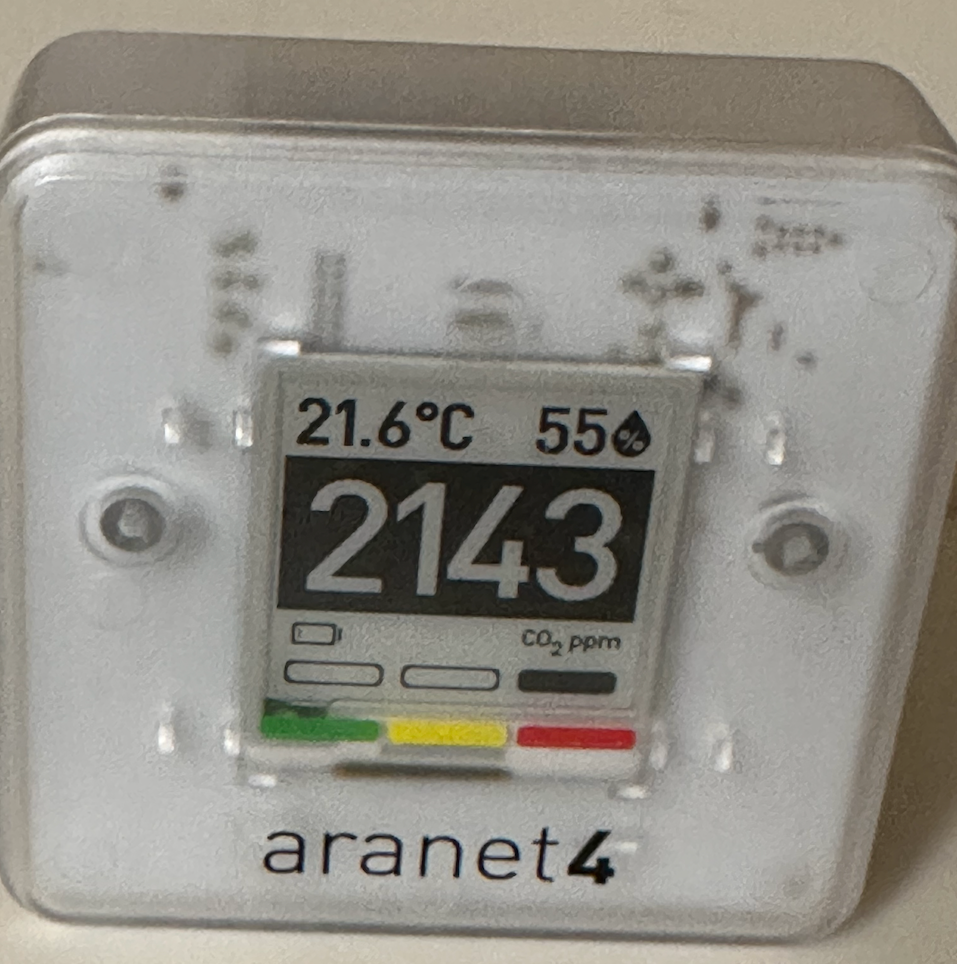
I now travel with a portable CO2 monitor. Outdoors it reads around 400 parts per million. In a closed meeting room with a handful of people in it, I have watched it climb past 2,000. The photo here is a real reading: 2,143.
That number matters more than it looks. Researchers at Lawrence Berkeley National Laboratory put people in a chamber and varied only the CO2. At 1,000 ppm, performance dropped significantly on six of nine decision-making measures compared with a clean-air baseline of 600. At 2,500 ppm, seven of the nine fell substantially, some into a range they called dysfunctional. A separate study out of Harvard found cognitive scores declining as CO2 rose, with the steepest losses in exactly the domains you called the meeting for: strategy, planning, and using information under pressure.
Here is the uncomfortable part. 1,000 ppm is not an extreme number. A closed room with a few people breathing in it reaches that inside the first hour. Your all-day planning session, your architecture review, your quarterly strategy offsite in the windowless boardroom: those are precisely the conditions that push CO2 into the range where decision quality measurably falls. You are running your highest-stakes thinking in the environment least suited to it.
And it is invisible from inside. Nobody in the room feels impaired. They feel a little tired, a little foggy, a little checked out, and they put it down to the length of the meeting, a bad night’s sleep, or the person who won’t stop talking. The one variable almost nobody checks is the air.
This is not only a boardroom problem. With so much work now remote, your people spend their days in small home offices with the door shut. Same physics, same climb, same afternoon fog. The dip your team hits mid-afternoon may owe less to motivation than to a room that hasn’t exchanged its air since morning.
A few years ago, one client tried to use this as an argument for bringing everyone back to the office. They touted how much better the building’s air was than anything people had at home. So I brought the monitor and it was eye-opening. Some parts of the building were genuinely as good as outdoor air; plenty were not. The meeting rooms were still a problem, and the more people in an area, the worse it got.
I’ve spent decades understanding why capable teams underperform, and I have learned to be suspicious of any explanation that starts by blaming the people. Before you conclude that the team is disengaged, that they can’t think strategically, or that the meeting culture is broken, it is worth ruling out the cheapest variable in the building. A CO2 monitor costs less than an hour of your time. Opening a window or a door costs nothing.
You already instrument your build pipeline, your cycle time, your defect rates. You measure the systems your people work inside because you know the environment shapes the output. The air in the room is part of that environment, and right now it is the one input you are not measuring.
I learned this the memorable way once, by sealing my own team into a room full of CO2 as a Halloween stunt. The everyday version is far less dramatic and far more common.
Open a window. Then watch what happens to the second half of the meeting.