You have full access to this article via your institution.

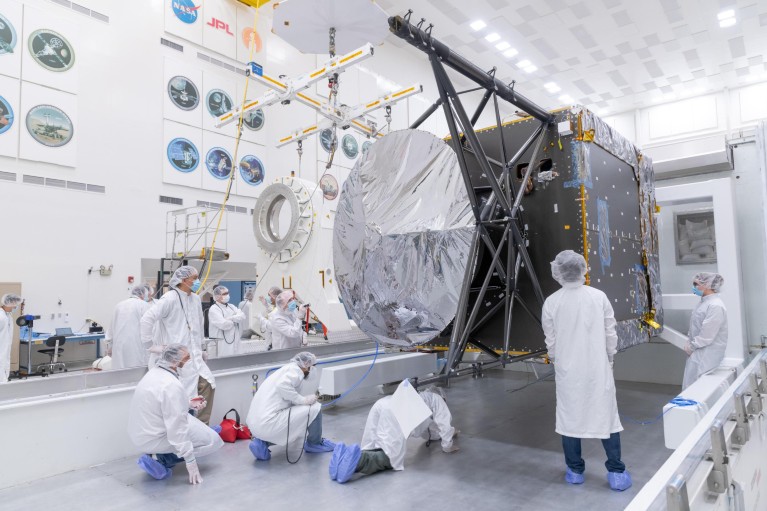
Many bacterial species resist cleaning chemicals and cling to sterile surfaces by producing sticky films in NASA's cleanrooms. Credit: NASA/JPL-Caltech
NASA’s cleanrooms are sterilised by reducing humidity, through intense cleaning, and radiation exposure. Yet, some microbes persist in these rooms, an international research team has found1.
The team has identified 26 new bacterial species in the cleanrooms where the Phoenix Mars Lander was assembled before its lift-off.
The team, which included researcher Karthik Raman at the Indian Institute of Technology Madras in Chennai, found many bacterial species that resist cleaning chemicals and cling to sterile surfaces by producing sticky films. Many have genes that protect their DNA from radiation damage, while some have genes that help control cell repair under oxidative stress.
Several bacterial species can form spores, helping them form hard, protective shells to live through harsh treatments.
Many of these bacteria also have genes that are useful for making valuable natural compounds. For instance, Agrococcus phoenicis and Microbacterium canaveralium produce an antimicrobial polymer used in food preservation and medicine. Sphingomonas canaveralia makes zeaxanthin, an antioxidant beneficial for eye health. One bacterium makes a molecule that helps capture iron and another synthesises molecules with anticancer and antimicrobial properties.
The unique metabolic capabilities of these bacteria make them promising sources of novel biomolecules that could benefit industry on Earth, the researchers note.