Dossier Summary
The Rule of 7 — the marketing belief that a buyer must be reached seven times before they buy — is the one number its own experts quietly abandoned decades ago, while a trillion dollars a year still moves on it.
The number was never measured. When the science arrived it put effective frequency at three exposures, not seven — and the thing the rule counts, how often one person is reached, is the single variable that cannot compound.
Five things move a sale; frequency is not one of them.
The error has a name — the reason a rule with no evidence still directs an entire industry’s spending, and the reason the cost of following it never stops.
Everyone in marketing knows where the Rule of 7 came from. That is the first problem with it.
The story is always the same — except for the number, which is never the same.
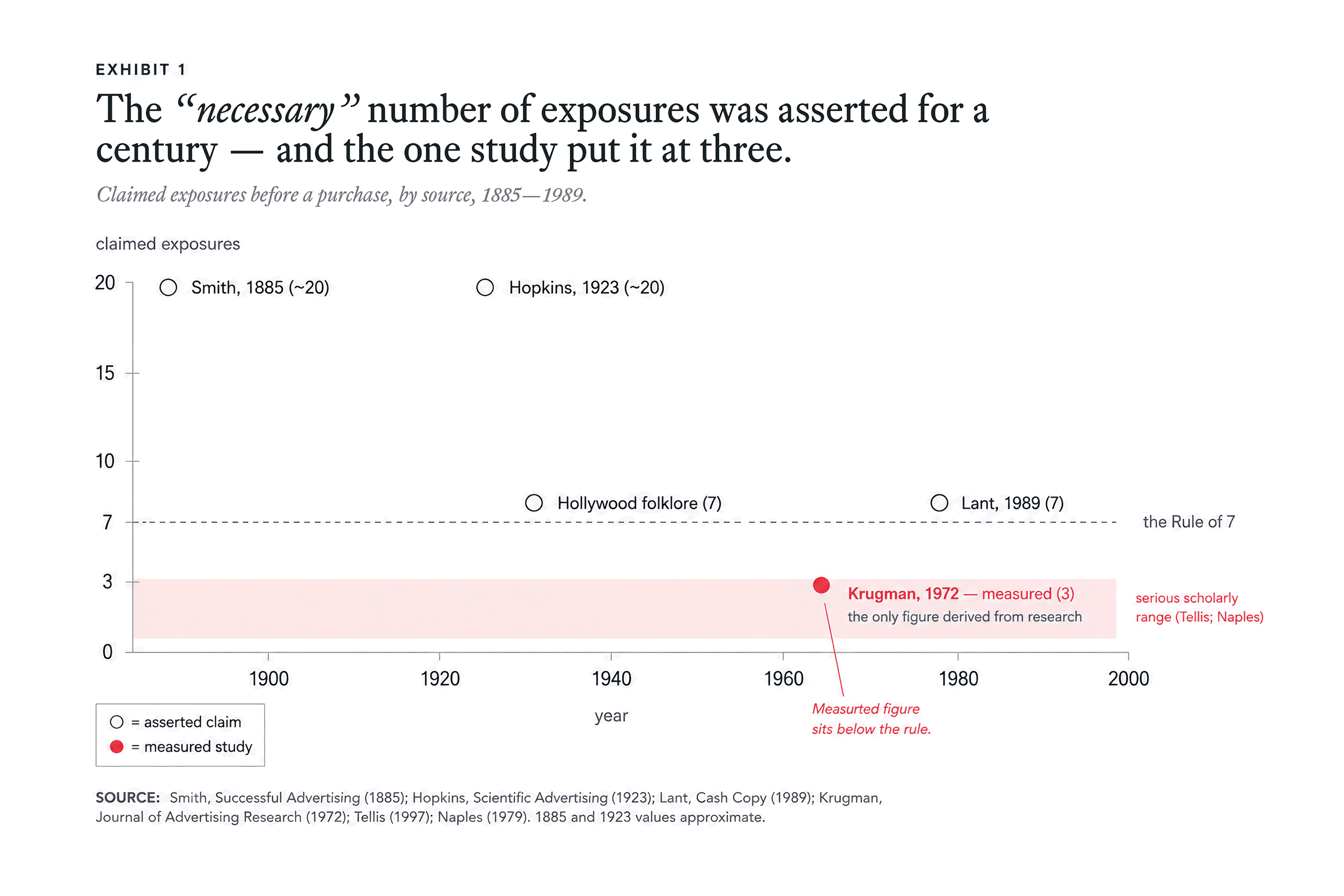
Hollywood in the 1930s is the usual origin: the studios are said to have found that a filmgoer needed seven looks at a poster before buying a ticket. But press on it and the rule comes apart in your hands. The earliest versions are not seven at all. Thomas Smith’s Successful Advertising, in 1885, put it at around twenty; Claude Hopkins, the father of modern copywriting, assumed much the same in 1923.¹
The modern B2B form — the one behind every nurture sequence and drip campaign — was named by the consultant Jeffrey Lant, who fixed it at seven exposures inside eighteen months.²
And the actual science, when it finally arrived, said three.³
A number that falls from twenty to seven to three across its own authorities was never a measurement. It was a run of assertions — each from someone with advertising to sell, or advice about it — and not one resting on a study.
And you can see why it held.
The rule encodes something everyone has felt — a name that means nothing on Monday and something by Friday, once it has crossed your path a few times. Repetition does work on a mind; every advertiser knows it, because every advertiser has been worked on. The intuition is sound. Whether any of the numbers deserve it is another question.
This would be a small matter — a figure with too many fathers and no study behind it — except that the marketer who follows it to the letter is the first to learn it does not work. The emails go out on cadence. The retargeting follows the visitor across the web. The seven touchpoints are hit, the sequence begins again.
And a year of it leaves nothing behind but the receipts: stop paying, and the presence is gone inside a fortnight, as though the account had never spoken.
So the question is not whether seven is the right number. It is why a rule that its own experts no longer believe still directs a trillion dollars a year — and why, followed perfectly, none of it adds up.
Stephen Shaw
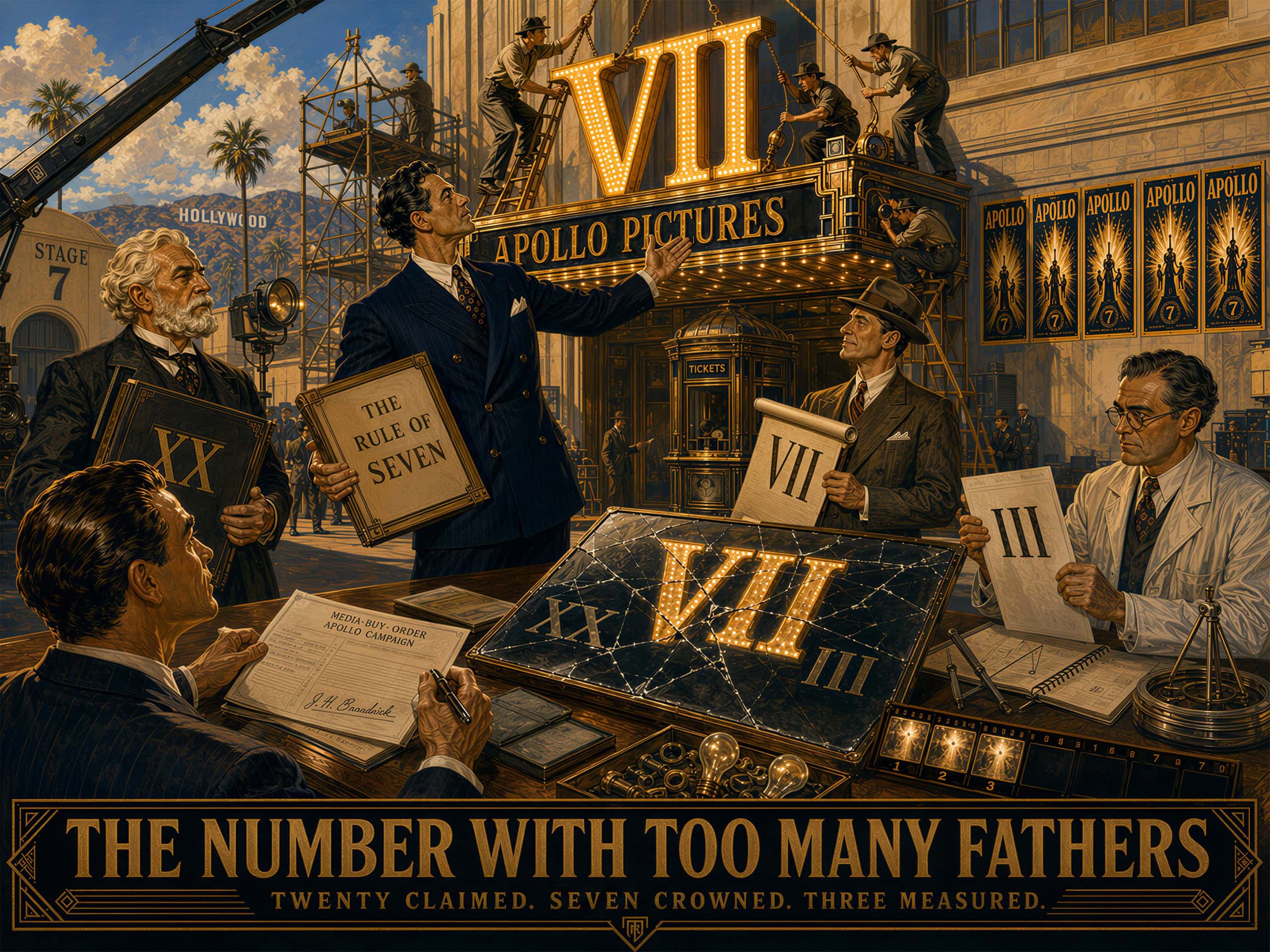
The Number With Too Many Fathers 2026. Digital 50’s-style painting.
How many touchpoints does a sale actually take?
There is a science of how many times an advertisement must be seen before it works — the question marketers call effective frequency.
It never settled on seven.
In 1972 a psychologist named Herbert Krugman, then at General Electric, published the paper the field still rests on, under a title that reads now like an accusation: “Why Three Exposures May Be Enough.” His account was almost gentle — the first exposure asks what is it?, the second what of it?, and the third decides; everything after is reminder.³
The serious argument has run between one exposure and three in the half-century since, and no one in it has ever argued for seven.⁴ He dismissed the larger numbers outright: effects credited to twenty or thirty exposures, he held, were only the first few counted again. And he named the thing this investigation is about.
The belief that an audience forgets you unless you repeat yourself often enough was, he wrote, a myth — and the myth was what justified the large budgets.³ The field kept the folklore and mislaid the science. When the modern industry set out to measure what actually moves a sale, frequency fared no better.
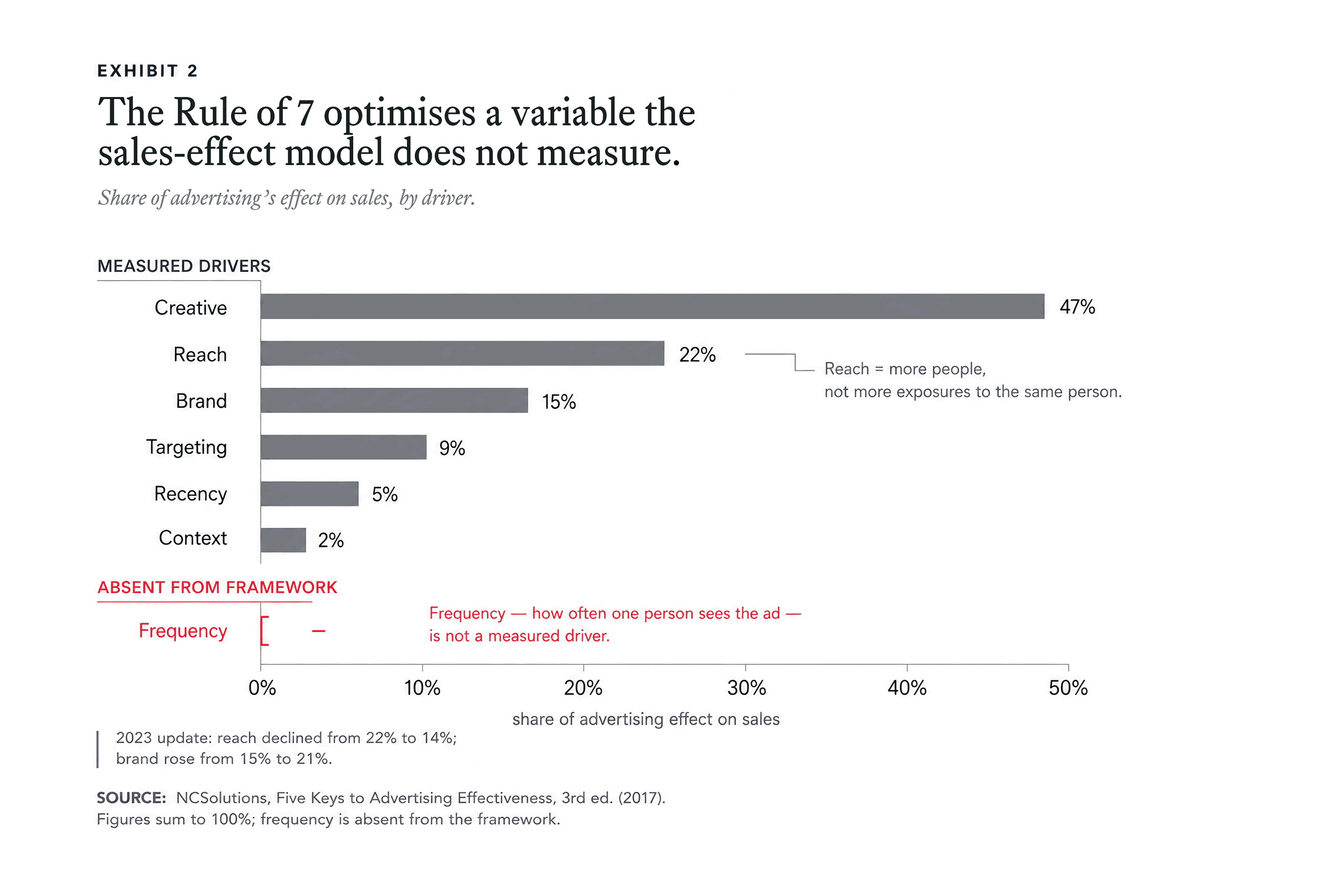
In 2017 Nielsen Catalina Solutions took apart the drivers of advertising’s effect on sales, across hundreds of campaigns, and found that five things carried it: the creative, the reach, the targeting, the recency, the context.
Creative led by a distance — close to half the effect, and more than half of it in digital.⁵ When they ran the study again in 2023, the balance had moved: raw reach had fallen from 22 per cent of the effect to 14, while the weight of what a brand had already built — loyalty, standing — had climbed from 15 to 21.
NCSolutions had a term for what that built standing does to a brand’s returns over time — a compounding effect.⁵
And frequency?
Frequency — how many times a single person saw the advertisement, the entire content of the rule — was not among the five. Reach was: being seen by more people drove better than a fifth of the effect. Being seen more often by the same people did not register at all.⁵
An economist examining thirty online display campaigns in 2015 looked for the point at which more exposures begin to compound, and found none: no evidence of increasing returns anywhere in the data — wear-out, or at best a flat line.⁶ More was not worse, exactly.
It simply was not more.
The rule’s defenders deserve their strongest case, and they have one.
A single campaign’s recall does climb across the first several exposures, the lift sitting somewhere between five and nine — close to where the rule has always pointed.⁷ Repetition earns recall; that much is real and well measured.
The trouble is what recall is, and what it is not.
And the field already knows all of this.
Open any current guide and the literal claim has quietly gone: the number is probably higher than seven now, or it depends on the channel, or it is a guideline and not a law. The people who teach it have abandoned the number, and repeat it in the same breath, as confidently as ever.
Part of why it cannot be killed is that it cannot be tested: advertising’s effect on sales is so faint against the market’s noise that the median rigorous experiment needs some 3.3 million observed customers just to tell a campaign that works from one that does nothing.⁸ A claim no instrument can disprove need not be true to survive.
It need only be repeated — and something was paying to repeat it.

Stephen Shaw
Three Exposures in the Laboratory 2026. Digital 50’s-style painting.
Why the Rule of 7 persists.
A belief that survives its own disproof is usually being paid to survive.
This one is being paid a great deal.
The instruction the Rule of 7 issues is simple: buy more exposure.
Consider how much of the economy is built to fill that order?
In 2025 the world spent over a trillion dollars on advertising, about three-quarters of it digital — a figure that has doubled in under a decade.⁹ Most of it moves through a handful of companies. Outside China, Google and Meta take about half of all the money spent on advertising; add Amazon and the three of them take more than half of it — and close to two-thirds of every digital dollar worldwide.¹⁰
And they grow in one way: by selling exposures.
In the third quarter of 2025, Meta’s advertising revenue rose by roughly a quarter. The larger part of that rise was not better ads. It was more of them: fourteen per cent more, served.¹¹
The platform’s growth and the rule’s instruction are the same sentence.
Below the platforms sits the product that is the rule made literal. Retargeting — the advertisement that trails a visitor from page to page — exists to put the same message in front of the same person again, and again, and is sold on exactly that promise.
It is an instrument for manufacturing touches, and it is priced by the touch.
Around all of it stands the apparatus that runs the campaigns: the agencies, the ad-technology firms, the measurement houses, whose business is the planning and buying and orchestrating and counting of exposure across channels. “Be everywhere, seven times” is not, to that apparatus, a claim about persuasion. It is a description of the work it bills for.
Follow the money and the irrationality dissolves.
The rule endures because nearly everyone able to correct it is paid in the unit it tells the buyer to maximise. Only the buyer has any interest in fewer, better touches. And the buyer is the one person not in the room when the rule is taught.

Stephen Shaw
The Marketplace of Exposures 2026. Digital 50’s-style painting.
Why seven touches never add up.
Set the findings side by side. The number has no source. The measurement has no frequency in it. The field has no belief left in it, and repeats it anyway. Three strange facts — and they rest on a single assumption, one so ordinary no one has thought to test it.
A touch is a touch.
That’s the assumption. It is also false.
A touch that builds on the one before it and a touch that starts the introduction over are not the same act. Only the instruments make them look alike — because impressions and reach and frequency can count exposures and nothing else, and they have no way to record whether anything carried from one to the next.
The 1930s number was not wrong for 1930.
In a world of few messages, repetition was accumulation: each exposure landed on an uncrowded mind, the last one still present to build on. Saturation broke the equation. When a person meets thousands of messages a day, frequency and accumulation come apart, and the rule keeps optimising the half that can be bought.
What that half buys is familiarity — the sense of having seen a name before.¹²
It is real, and it is not nothing, and it is rented.
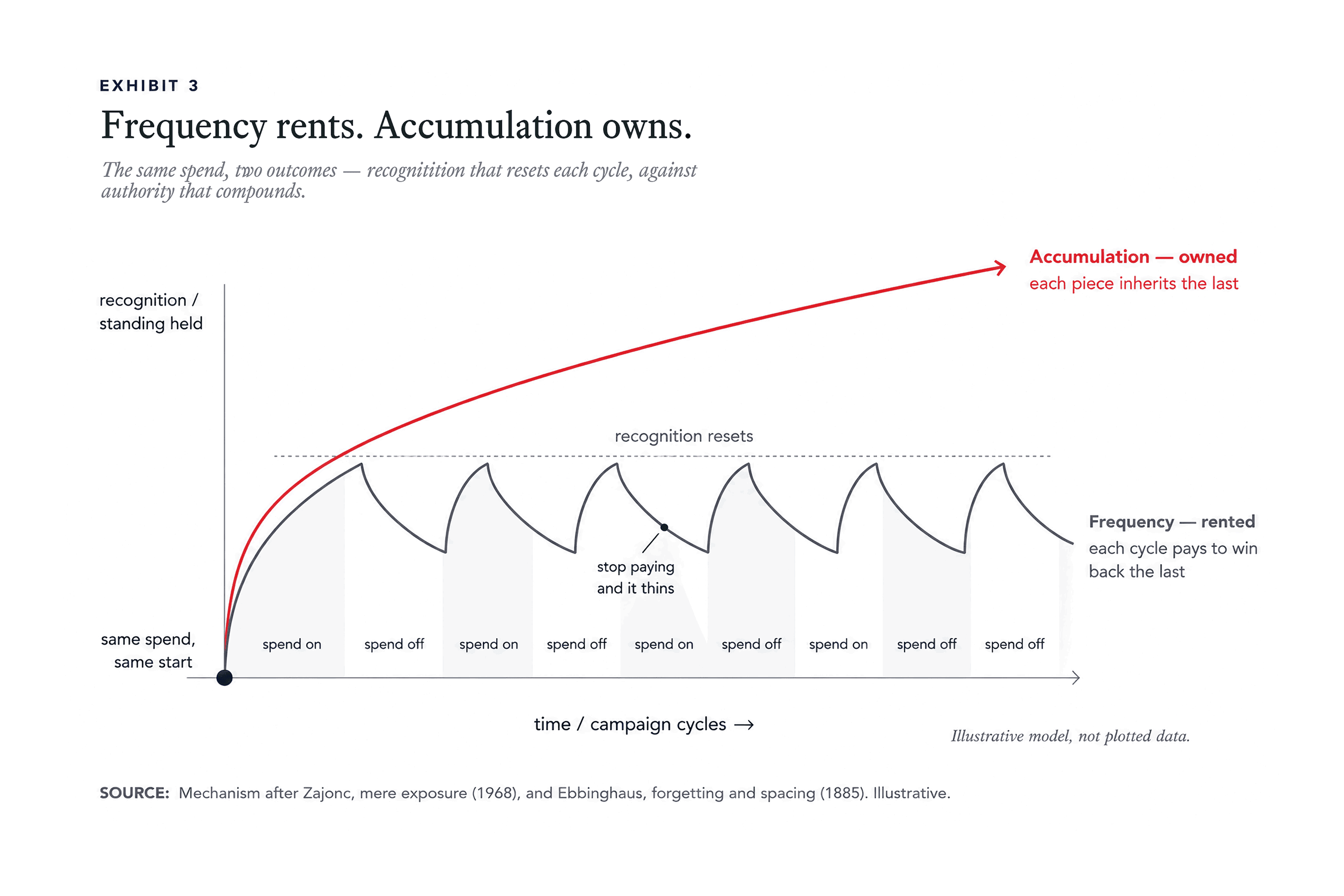
You hold the recognition only while the payments continue; it thins the moment they stop, because nothing was built.
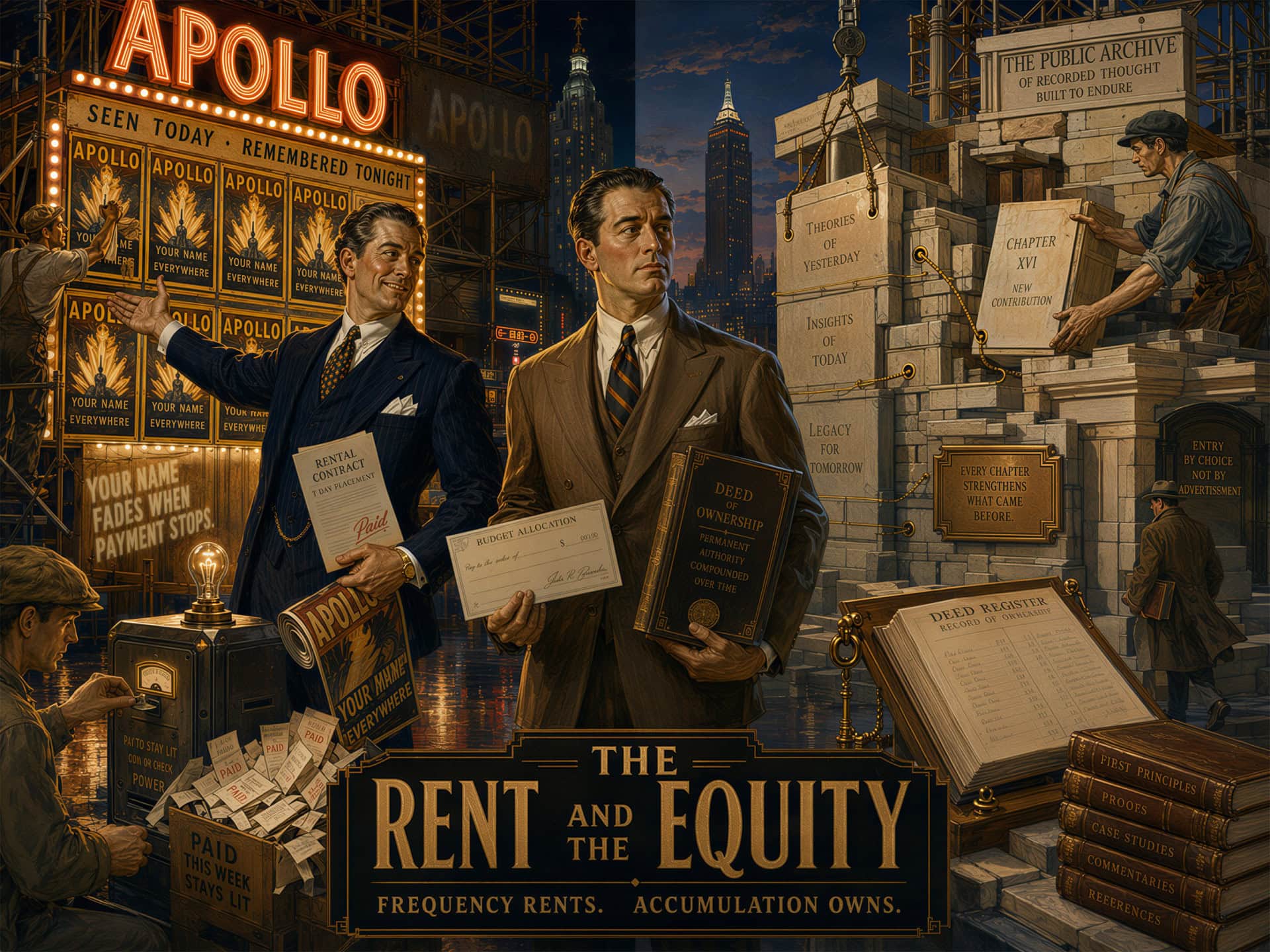
The same money hired the same recognition again. It is the difference, in the only language the people footing the bill actually use, between rent and equity. Frequency rents. It never owns.
Seven touches that do not accumulate are not seven touches. They are one touch, attempted seven times.
What owns — what compounds — is the other act entirely: the touch that inherits, that carries the last one forward, until a year of work is a position and not a receipt. The rule could never measure it, because it could never see it.
The question was never how many touches.
It was whether they accumulate.
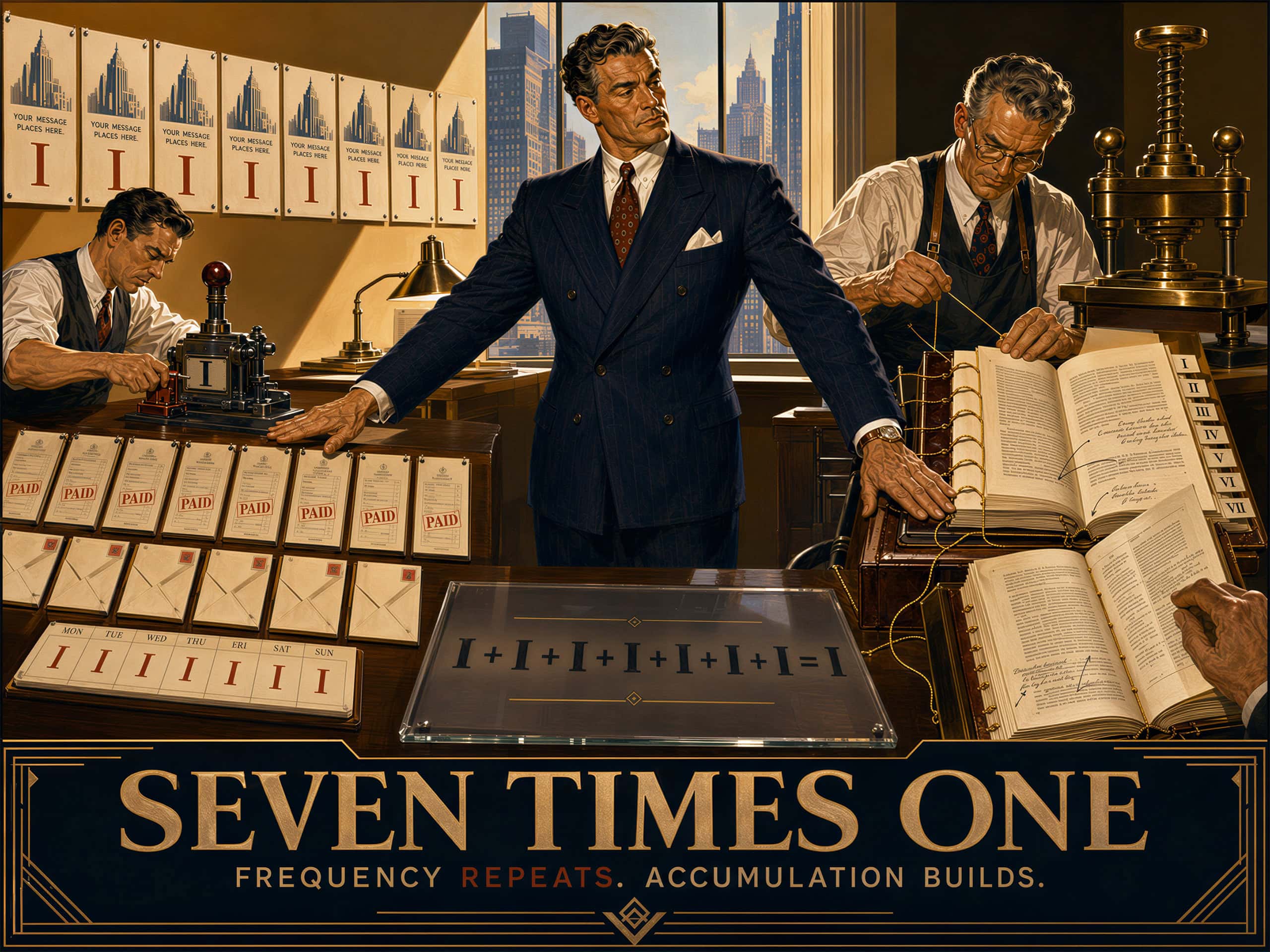
Stephen Shaw
Seven Times One 2026. Digital 50’s-style painting.
That alone would be enough to bury the rule: it optimises the one thing that cannot accumulate.
But it is not the bottom of the matter — and the bottom is not in advertising at all. The same law that governs why frequency fails was set down in a laboratory in 1885, and it concerns the most ordinary thing a mind does, which is forget.
Hermann Ebbinghaus, drilling himself on lists of nonsense syllables, found that material crammed into a single sitting fell away fast, while the same number of repetitions spread over time held.¹³ A century of work since has only confirmed it — a synthesis of more than three hundred experiments found the spaced advantage almost without exception.¹⁴
The mechanism is what matters here.
A repetition that arrives while the memory is still fresh does almost no work; the mind already holds it, and lays down nothing new. Memory consolidates only when each return has to rebuild a trace that has begun to fade.
The effort of the rebuild is the thing that lasts.
Which means the reminder only works because the audience has begun to forget. Read that back onto the rule, and its true shape appears.
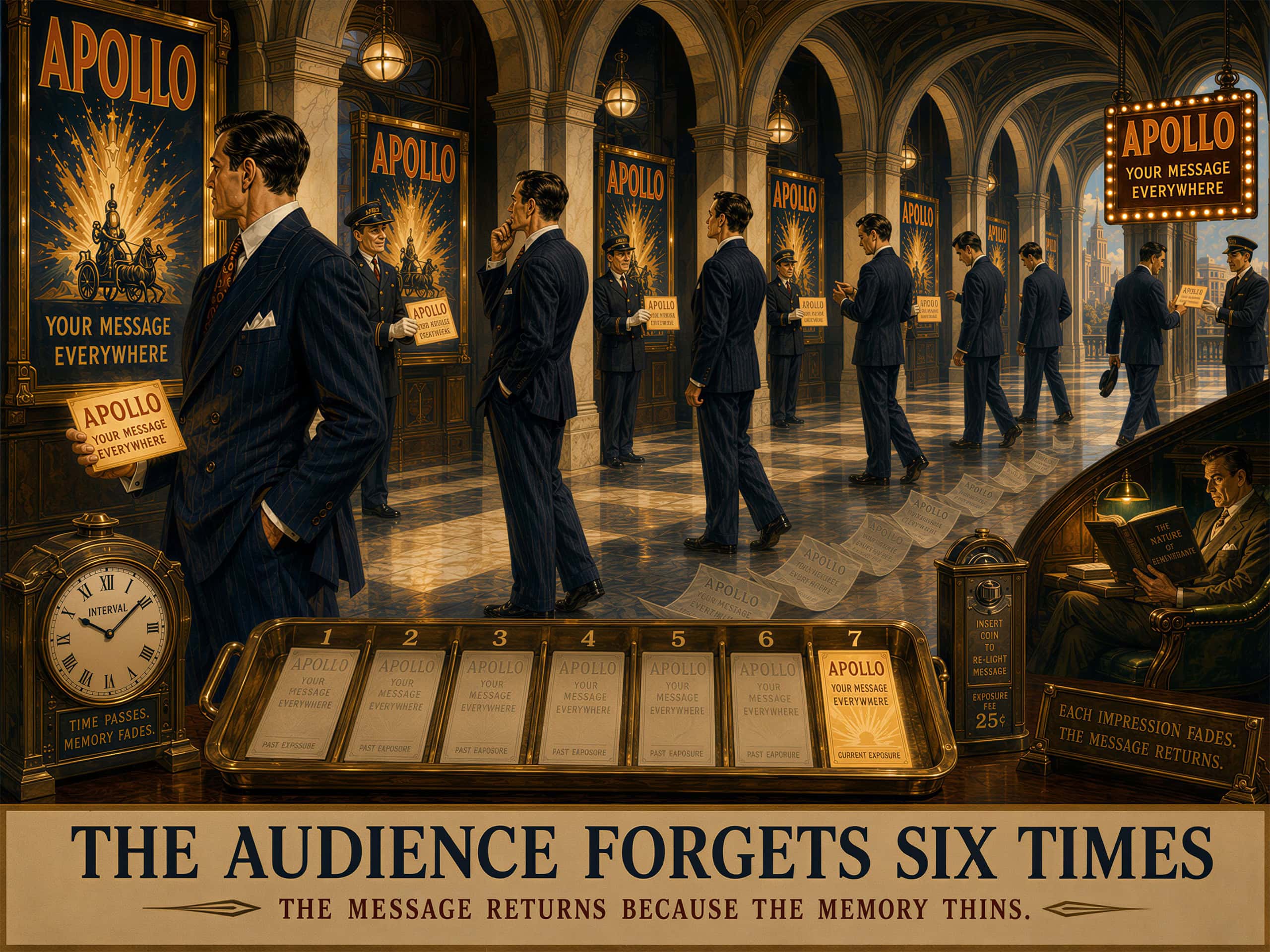
Stephen Shaw
The Audience Forgets Six Times 2026. Digital 50’s-style painting.
The Rule of 7 is a method for being forgotten slowly enough that you can keep paying to be remembered again.
A brand that needs seven touches has agreed to be forgotten six times. It is not building an audience; it is renting one that resets by design — paying, every cycle, to win back the ground the last cycle lost.
The cleverer marketers have heard half of this.
“Spaced beats massed,” they say — so space the touches out, drip the nurture, lengthen the cadence.
They took the easy half.
Spacing works because of what the psychologist Robert Bjork named desirable difficulty: the struggle of rebuilding a fading memory is the very thing that strengthens it, which is why people who cram feel more confident and remember less — they mistake the ease of recognition for learning.¹⁵
The laboratory cannot quite stand in for the marketplace — its subjects are trying to remember, and an audience is not — but the shape transfers: what is rebuilt with effort lasts, and what arrives for free does not.
A spaced run of frictionless reminders is still cramming; it has only slowed down. The lever was never the timing of the touch. It is whether absorbing it costs the audience anything at all. Frequency, spaced or massed, asks nothing of anyone.
That’s why it never sets.
The diagnosis is simple enough to say in a sentence, which is the test of whether it holds.
The error has a name ..
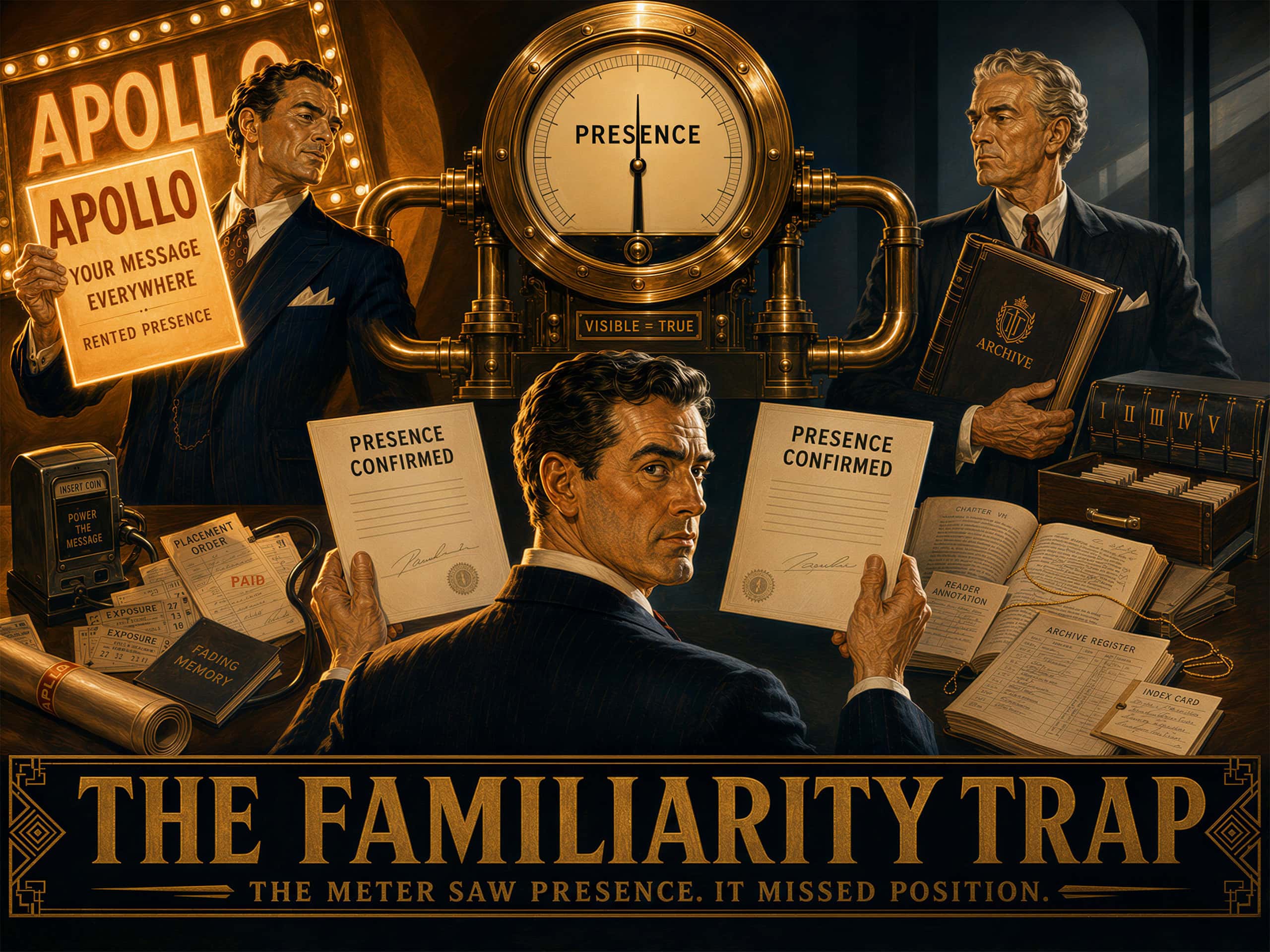
Stephen Shaw
The Familiarity Trap 2026. Digital 50’s-style painting.
The Familiarity Trap.
Repeated exposure can only ever rent familiarity.
It can never own authority, because it has no mechanism of inheritance — no way for one touch to carry the last. From inside the dashboard the two are indistinguishable: familiarity and authority surface as the same reading — presence.
So the market keeps paying for the one that evaporates, mistaking the warmth of recognition for the weight of a position, exactly as the crammer mistakes fluency for knowledge.
This is why the rule could lose its evidence and keep its authority.
It optimises the single variable that cannot compound — frequency — because the one that can — accumulation — is invisible to the instruments and unprofitable to the firms that sell them.
A trillion-dollar economy is denominated in exposures, and exposures are the precise thing that does not add up.
And the cost runs the wrong way.
Reach — the cost of being seen by more people — can build something; even the brand scientists who would most distrust this argument agree the lever is reach, not frequency.¹⁶ It is frequency-per-person, the literal content of the rule, that buys nothing that lasts; a decade of it leaves nothing on the balance sheet but the cancelled cheques.
Which is what the number always measured.
Seven is what you need when no single thing you make is worth remembering on its own — a debt to pay down, not a target to raise, the price of having nothing that gets carried. A brand that has earned authority is not seen seven times; it is the thing the others are read against.
The Hollywood studios were not wrong.
They were right about a world that no longer exists — a world thin enough that seven exposures genuinely accumulated. We kept their number and lost their world. And Krugman was right about the world that replaced it: three exposures, not seven, and a myth dressed as diligence.
But Krugman drew one more conclusion, and it is the one the field chose to remember.
Because you never know when the buyer is looking, he wrote, you must — like a product on a shelf — rent the shelf space all the time.³ He was right, too. Rented presence is the price of sitting on a shelf: when the buyer does not know your name, you must simply be there at the unpredictable moment of need, and pay to stay there forever.
What he never asked is what happens when you are not on the shelf at all — when you are the thing the buyer comes looking for, by name.

Stephen Shaw
The Thing They Came Looking For 2026. Digital 50’s-style painting.
The brand scientists are right that mental availability decays, and that a soft drink must keep refreshing the memory of itself or fade.¹⁶ But a body of published work that a field reads on its own initiative — that it cites, and argues with, and returns to — is not a memory being refreshed.
It is a position — one that still must be tended, but that compounds rather than resets, because each piece inherits the ones before it, where rented familiarity vanishes the moment the paying stops.
This is not a hypothesis.
Professional services has known it since Marvin Bower forbade McKinsey to advertise or solicit and told the firm to publish instead — articles, books, the Quarterly — on the reasoning that a client who arrives already convinced is worth more than one who must be sold.¹⁷
The pattern still holds, and it is now measured: B2B buyers say a firm’s published thinking is a more trustworthy guide to its quality than its marketing, and the firms whose work they already read are the ones they invite to bid and pay a premium to keep.
None of which licenses simply publishing more: shown more thought leadership than ever, buyers now rate almost none of what they read worth the time.¹⁸ Volume rebuilds the trap in a new medium — no more an escape than frequency was.
A lighthouse is the opposite of rented shelf space: built once, then kept lit. No one stumbles onto a lighthouse in the moment of need — the ships set their course by it long before they reach the harbour.
You do not rent that shelf. You are what people came in for.

Stephen Shaw
Lighthouse keeper at twilight vigil 2026. Digital tempera-style painting.
Which leaves the only question worth the next investigation.
The brand scientists can tell you to be broadly available; their own critics now argue that availability is not enough — that a buyer needs a reason to choose, and reach supplies none.¹⁹
Neither has named the thing that earns the choosing.
If frequency merely rents familiarity, what is it that builds the authority that compounds — the body of work in which each piece inherits the last, until a field is read against it rather than reminded of it?
That is a different discipline, with a different instrument.²⁰
It cannot be counted in touches.
Index
Sources referenced.
- Thomas Smith. Successful Advertising. London, 1885; and Claude C. Hopkins. Scientific Advertising. New York: Lord & Thomas, 1923. The pre-scientific lineage of the rule, each putting the necessary number of exposures at roughly twenty — a chain of assertions by men selling advertising or advice about it, none resting on a study. With note 3, establishes the historical drift (twenty → seven → three) and that the number was never stable or empirical.
- Jeffrey Lant. Cash Copy: How to Offer Your Products and Services So Your Prospects Buy Them … Now! Cambridge, MA: JLA Publications, 1989 — the source of the modern “Rule of Seven.” Establishes the rule’s named modern claimant — a minimum of seven exposures within an eighteen-month period — and that the Lant lineage is the B2B, multi-touch, nurture-cadence version (emails, drip sequences, retargeting) the piece chiefly addresses. Corrects the earlier “no name” overstatement.
- Herbert E. Krugman. “Why Three Exposures May Be Enough.” Journal of Advertising Research 12, no. 6 (1972): 11–14. The founding paper of effective-frequency theory: the first exposure asks “What is it?”, the second “What of it?”, the third decides, and further exposures only repeat the third — hence three, not seven. Krugman explicitly dismissed campaign effects credited to twenty or thirty exposures as illusory multiples of the first few, and called the belief that audiences forget without heavy repetition a myth that sustained large advertising budgets. The same paper, however, contains the strongest statement of the opposing case: because the in-market moment is unpredictable, Krugman wrote, “like a product sitting on a shelf … the advertiser must rent the shelf space all the time.” The piece’s rent/equity architecture is his merchant’s metaphor, deployed in reverse — see the Act III re-appropriation.
- Gerard J. Tellis. “Effective Frequency: One Exposure or Three Factors?” Journal of Advertising Research 37, no. 4 (1997): 75–80; and Michael J. Naples. Effective Frequency: The Relationship Between Frequency and Advertising Effectiveness. New York: Association of National Advertisers, 1979. Together these map the serious scholarly debate over advertising frequency, which has run between the “minimalist” position (one exposure per purchase cycle is sufficient) and the “repetitionist” position (around three). No position in this literature proposes seven exposures as a threshold.
- Nielsen Catalina Solutions / NCSolutions. Five Keys to Advertising Effectiveness, 3rd ed. (August 2017), and the 2023 update. The 2017 study decomposes the drivers of advertising’s effect on sales into five elements — creative (47%; higher, around 56%, in digital), reach (22%), brand (15%), targeting (9%), recency (5%) — with frequency absent from the framework. The 2023 update, on nearly 450 CPG campaigns, finds reach fallen to 14% and brand factors risen to 21%: what a firm has built matters more over time, raw exposure less. NCS describes the long-run payoff of that built loyalty — loyal buyers continuing to generate sales — as a compounding effect on advertising effectiveness. The newest figures bend toward the argument.
- Randall A. Lewis. “Worn-Out or Just Getting Started? The Impact of Frequency in Online Display Advertising.” Working paper, Google / American Economic Association meetings, 2014–15. Using a natural experiment on the Yahoo! Front Page across thirty online display campaigns, finds no evidence of increasing returns to additional exposures: responses run from constant returns to wear-out, never accelerating. Establishes empirically that additional impressions do not compound.
- Nielsen. Digital Ad Frequency: Impact on Awareness and Purchase Intent. Nielsen Digital Brand Effect (Australia), 2017. Finds that, for a single campaign, brand recall and resonance rise most steeply across the first several exposures, with the strongest lift at roughly five to nine. Cited as the opposition’s strongest evidence — for recall specifically, which the argument then distinguishes from durable authority.
- Randall A. Lewis and Justin M. Rao. “The Unfavorable Economics of Measuring the Returns to Advertising.” Quarterly Journal of Economics 130, no. 4 (2015): 1941–1973. Establishes that advertising’s effect is so small relative to the variance in sales that the median field experiment needs roughly 3.3 million exposed observations merely to separate a profitable campaign from an ineffective one. Supplies the citable mechanism for “invisible to the instruments”: a measurement vacuum sufficient to let an unfalsifiable rule survive.
- eMarketer. “Worldwide Ad Spending Forecast 2025” (January 28, 2025); and WARC, “Global Ad Spend Forecast, Q3 2025 Update” (via Marketing Dive, September 25, 2025). Global advertising spend passed one trillion dollars for the first time in 2025 — estimates range from approximately $0.98 trillion (MAGNA) to $1.17 trillion (WARC) — having roughly doubled since 2016. Digital accounts for about 73–75 per cent of the total.
- WARC, Global Ad Trends (2025); eMarketer, Worldwide Ad Spending (2025). Outside China, Google and Meta together take roughly half of all advertising spend; with Amazon, the three take more than half of advertising ex-China (WARC: ≈56%) and close to two-thirds of digital spend (eMarketer: ≈62% in 2026). The bases — total-ex-China versus digital — are named in the text so the figures are not conflated.
- Meta Platforms, Inc. “Meta Reports Third Quarter 2025 Results.” SEC Form 8-K / press release, October 29, 2025. Total revenue rose 26% and advertising revenue 25.6% year on year; ad impressions rose 14% and the average price per ad 10%. The arithmetic (1.14 × 1.10 ≈ 1.25) confirms the larger share of the increase came from serving more advertisements than from price.
- Robert B. Zajonc. “Attitudinal Effects of Mere Exposure.” Journal of Personality and Social Psychology 9, no. 2, pt. 2 (1968): 1–27. Establishes the mere-exposure effect: repeated exposure to a stimulus, in itself, increases liking and the sense of familiarity. Names precisely what repeated advertising reliably produces — familiarity — which the argument distinguishes from authority.
- Hermann Ebbinghaus. Über das Gedächtnis: Untersuchungen zur experimentellen Psychologie. Leipzig: Duncker & Humblot, 1885. The founding experimental study of memory and forgetting. Learning lists of nonsense syllables on himself, Ebbinghaus documented both the forgetting curve and the spacing effect: repetitions distributed over time produce far more durable retention than the same number massed into one session.
- Nicholas J. Cepeda, Harold Pashler, Edward Vul, John T. Wixted, and Doug Rohrer. “Distributed Practice in Verbal Recall Tasks: A Review and Quantitative Synthesis.” Psychological Bulletin 132, no. 3 (2006): 354–380. A quantitative synthesis of 839 assessments across 317 experiments in 184 articles. Establishes the robustness and generality of the spacing effect across more than a century of research.
- Robert A. Bjork and Elizabeth L. Bjork. “Making Things Hard on Yourself, But in a Good Way: Creating Desirable Difficulties to Enhance Learning.” In Psychology and the Real World, ed. Morton A. Gernsbacher et al. New York: Worth Publishers, 2011. Introduces “desirable difficulties” — that effortful retrieval and the reconstruction of partly-forgotten material strengthen memory — and documents the illusion of competence, whereby massed practice (cramming) produces high confidence but poor retention. Supplies the mechanism by which familiarity is mistaken for mastery; applied here as an illuminating parallel, not a proof, since its subjects are deliberately learning and an advertising audience is not.
- Byron Sharp. How Brands Grow: What Marketers Don’t Know. Oxford: Oxford University Press, 2010; and the Ehrenberg-Bass Institute body of work on mental and physical availability. The field’s dominant evidence-based school, and two-edged here. It is the source of the strongest objection — mental availability decays, so brands must advertise continuously — which the piece answers with a domain boundary: a published canon that is sought by name is not a memory being refreshed. The boundary is not a claim that authority is exempt from decay, but that it decays from an accumulating base, where bought familiarity decays to nothing — upkeep that falls rather than resets. Nor is the quarrel with reach or distribution as such: a canon must still be carried to its readers, and at scale that carriage may be bought; the argument is only against frequency-per-person standing in for something worth seeking. It is also the piece’s ally, since Ehrenberg-Bass holds that growth comes from broad reach and distinctiveness, not high frequency, which disarms the “anti-advertising” charge.
- On McKinsey: Duff McDonald. The Firm: The Story of McKinsey and Its Secret Influence on American Business. New York: Simon & Schuster, 2013; and Amar Bhidé, “Building the Professional Firm: McKinsey & Co., 1939–1968” (Harvard Business School working paper, 1996). On Andreessen Horowitz: Marc Andreessen, “Why Software Is Eating the World,” Wall Street Journal, August 20, 2011 — the “media company that monetises through VC” characterisation is Benedict Evans’s, the firm’s former in-house analyst, as reported in Columbia Journalism Review (2021). On Christensen: Joseph L. Bower and Clayton M. Christensen, “Disruptive Technologies: Catching the Wave,” Harvard Business Review73, no. 1 (1995): 43–53; and Clayton M. Christensen, The Innovator’s Dilemma: When New Technologies Cause Great Firms to Fail. Boston: Harvard Business School Press, 1997. Three registers of one pattern. Marvin Bower’s founding doctrine for McKinsey held that the firm should build its reputation by publishing thought leadership — articles, books, speeches — and neither advertise its services nor solicit clients, on the reasoning that a client who approaches the firm arrives without the “show me” scepticism of a buyer sold to after a pitch. The McKinsey Quarterly launched in 1964; where only two books by McKinsey authors appeared between 1960 and 1980, more than fifty appeared between 1980 and 1996, throwing off frameworks — the 7-S model, “the war for talent” — that entered the language of management. The pattern is not antiquarian: Andreessen Horowitz built what a former in-house analyst called “a media company that monetises through VC,” out-publishing the venture industry into the front rank with the avowed aim of being the firm to which founders come. And it operates at the level of the individual: Clayton Christensen’s single idea — coined as “disruptive technologies” in the 1995 article and generalised to “disruptive innovation” in his later work — compounded into what The Economist called the most influential business idea of the early twenty-first century, and brought Intel’s Andy Grove looking for its author. Establishes that authority built from a published body of work, and sought by name, is the documented practice of the most authoritative firms and thinkers — not a conjecture.
- Edelman and LinkedIn. B2B Thought Leadership Impact Report, 2024 (sixth annual edition; approximately 3,500 B2B decision-makers across seven countries). Among the findings: 73 per cent of buyers consider a firm’s thought leadership a more trustworthy basis for judging its competence than its marketing materials; 86 per cent are moderately or very likely to invite a consistent producer of high-quality thought leadership into an RFP; 60 per cent will pay a premium for it; and, among those who engaged a piece that led them to research something they had not been considering, 23 per cent went on to buy from the organisation that published it. The study also documents a “mediocre middle” — as more firms publish, only 15 per cent of buyers rate the thought leadership they encounter as very good or excellent, and what clears the bar is distinctive, research-backed work from recognised experts: the Familiarity Trap in publishing form. An industry study (Edelman sells thought-leadership services), and one built on self-reported attribution — a weak instrument in both directions, since buyers may over-credit the thinking they recall and under-credit the advertising they do not. Treated here as directional: rigorous, recurring, and large, but cited for the order of magnitude, not the decimal.
- Felipe Thomaz, Saïd Business School, University of Oxford. Research contesting “reach sufficiency,” based on more than 1,000 campaigns and roughly a million customer journeys (reported 2024–25; peer review pending). Shows the brand-science consensus is itself under challenge from the differentiation side — that reach alone is insufficient and meaning matters. Locates the piece’s “something worth remembering on its own” in the contested gap between the two camps rather than against the evidence base.
- Nassim Nicholas Taleb. The Black Swan: The Impact of the Highly Improbable. New York: Random House, 2007; and Antifragile: Things That Gain from Disorder. New York: Random House, 2012. The method here is Taleb’s — the graveyard of silent evidence, and the firmer footing of negative knowledge (that we know what is false more securely than what is true); the application to the Rule of 7 is the piece’s own. The symmetry objection — that this argument unseats an unmeasured number only to install unmeasured cases — runs the other way. The verdict against seven rests on measurement (that frequency does not drive sales, notes 5–6) and on the rule’s own authorities recanting (notes 1–4): a negative claim, and negative claims do not suffer the survivorship that afflicts success stories. The alternative — that a published canon compounds into authority — is offered as direction and existence proof, not as a rival threshold, and it names no number, because to count the thing that compounds would be to repeat the original error. The cases do not promise that publishing guarantees standing (it does not); they establish that the mechanism is real, while the population evidence (note 18) supplies what cases alone cannot. The claim is bounded, too: where availability rather than authority drives the purchase — the impulse buy, the low-consideration good — frequency keeps a role, though seven remains folklore there as well.