Ghost Font is an anti-AI font that writes a message using motion. Using a combination of motion, video, noise, and decoys, it's a unique way to share a message with other real humans. I suppose technically, it's not a font in the traditional sense of a TTF font file. But, Ghost Font is an experiment of a way to graphically communicate in writing in a format that AI cannot easily understand. While it's not as legible as regular text, the letters are still immediately readable to a human eye, but even leading AI models can't decipher it easily.
Videos generated with Ghost Font were then passed to leading AI models like Claude Fable and GPT Sol 5.6 Ultra. Even these recent agents, with the ability to code, struggled to decode the moving message until prompted with the exact technique to look for.
The playground above is just a prototype of this concept. Type a few words and the letters appear but only because the motion of the dots is visible to a human eye.
When the video is paused, the static dots blend together, and it becomes impossible to tell just from looking at a single frame what message is embedded in the image. That means that screenshotting the page won't reveal the message.
This experiment works locally—type the message and preview it live, or download the video to share and test it out yourself. The data is not shared or sent to any server.
About this project
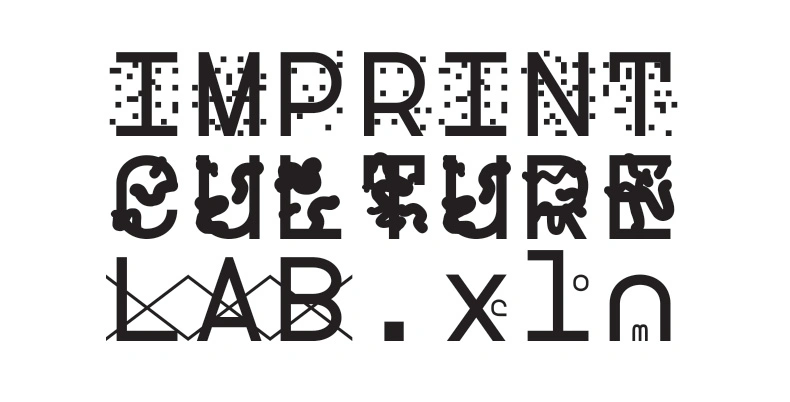
In 2013, designer Sang Mun released a font called ZXX. It was a typeface with four fonts designed to be readable by humans but not by optical character recognition (OCR) software. The letters were camouflaged with noise, crossed out, and buried under false marks. At the time, this font was deemed "surveillance-proof"—but fast forward to today, and modern AI agents can easily read text rendered in ZXX.
While this might have defeated OCR software in 2013, modern AI models can read the text in ZXX pretty easily. I copied this image into ChatGPT 5.5 on Instant mode, and it was still able to get the words including some small details as well in a single prompt:
However, the same process with Ghost Font won't work quite as easily. A single screenshot of Ghost Font will yield just a completely static image with no readable text. That's because every letter in Ghost Font is made up of dots that look exactly like the background, so any single image from the video will not reveal anything about the message:
After a 19-minute analysis, ChatGPT 5.5 Pro hallucinated a message that doesn't exist.
However, simply hiding a message in a video isn't a perfect solution. While an online model environment might not be able to get it from individual frames, a dedicated agent that has a local code execution environment can still analyze the motion of the dots and decode the message. Ghost Font solves this in another layered way: a decoy message is included in every video generation.
The decoy message serves as a final trick for a determined agent. When looking for a hidden message, it might first find the decoy message and think that that is the real embedded message in the video. That's how Ghost Font is able to hide a message even from the strongest thinking models like Fable and GPT Sol 5.6 Ultra.
Ultimately, the way to truly hide a message is to use encryption, or some sort of key. No AI will be able to read a message that requires a specific password to unlock that only humans know. However, this project explores whether it's possible to create a shareable file containing a visual message that can't be easily read by AI models.
We created this experiment as a way to explore the limits of AI perception while also preserving something human. As AI takes over font generation, our hope is that humans will continue to have a unique creative voice.
What's next?
There are certain implications for Ghost Font that I think would be interesting to continue to explore. For example, it would be interesting to incorporate Ghost Font into CAPTCHA systems, as most systems are easily solved by AI today. Using motion in a video would be a way to make it much more difficult for an automated bot to decipher but still relatively easy for a human to read.
Ghost Font might also be an interesting way to benchmark AI progress when it comes to visual perception. Right now, multimodal models are image-based, and even when passed a video, they usually split the video into frames and analyze individual frames. In the near future, I assume there will be a video-native model that will be able to read the text directly.
A final lesson is that AI is certainly getting really good. While Ghost Font is hard for AI to read, it's also pretty hard for humans to read! The gap continues to close. It will be interesting to see what the future holds when it comes to AI perception and multimodal models.
As a next step, I plan to release the code for the video generation as an open-source project—stay tuned for that! I also hope to expand the size and handle longer text strings. I hope you enjoyed this experiment and I would love to hear your thoughts. You can find me on X at @ericlu.
- Eric