Posted on behalf of Davide Castelvecchi
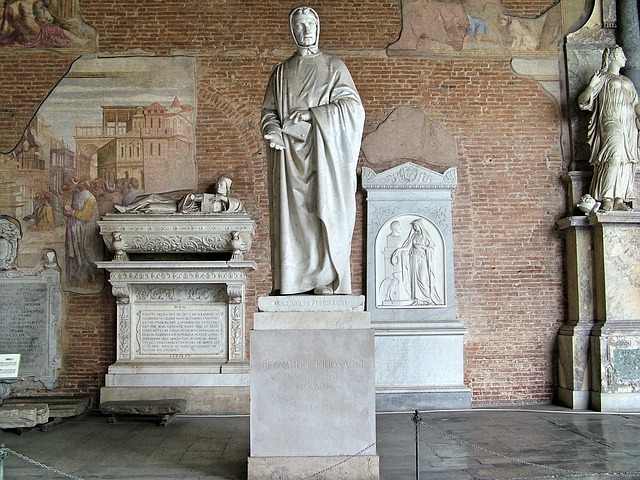
Monument of Leonardo Pisano (Fibonacci) by Giovanni Paganucci (1863) in the Camposanto di Pisa.{credit}Hans-Peter Postel, Wikimedia Commons{/credit}
For hundreds of years until the ebb of the Italian Renaissance, one name was synonymous with arithmetic. This was Leonardo — not the polymath from Vinci, but Leonardo Pisano (ca. 1170-1250), now popularly known as Fibonacci.
Yet we know little of Fibonacci’s life beyond the nickname and his Pisan roots: most details come from a 160-word autobiographical sketch written in 1202. He is often assumed to have discovered the so-called ‘Fibonacci sequence’, which starts with zero and 1 and is thereafter the sum of the two previous numbers (so 1, 2, 3, 5 and so on). The sequence shows up with astonishing frequency in natural spiral structures such as shells and plant tendrils.
Fibonacci did not, however, discover the sequence – it was recorded in Sanskrit at least as far back as 200 BC. Nor does the sequence explain anything about artistic beauty via the so-called ‘golden section’, as Keith Devlin reminds us in his new book Finding Fibonacci. The Pisan’s greatest legacy was to help Europe dump the ancient system of Roman numerals and switch to Hindu-Arabic numbers from 1 to 9 and, perhaps most importantly, 0, which Fibonacci called zephirum after the Arabic ṣifr. (Finding Fibonacci repeats some of Devlin’s arguments in his 2011 The Man of Numbers, and indeed is in large part a meta-narrative exploring the making of that earlier book.)

A page of Fibonacci’s Liber Abaci from the Biblioteca Nazionale di Firenze showing (in box on right) the Fibonacci sequence with the position in the sequence labeled in Roman numerals and the value in Hindu-Arabic numerals.{credit}National Library of Florence, Wikimedia Commons.{/credit}
During Fibonacci’s lifetime, much of Italy was part of the Holy Roman Empire, yet many Italian cities were in practice independent city-states. Pisa, Genoa, Amalfi and Venice had been gaining prominence as maritime powers, establishing trade routes across the Mediterranean. As commerce boomed, Italian merchants needed to keep track of finances efficiently. Roman numerals made multiplication and division extremely cumbersome (try dividing MXCI by LIII); they were no match for the 10-digit positional system invented by the Hindus some time before 700 AD and common in the Arab world. And compared to using, say, an abacus, calculations in Hindu-Arabic numbers also allowed an “audit trail”, as Devlin points out: “An individual sitting in Pisa controlling a network of traders needed to be able to review the financial books on a regular basis.”
To fill that need, in 1202 Fibonacci (the son of a notary working for Pisan traders) published Liber Abaci, a compendium of Hindu-Arabic arithmetic and its practical applications to trade. The 600-page book introduces the numerals and explains how to use them for basic calculations. Like every good maths textbook, it also features many practical problems, such as how to convert currencies (Italy alone had 28 at the time, Devlin notes), or puzzles such as this:
It is proposed that 7 rolls of pepper are worth 4 bezants and 9
pounds of saffron are worth 11 bezants, and it is sought how
much saffron will be had for 23 rolls of pepper.
Such problems may seem trivial to someone trained in modern elementary-school algebra, but the symbolic notation for equations with x’s and y’s had not yet been invented at the time, so all solutions had to be spelled out in words. As mathematician John Hannah wrote in his 2011 review of The Man of Numbers,“It is awe-inspiring to see how far medieval mathematicians could progress using such primitive tools.”
Liber Abaci was published in Latin, as was the norm for learned texts. But soon, ‘popular arithmetic’ books in local vernacular, many citing Fibonacci as their source, began to appear. These ‘abacus books’ became standard in schools; at least 600 were written over the next few centuries. Through these texts Italy, and later Europe, learned to do maths.
In Finding Fibonacci Devlin tells us (22 times) that Liber Abaci “changed the world”, comparing the medieval mathematician to tech giant Steve Jobs. He even contends that the book made Western science and technology possible. But although Liber Abaci seems to predate the vernacular abacus books, did it actually inspire them?
Devlin points out that Fibonacci had also written a shorter, simpler abacus book in the vernacular, intended for merchants. That is now generally considered to be lost. If this book could be found, he argues, it might turn out to be the “missing link” between Liber Abaci and the spread of popularized arithmetic texts that came later.
Medieval whodunit
In 2003, historian of mathematics Raffaella Franci discovered such a vernacular text, Livero de l’abbecho, from the late 1200s. Devlin centres both his books on the assertion that Franci concluded that this text was a copy of Fibonacci’s lost book; Devlin avers that it is a “slavish” copy. He states that thanks to Franci and subsequent studies by other researchers, “we can now say with historical certainty” that Livero de l’abbecho is indeed Fibonacci’s missing link.
But is this as certain as Devlin claims? Franci wrote to me: “I do not believe and I have never claimed that Livero de l’abbecho should be attributed to Leonardo Pisano.” She found evidence that Livero de l’abbecho was based on Fibonacci’s lost book — not that it was a word-for-word copy. Another historian of mathematics, Elisabetta Ulivi, adds that Livero cannot be an exact copy as it’s written in an Umbrian dialect, not Fibonacci’s Tuscan. And historian Jens Høyrup even disputes the importance of Livero and Fibonacci to the importation of Hindu-Arabic arithmetic.
Devlin emailed me that Livero “can be taken to be a fairly close copy” (in Finding Fibonacci he describes it as “a medieval equivalent of a photocopy”) of Leonardo’s lost book. “My duty as a writer of history is not to list the ‘facts’,” he added. “It is to present the best account I can.” Devlin did not respond to follow-up questions about why, in both his books, he describes his attribution of Livero to Fibonacci as “Franci’s conclusion”.
Still, Finding Fibonacci showcases Devlin’s writerly flair. My favourite passages are the incredible story of how Liber Abaci (or at least, the edition he wrote in 1228, the sole surviving one) became available in English for the first time – to this day the only modern-language translation. Mathematician Laurence Sigler had made it his mission to translate the book, rushing to complete the task right before he died of lymphocytic leukemia in 1997. But his editor moved on, and the manuscript languished on floppy disks for years. For a while Sigler’s widow Judith Sigler Fell, fearing the project would be killed, took the extraordinary step of impersonating her husband in communiqués.
By the time Fell found a new publisher, Springer Verlag (now part of the same publisher as Nature), floppy disks had been superseded and she had to hire a hacker to extract the files. Fell then discovered that Springer only accepted submissions in TEX format, the technical standard for physics and mathematics texts. She learned it and spent six months retyping the text. Fibonacci’s Liber Abaci was finally published in 2002 — the 800th anniversary of the book’s first appearance.
Davide Castelvecchi is senior physical sciences reporter at Nature. He tweets at @dcastelvecchi.
For Nature’s full coverage of science in culture, visit www.nature.com/news/booksandarts.