I have come to understand four very different time scales for development of technologies and their deployments. And I think people often jump between them and end up making outrageously wrong, and sometimes damaging, predictions of when in the future a technology is going to be able to do what.
Time scale 1. New Research Ideas
New research ideas take ten to twenty years to form before there is an understanding to bring them to really solid lab demonstrations. Some things take much longer as there are many, many false starts, or there is a really hard step which takes decades to crack.
Once things really have been established as a solid laboratory technology there is often a gold rush phase where major new tweaks, on essentially the same idea, come along every six months or so and it feels like the ground is shaking under us.

The first “computational” models of neurons were published in 1943 (McCulloch and Pitts), but it wasn’t until after a chain other models were tried, that a dominant variety became established in 1960 (Widrow), the linear threshold neurons that are recognizable as the “neurons” of today’s neural networks. Then years more work, were necessary to get to (1) good convolutional networks with (2) back propagation, allow for learning2 about objects anywhere1 in an image. And then it was twenty years until in 2012 (Hinton) the larger structure, the “deep” in deep learning, let trained neural network image labelling take over from conventional non-neural vision algorithms. Another decade on we got to today’s LLMs (Large Language Models), the thing that is getting the whole world in a tither. So this one was sixty years in the research making. And it was declared dead many times along the way, but a few brave, or stubborn, souls persisted.
Time scale 2. Hype generation
Often there are incredible hype cycles where we go from all but a small number of people having heard of the idea to it appearing daily in the business press. And all manners of researchers and companies re-market their work and claim that they have been doing it all along. Just look at how quickly “AI agents” went from nothing to decorating the sides of busses on the streets of San Francisco. None in mid 2025, and now today it is hard to find a bus that has any sort of AI ads on it that are not about agents. And they all have AI ads on them.

Then the hype dies down as new hype comes along. Above I’ve named a few. If you are 30 years old you may remember block chain and also the metaverse. Pretty much gone now. Computers are not heating up the world working the blockchain algorithm for bitcoin mining. Instead it is data centers for training LLMs — itself a new subject of hype, AI training. If you are a bit older you may well remember IBM Watson and even nanotechnology molecular machines. I remember when a maker of chinos had TV ads touting the nanotechnology that they had put in their pants (the ones there were selling). And if you are old enough to get social security payments you may remember expert systems which were going to capture all the knowledge of experts and let companies lay off their workers.
The problem is that many people not steeped in technology understanding may get confused between ongoing research and the hype about how it is going to change everything. Which it only very rarely ends up doing. Additionally, there are a lot of delusional people who really believe things that they say, but which are impossible due to such little problems like fundamental physics. The ratio of extraordinary hype events to actual extraordinary technologies is way too high.
Time scale 3. At scale deployment
The next time scale is driven by how long it takes to go from really solidly engineered product to mass adoption.
Software has zero marginal cost to manufacture more copies. You don’t really need much in the way of supply chains and raw materials to go from one copy of software running on one machine to having it run on thousands of machines, if they already exist.
But even so, software typically takes 20 years or more to scale up. Just because some interesting software exists it doesn’t mean that everyone is going to jump in and re-engineer their business to use it right now. Some people wait to see how well it works out for others. And other people just don’t want to change their existing business practices to adopt the new software.
Unix was developed at Bell Labs starting in 1969. Commercial versions of it were shipping 15 years later, but the dominant operating system was Microsoft Windows. Then a free open source version of Unix was developed starting in 1991, known as Linux. Every computer science graduate student had heard of Linux within five years of it being established, but it wasn’t until 2012 that it was adopted by Microsoft. Now most backend systems and billions of mobile devices run on Linux.
Hardware based systems take even longer to adopt at scale. I first sat through a talk showing a self-driving car running on a freeway outside of Munich back in 1987 (Dickmanns). It wasn’t until the DARPA Urban Challenge of 2007 that the idea of such cars being practical got into people’s consciousness. I first rode in a Waymo predecessor (when it was still at Google X) in 2012, out onto highway 101 and safely back to the office. Last night I rode in a Waymo in San Francisco. They are now licensed to operate about 4,000 vehicles in the city and they are the clear leaders in the US market. But the scale is tiny compared to the number of cars in San Francisco, let alone the whole of the US. Oh, and despite promising in the app to take to my house the Waymo didn’t — it dropped me off somewhere else despite me being on the line with “customer support” for over 20 minutes.

Getting things to work at scale is orders of magnitude harder than getting them to work at first and having your first few dozen satisfied customers. Scale has always taken Herculean effort.
However, people make the mistake of thinking adoption and scaling up the supply chains, the deployments, and the customer support will just happen. It doesn’t.
Time scale 4. Reshape the economy
The themes of the two biggest hype concentrations right now are the same. Replacing massive swaths of human labor with AI (LLMs to replace white collar labor) and robotics (humanoid robots to replace blue collar labor). Then everyone will somehow, magically, be so rich that the world will be wonderful. A new world economy. A new world order. A reshaping of the economy.
Many, many, many technologies have reshaped the world’s economy over the last few millennia, from domesticated animals to sailing ships in the ancient world, from domestic electrification to commercial air transportation to shipping containerization in the 20th century. But each of these things took over 50 years of continuous at scale deployment.
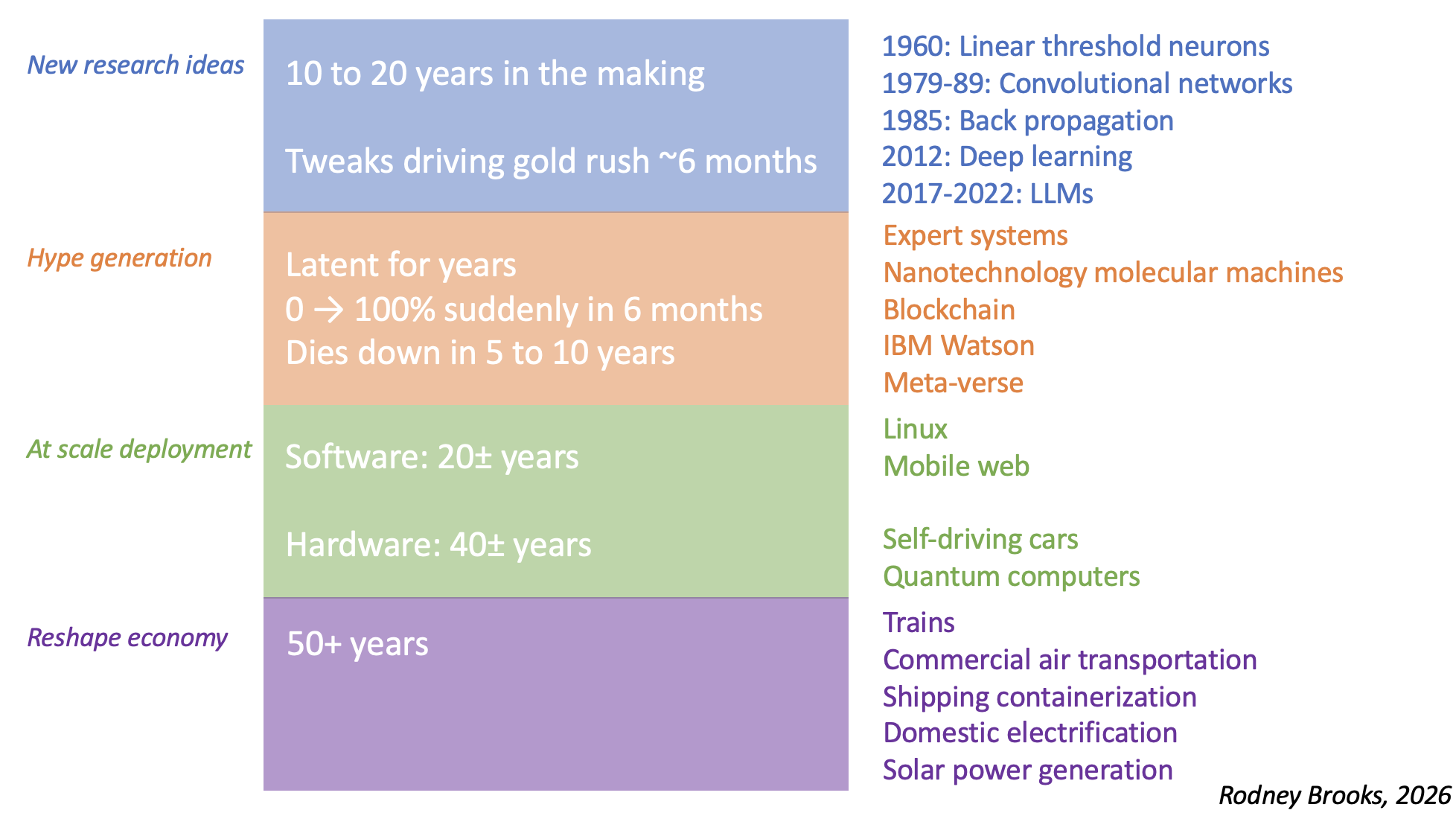
People think that when they hear about a new research result it is going to change everything. And then they believe the hype about how soon it will do so, as hype-notists manipulate capital markets thought their promises. Some things fail completely in the commercial world despite high hype levels (all the companies formed to commercialize Hyperloop have now shut down, and the Hyper-hype has quietly disappeared). And then, people think that it can change the world economy in one or two or ten years. It really does take decades, essentially a human lifetime (and there is a causal correlation), to deploy a technology at large enough scale that it reshapes the world’s economy.