
Americans are moving less than they used to. Moving rates have declined steadily for decades, falling from close to 20 percent annually in the mid-1980s to below 10 percent by 2019. This decline has persisted through business cycles and has been evident across all regions, and has affected a broad range of demographic groups. Falling mobility matters because moving helps households access job opportunities, adjust to changing circumstances, and improve their housing situations. In this post, we show that the decline in mobility also holds for renters, with growing challenges to owning a home being an important contributing factor. We use data from the annual New York Fed SCE Housing Survey to study renters’ expected mobility and the factors that shape it. Renter mobility is important as renters account for roughly a third of U.S. households and, unlike homeowners, are not subject to mortgage rate lock-in. Since expected mobility predicts actual moving behavior, it provides an early signal of where residential mobility is headed before moves occur.
Renters’ Expected 3-Year Mobility Fell 20 Percentage Points in the Last 12 Years
Notes: The chart shows the mean percent chance of moving to a different primary residence within the next three years, by owner/renter status.
The chart above shows the mean three-year probability of moving to a different primary residence for homeowners and renters over time. Both groups have seen a steady decline in expected mobility, with some acceleration in the decline after the pandemic. The mean three-year moving probability for renters fell from roughly 57 percent in 2014 to about 37 percent in 2026, while homeowners’ mean moving probability fell from about 21 percent to 14 percent over the same period. Relative to their initial levels, expected mobility declined somewhat more for renters than for homeowners.
Renters Are Less Likely to Expect Future Homeownership
For renters, moving can be closely associated with the decision to become a homeowner. In the SCE, we measure this by asking renters for the percent chance that they will ever own a home.
Renters Less Optimistic About Ever Owning a Home
Notes: The chart shows renters’ average reported percent chance of ever owning a home.
As shown in the above chart, renters’ average probability of ever owning a home declined from roughly 52 percent in 2015 to about 35 percent by 2025, with the decline especially sharp after 2021.
In the next chart, we show that the renters with reduced expectations about future homeownership are precisely the ones who do not expect to move in the near future. Renters who report a low probability of ever owning a home (0–20 percent chance) have a mean three-year moving probability of about 25 percent. This figure compared with about 76 percent among those who are nearly certain they will own (81–100 percent)—a difference of more than 50 percentage points across the distribution.
Renters Who Don’t Expect to Move Also Don’t Expect to Ever Own a Home
Probability of moving: 3-year, percent
Notes: The chart shows the correlation between the reported probability of ever owning a home and the probability of moving within three years.
These patterns raise a natural question: what is driving renters’ declining expectations of ever owning a home? Two explanations suggest themselves. First, renters may increasingly find homeownership unaffordable, due to perceptions of higher mortgage rates, home prices, and associated costs. Second, renters may simply no longer want to own a home as much as they once did—a shift in preferences rather than affordability. We examine each in turn.
Renters View Mortgages as Less Affordable
One key factor in renters’ path to homeownership is whether they can obtain a mortgage at an affordable rate. In the SCE, we ask renters how difficult they expect it would be to obtain a mortgage and what rate they expect to receive if they applied today. The next chart shows both measures over time.
Renters Perceive Mortgages as Increasingly Difficult to Afford as Interest Rates Increase
Proportion of getting mortgage would be very difficult, percent
Mortgage rate they would receive, percent
Source: Survey of Consumer Expectations Housing Surveys, February 2014 through February 2026.
Notes: The left panel shows the share of renters who report that obtaining a mortgage would be very difficult. The right panel shows the median mortgage rate that renters believe they would receive if they applied today.
Both measures suggest that mortgage access has felt more difficult and more costly for renters in recent years. The share who report that obtaining a mortgage would be very difficult hovered around 27 percent in 2021 but rose sharply to over 45 percent by 2024. At the same time, the median mortgage rate renters expect to receive if they applied today increased from about 3.3 percent in 2021 to nearly 6.8 percent by 2024—more than doubling over three years.
We next examine how renters’ expected mobility varies with their perceptions of mortgage affordability. The chart below shows that renters who view mortgage access as more difficult or expect higher mortgage rates tend to report lower expected mobility.
Renters Who Expect High Mortgage Rates Are Less Likely to Move
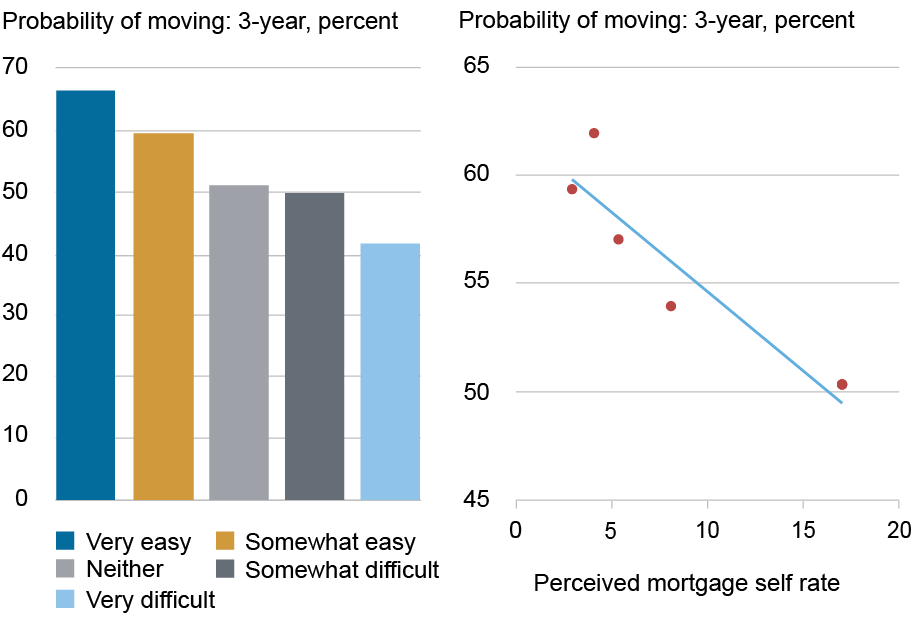
Notes: The left panel shows the mean three-year probability of moving by renters’ perceived ease of obtaining a mortgage. The right panel shows a binned scatterplot of the three-year probability of moving against renters’ expected mortgage rate if they applied for a mortgage today. Each point represents the mean probability of moving within three years for a given quintile of the perceived mortgage rate for self today distribution; the solid line displays a linear line of best fit.
In the left panel, renters who say obtaining a mortgage would be very easy report a mean three-year moving probability of about 66 percent, compared with about 42 percent among those who say it would be very difficult. The right panel shows a similar pattern for expected mortgage rates. Renters expecting higher mortgage rates report lower moving probabilities, with the mean moving probability falling from about 60 percent among those expecting a rate near 3 percent to about 54 percent among those expecting a rate near 8 percent. Although these comparisons do not control for differences across renters, such as credit scores, or for changes in economic conditions over time, they suggest that affordability perceptions are closely related to renters’ moving plans.
Renters Still Prefer to Own a Home
Another possible explanation for renters’ declining expected mobility is that they no longer want to own a home as much as they once did. To examine this, we ask renters whether they would prefer to own a home if they had the financial resources to do so—a hypothetical question that separates preferences from affordability—and whether they view homeownership as a good investment.
These measures have been broadly stable since 2015. The share of renters who say they would prefer or strongly prefer to own a home if they had the financial resources has fluctuated narrowly between 65 and 74 percent since 2015, standing at about 65 percent in 2026. The share who view homeownership as a good or very good investment has similarly remained in the 51 to 68 percent range since 2015. These patterns suggest that renters’ growing pessimism about ever owning a home—and their lower expected mobility—reflects affordability constraints rather than a weakening desire for homeownership.
What These Patterns Suggest
The decline in renters’ expected mobility coincides with a growing share of renters believing that homeownership is increasingly out of reach. Renters increasingly report that obtaining a mortgage would be very difficult and expect higher rates if they applied for a mortgage today. These affordability perceptions are associated with renters’ moving plans, although they are only one contributing factor shaping expected mobility. More broadly, our results highlight that housing affordability may be one factor behind declining expected mobility among renters.
Christopher Gresh, a former research analyst in the Federal Reserve Bank of New York’s Research and Statistics Group, is a Ph.D. candidate at Princeton University.

Andrew F. Haughwout is a research advisor emeritus in the Federal Reserve Bank of New York’s Research and Statistics Group.

Eungik Lee is a research economist in the Federal Reserve Bank of New York’s Research and Statistics Group.

Wilbert van der Klaauw is an economic research advisor in the Federal Reserve Bank of New York’s Research and Statistics Group.
How to cite this post:
Christopher Gresh, Andrew F. Haughwout, Eungik Lee, and Wilbert van der Klaauw, “Why Do Fewer Renters Expect to Move?,” Federal Reserve Bank of New York Liberty Street Economics, August 6, 2026, https://doi.org/10.59576/lse.20260806
BibTeX: View |
@article{GreshHaughwoutLeevanderKlaauw2026,
    author={Gresh, Christopher and Haughwout, Andrew F. and Lee, Eungik and van der Klaauw, Wilbert},
    title={Why Do Fewer Renters Expect to Move?},
    journal={Liberty Street Economics},
    note={Liberty Street Economics Blog},
    number={August 6},
    year={2026},
    url={ https://doi.org/10.59576/lse.20260806}
}
Disclaimer
The views expressed in this post are those of the author(s) and do not necessarily reflect the position of the Federal Reserve Bank of New York or the Federal Reserve System. Any errors or omissions are the responsibility of the author(s).