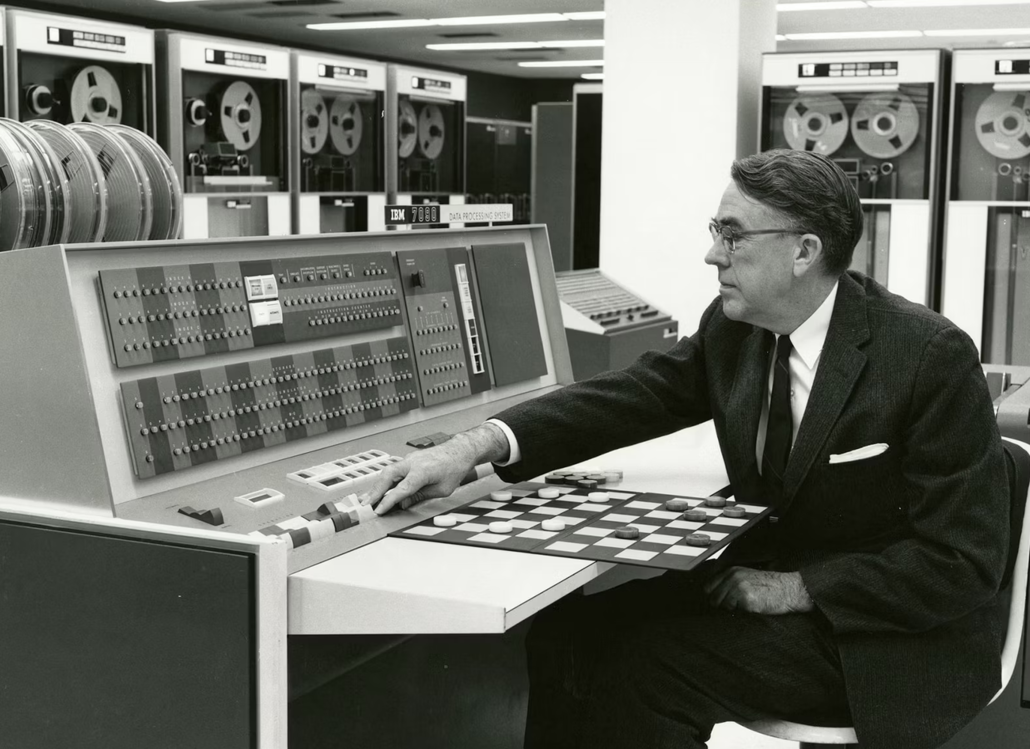
 Samuel playing against the IBM 7090. Source: IBM
Arthur Samuel started out working on vacuum tubes at Bell Labs in the 1930s. In 1946 he became a professor at the University of Illinois. Wanting to get a computer for the university, he came up with a proposal to build one, and for it to run a program that could play checkers. He started planning for it on paper, but both it and the computer were not finished when he left in 1949 to work at IBM.
There his main role was on vacuum tubes and later transistors, but the problem of checkers still intrigued him. He worked on it using the IBM 70x series of machines - according to a letter to a computer magazine journalist in 1979, it was written initially in raw machine code as even an assembler was not available for the IBM machine yet. A first version was ready in 1952, but
It was not until 1954, with the advent of the IBM 704 that my program was able to play an interesting game. My contribution was to add learning to the program, and I believe that I can claim a first for this.
In 1956 the program was demonstrated on TV and caught the imagination of the public. Eventually it was able to play games at a level that could sometimes challenge a master player.
Using techniques such as minimax, alpha-beta pruning and rote learning, his work was influential in the early years of AI; Samuel was present at John McCarthy's 1956 Dartmouth workshop and his work was included in Feigenbaum and Feldman's seminal 1960s overview of AI, Computers and Thought.
He retired from IBM in 1966 and came to SAIL as a senior member of staff. Here he helped with many of the lab's projects, and also ported his IBM 7090 assembly program to PDP-10 assembly language. The version we have running today is from 1972.
 Checkers running on WAITS. Source: Rupert Lane. License: CC0.
He picked it up again in 1976 due to interest from other researchers, and played against a team at Duke University who had a new program running on an IBM System/360. Two games were played, but not to completion due to the amount of CPU time needed. According to an account by Samuel:
it was believed that the Duke program had a possible win in both games. Subsequent analysis reveals that one of these games might still lead to a draw.
Also in 1977, he worked with the makers of the VideoBrain Family Console to develop a version of checkers for this early home computer. This was a cut-down version, as the system only had 1KB of RAM, but offered four different levels of difficulty. He also helped on the AI for the VideoBrain version of Reversi/Othello, Vice Versa.
 VideoBrain checkers program and manual. Source (l) atariprotos.com (r) archive.org