“I know we’re all anti-AI here,” a friend texted in the group chat. “We should co-write an article on how AI has no place in education,” a professional acquaintance suggested during a collaboration session.
This was becoming an awkward time to announce my return to AI… specifically, to focus on AI in education. My friends are right. There is a lot that is terrible about AI. Part of why I haven’t written a blog post in the last 5 months is that I feel so discouraged by how over-saturated the internet is now with writing by and about AI. I still spend weeks and sometimes months researching and writing my posts, but fewer and fewer people even see them in a world awash in slop. Execs make claims about AI capabilities that are so overhyped they verge on fraud.
People of all ages are outsourcing their thinking to AI. However, skills atrophy when you stop using them, and reading, writing, and understanding texts are core parts of being human.
Professor friends share how widespread AI use has upended their curricula, with students submitting essays generated by AI, or reading scripts generated by AI for their presentations. Maintainers of open-source code repositories are flooded with low-quality pull requests of AI-generated code.
Most AI-powered education products are terrible, chasing after gameable metrics. Rather than entice kids to get absorbed in real novels, one AI-powered school shows kids AI-generated passages and then quizzes them with AI-generated multiple choice questions. Other AI education products are downright scams, such as the one that Los Angeles Unified School District wasted $3 million on before the founder was charged with fraud and identity theft.
A decade of AI worries
I have spent a decade worrying about where AI was headed. In 2016, Jeremy Howard and I co-founded fast.ai, inspired by the power of neural networks and alarmed by the direction of the major AI companies.
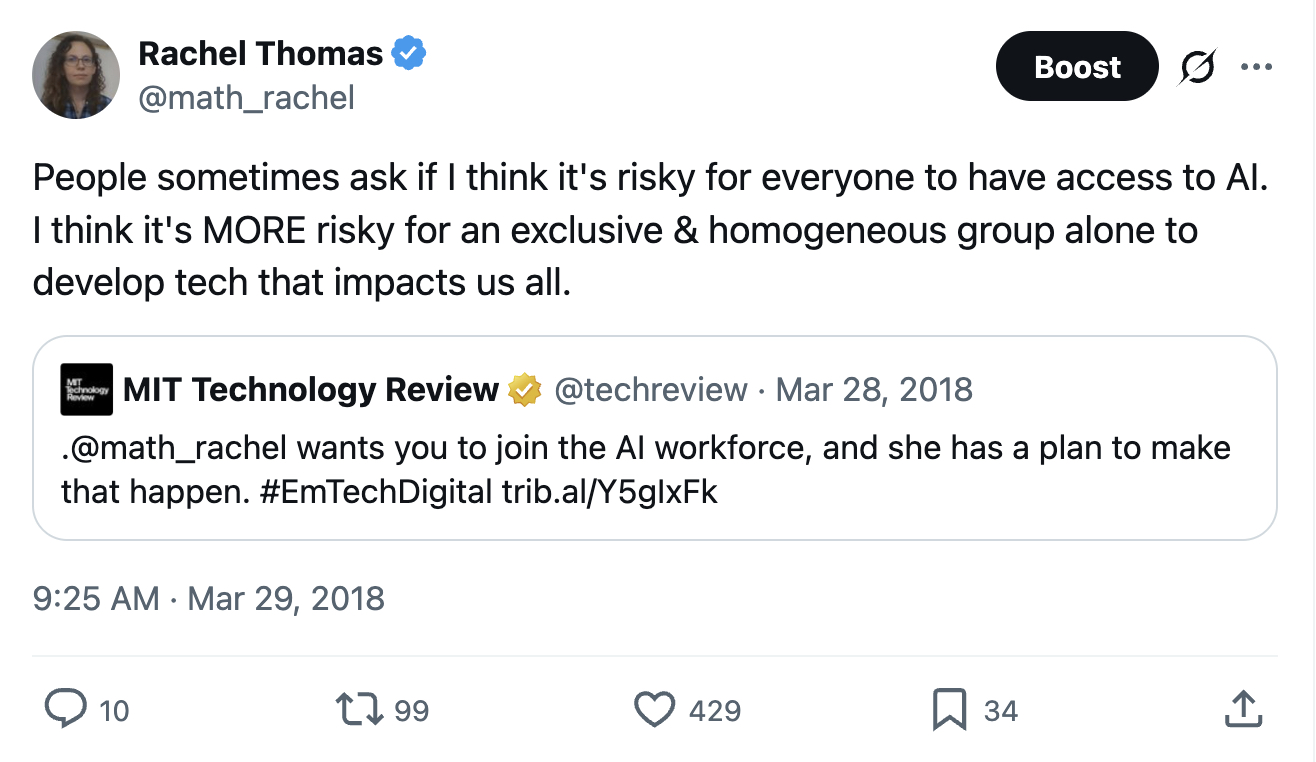
Ten years ago, AI development was the domain of a small, homogeneous elite group making decisions with wide-ranging impact. We tried to counter that concentration of power by getting a more diverse group of people with unlikely backgrounds involved in the field. And yet today, a handful of billionaires running the top AI labs hold more power than ever before.

The big AI labs behaved as though computing power and money were limitless. Most of the world cannot afford that assumption. Jeremy and I wanted researchers to treat constraints as a source of creativity, rather than something they could spend their way around.

I wanted ethics to be part of how data scientists were trained, rather than an optional discussion after the technical work was done. At the University of San Francisco, I founded the Center for Applied Data Ethics, created a data ethics course, and we made it a requirement for the MS in Data Science program. Yet AI ethics is still often treated as a marketing exercise, or focuses on theoretical questions over actual human suffering.
Returning to AI
After years working in AI, I burnt out. I was exhausted by the effort of pushing back against companies with vastly more money, power, and reach. I hated watching the field move further in the direction I was trying to resist. In 2023, I left the field and returned to school to earn an MS in Microbiology-Immunology. Yet last year, just as the public backlash against AI was growing stronger, I decided to return to an increasingly hated field.
Why? The AI haters have many good points. AI is degrading the blogging ecosystem, my email inbox, the schools my friends’ children attend, open-source code, and more. AI companies are pretending that resources are unlimited, even as the climate crisis forces us to reckon with shortages of clean air and clean water.
There are tons of false and over-hyped claims about what AI can do, but underneath those, it is a genuinely useful technology. I want to use AI in ways that don’t degrade my own critical thinking skills and that don’t pretend that resources are unlimited.
While I was away, fast.ai had grown into Answer.AI. Jeremy and the team are continuing the work we began a decade earlier: making powerful technology available to more people while centering human judgment and autonomy.
They had built SolveIt, a tool where people can directly edit the AI’s responses and decide for themselves what to do next. Its design treats AI as fallible and keeps the human in control. Joining Answer.AI was a return to the work Jeremy and I had started together and to the desire to make a difference.
SolveIt takes its name from George Pólya’s 1945 book, How to Solve It. Pólya divided problem-solving into four stages: understand the problem, devise a plan, carry out the plan, and look back at the result. Each stage requires you to think and exercise judgment.

When chatbots rush from your initial request to a finished answer, you skip the work through which you come to deeply understand the problem. Without having done this thinking, you cannot judge whether the solution is any good, and you will be less prepared for the next problem that builds on it. SolveIt is explicitly designed to be the opposite of an overly “helpful” chatbot.
AI is not one thing
The biggest companies have made their vision for the technology seem like the only option. It isn’t. OpenAI, Anthropic, Google, and xAI don’t own AI. Their values and decisions aren’t the only version of what AI technology can be.
There are many issues that will shape the forms that AI ultimately takes. Will open source be protected? Will the major AI labs block the development of a robust ecosystem of small companies building atop their work (e.g. Anthropic announcing plans to charge more for use of its SDK than for using its web app)? Will tools be designed to encourage human collaboration, or just to automate as much as possible?
Thousands of people around the world are working on AI outside of the dominant narrative, in ways that embrace their own values. Answer.AI’s work on SolveIt is just one example.
I understand why many people are anti-AI. My new job is rooted in the same objections. I returned to the field because I want to figure out how to use AI in ways that protect human creativity, autonomy, and problem-solving.