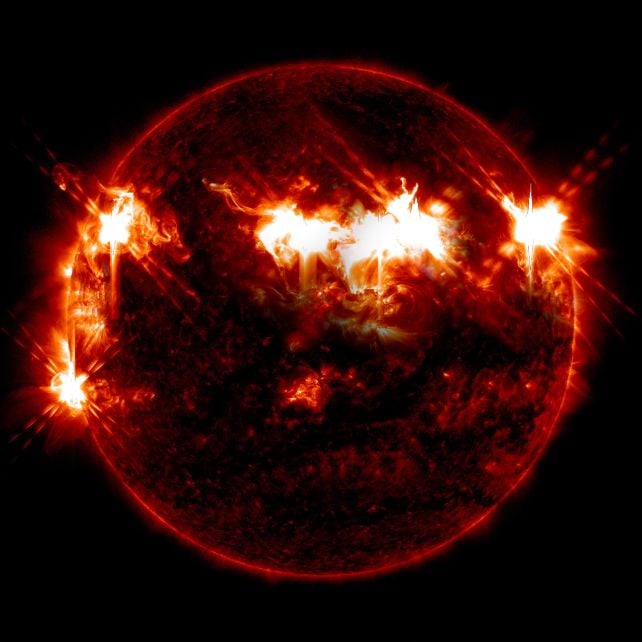
In November 2025, Earth was buffeted by several massive eruptions of solar material that slammed into the magnetosphere.
For many, the result was wonder. Much of the world watched in awe as a solar superstorm lit up Earth's skies with dazzling auroras to rare low latitudes.
The sword, however, was double-edged. The same storm also wrought havoc on the technology we rely on here on the ground.
And now, scientists led by space physicist Endawoke Yizengaw of The Aerospace Corporation in the US have discovered that the disruption was stranger – and more widespread – than anyone realized.
In a new analysis of data collected during the storm, the researchers found widespread, coast-to-coast disturbances in the atmosphere across the continental US – a phenomenon that has never been seen before on this scale.
That may not seem like much, but the effects of this would have been profound – throwing GPS off by more than 10 meters (33 feet) in some places. That's significant enough to disrupt precision agriculture and autonomous vehicles, the researchers say.
"The results underscore the importance of accurate understanding of various space weather phenomena to enhance our predictive capabilities through coordinated observations and physics‐based modeling and ultimately reducing disruptions to RF applications during space weather events," they write in a paper published in Geophysical Research Letters.
The impact of solar outbursts on human technology is already well known. Solar flares, which unleash powerful bursts of X-rays and ultraviolet radiation, can slam into Earth's upper atmosphere, temporarily disrupting high-frequency radio communications.
Solar storms are a bigger problem. A coronal mass ejection belches out a cloud of high-speed charged electrons and protons across the Solar System; when it slams into Earth's magnetosphere, it can generate electrical currents that disrupt power grids, change the shape of our atmosphere, and interact with atmospheric particles to generate the auroral glow.
The effect Yizengaw and his colleagues investigated is produced in a similar way. During a geomagnetic storm, energetic particles can rain down into the ionosphere, a region GPS signals have to travel through.
This mixing and roiling can create density fluctuations in the upper atmosphere. Think of an antique window pane, where the glass is unevenly distributed. Light traveling through that glass can distort and magnify the image it carries, so you see a skewed representation of the world outside.
Similarly, radio signals traveling through the lumpy ionosphere can become distorted and diffracted, causing their strength to fluctuate rapidly by the time they reach a ground receiver. This effect is known as amplitude scintillation.
Ionospheric scintillation isn't unusual, particularly towards the poles and around the equator. The mid-latitudes, however, are generally considered relatively calm and safe when it comes to this particular space-weather hazard.
The November 2025 superstorm said PSYCH.
As the storm intensified, the auroral oval expanded towards the equator, bringing the atmospheric chicanery usually associated with higher latitudes along for the ride.
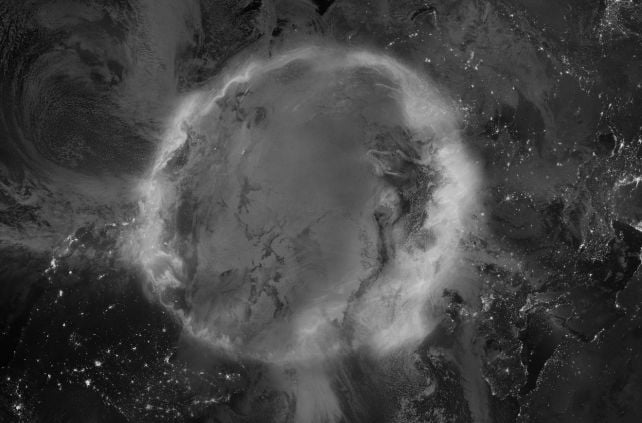
Yizengaw and his colleagues pieced together what happened using observations from multiple instruments across North America, including aurora cameras and a network of ground-based Global Navigation Satellite System (GNSS) receivers.
They saw a huge band of enhanced electron density stretching east to west across the ionosphere. Along its edge, the electron density changed sharply, creating conditions perfect for the formation of smaller-scale irregularities.
And those irregularities were everywhere.
Strong amplitude scintillation appeared across a vast swathe of the continental US, from roughly 80 to 120 degrees west longitude.
Other measurements showed the disturbance extended even farther, producing a strip of enhanced electron density that reached almost from the West Coast to the East Coast.
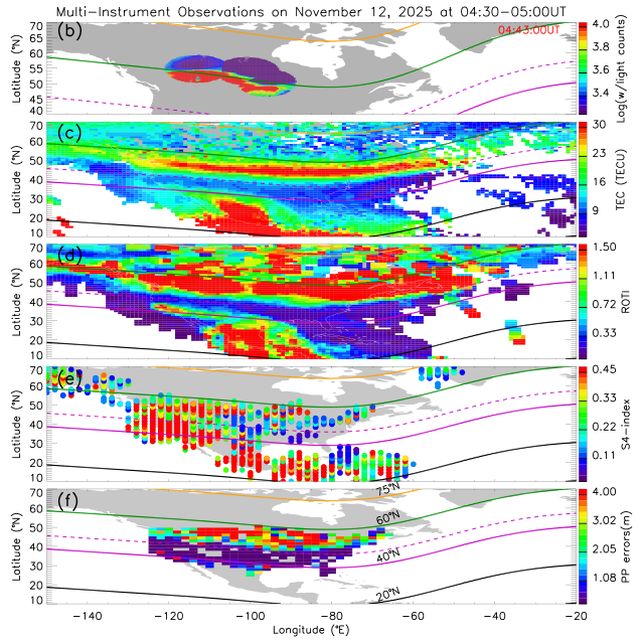
The timing lined up, too. The researchers saw that, as the aurora brightened, electron density and irregularities intensified. At the same time, satellite signals began to scintillate, and GPS accuracy deteriorated.
Amplitude scintillation has been detected at mid-latitudes before, but only in limited observations, mostly at individual locations. Strong amplitude scintillation spanning such a wide range of longitudes has never been seen before, the researchers say.
In some regions, the resulting horizontal positioning errors exceeded 10 meters. Even an error of just one or two meters can spell serious trouble for technologies that depend on precision positioning, including autonomous vehicles and agricultural machinery.
Indeed, the solar storm of May 2024 is estimated to have cost the US agricultural industry $500 million due to disruptions in precision navigation.
The November 2025 superstorm is unlikely to have cost anywhere near the same amount, which really highlights the sheer dumb luck of the draw. The 2024 storm happened during the farming season; the 2025 one did not.

Together, however, the two events indicate how vulnerable certain industries can be to the vagaries of the Sun at the peak of its 11-year activity cycle.
Related: The Most Violent Solar Storm Ever Detected Hit Earth in 12350 BCE
But if scientists can better understand and predict how extreme solar activity affects the ionosphere, we may be better prepared to mitigate the disruption when the next big storm arrives.
"If the November superstorm onset had occurred during farming season in the American sector, it could have led to significant losses for the American farming and transportation industries," they write in their paper.
"Hence, understanding the storm time high‐ and mid‐latitude irregularities – and characterizing their impact on radio-frequency applications – requires knowledge of physical processes that control and describe the dynamics of auroral features, such as energy flux, expansion velocity, and precipitation scale sizes present in the auroral arc, all of which contribute to generating density irregularities that can cause scintillation."
The analysis has been published in Geophysical Research Letters.
This article was fact-checked by Fiona MacDonald and edited by Fiona MacDonald. While we pride ourselves on our process, we are only human. If you spot a mistake, please let us know.