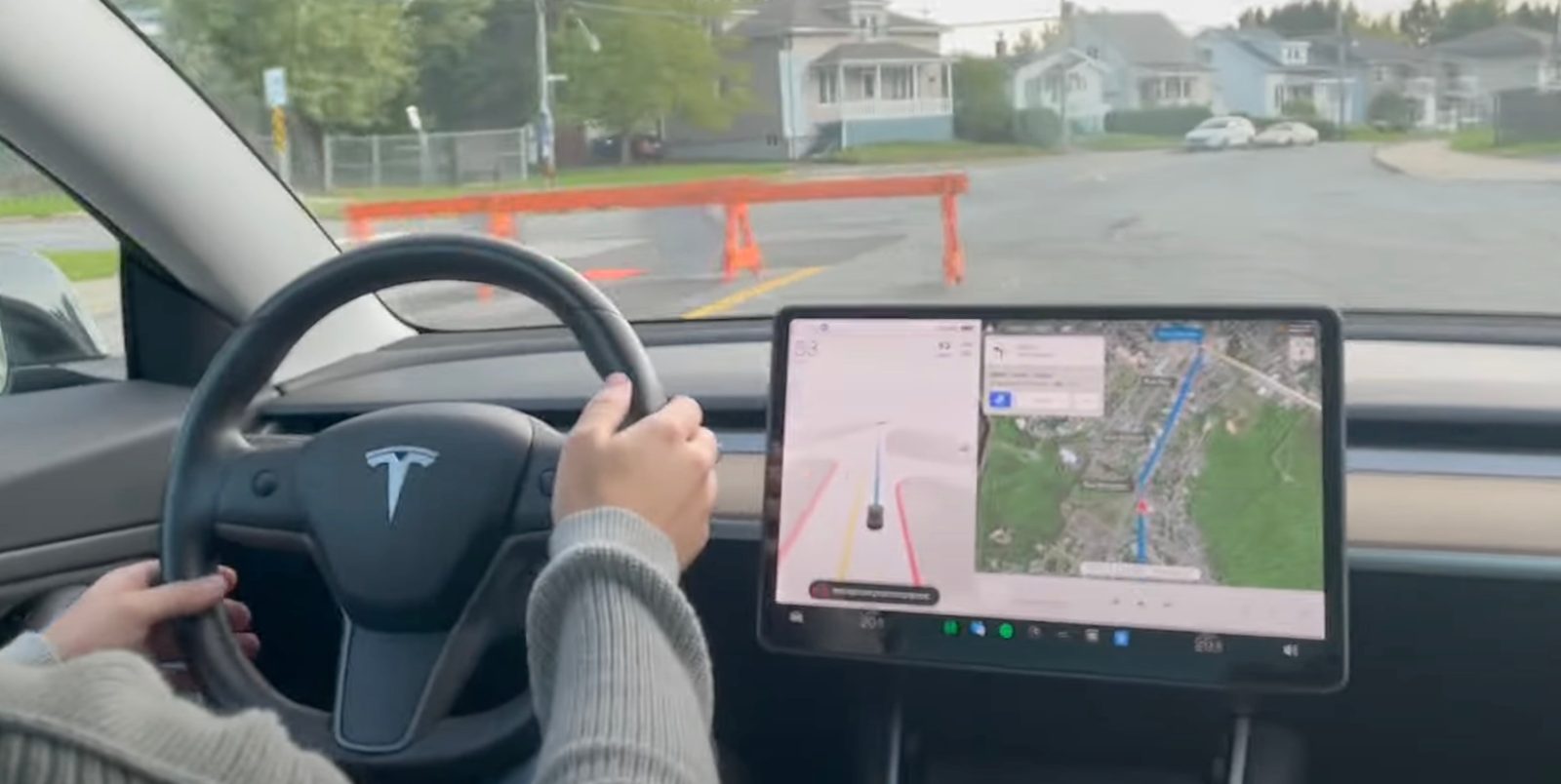
A Tesla Model 3 ran a stop sign in Buena Vista Township, New Jersey, and hit a Honda Civic turning left through the intersection. The Civic’s driver, 82-year-old Stephen Field, was killed.
Police reported it as a car that failed to stop. What no one reported is that Tesla’s own data says the car’s driver-assist system was engaged. This is part of an ongoing Electrek investigation matching reported crashes to Tesla’s redacted NHTSA data.
What happened at Route 671 and Chestnut
Around 6:57 p.m. on Sunday, July 6, 2025, New Jersey State Police troopers were called to the intersection of County Route 671 and Chestnut Avenue in Buena Vista Township, in Atlantic County. A Tesla Model 3 failed to stop at a stop sign and struck a Honda Civic that was making a left turn, NJSP spokesman Jeffrey Lebron said.
Field, the Civic’s driver, suffered fatal injuries. The Tesla’s driver and three passengers were hurt and taken to a hospital with moderate injuries. The crash is still under investigation.
The handful of local reports described it as a Tesla that ran a stop sign. None mentioned Autopilot, “Full Self-Driving,” or any driver-assist system. As far as the public knew, this was an ordinary human-error crash.
What Tesla told the federal government
It wasn’t. Under a NHTSA Standing General Order, automakers must report crashes where a Level 2 driver-assist system was engaged within 30 seconds of impact. Tesla filed a report on this one.
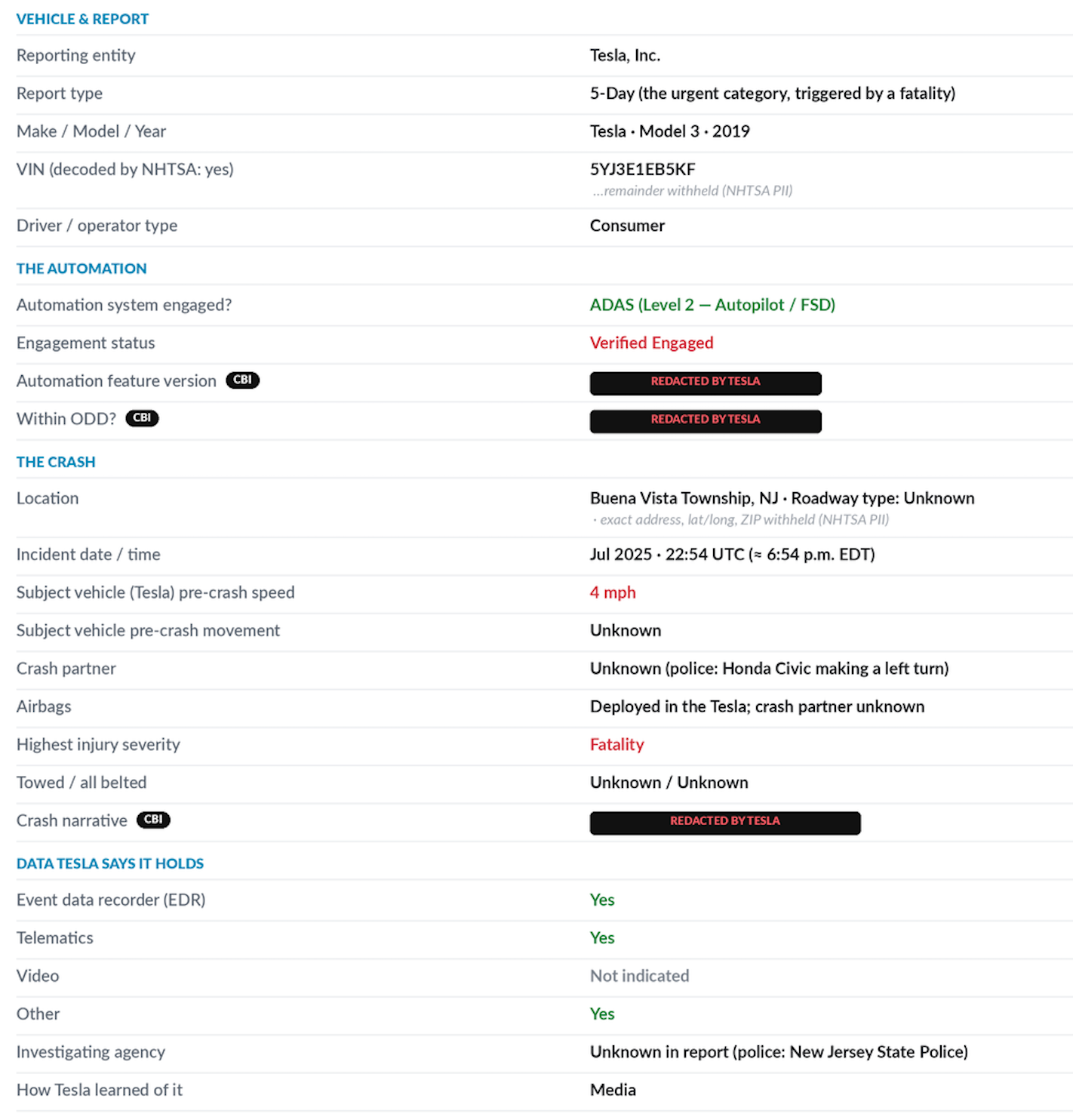
In it, Tesla identifies the car as a 2019 Model 3 and marks the automation “Engagement Status” as “Verified Engaged” — meaning it confirmed through its own telematics that the system was active. It logs a fatality, and it says it holds the event-data recorder and telematics from the car.
Then it redacts the three fields that would explain what happened: the crash narrative, the software version, and whether the road was within the system’s approved operating area. All blacked out as “confidential business information,” the same redactions Tesla applies to 99.9% of its reports.
Autopilot or “Full Self-Driving,” and why the stop sign points to FSD
Because Tesla redacted the software version, we can’t say for certain whether this was basic Autopilot or “Full Self-Driving.” But the intersection points to FSD.
Reading a stop sign and deciding whether to stop is a City-Streets function, and that’s FSD. Basic Autopilot is built as a highway lane-keeping system, and it does not respond to stop signs. So a driver-assist car verified engaged as it ran a stop sign was, most likely, running FSD.
That’s not a certainty. We’ve documented Teslas on basic Autopilot reaching intersections it was never meant to handle and blowing straight through them, because the driver engaged it on a road it doesn’t belong on and the system did nothing about the stop. Either way, the point cuts against Tesla: one system isn’t supposed to handle stop signs, and the other is the one Tesla sells as self-driving.
If it was FSD, there’s a second possibility worth putting on the table, and we’ll be clear that it’s a theory. In the fatal Katy, Texas crash, where an FSD Tesla left the road and killed a woman in her own home, Tesla moved fast to release data, which is unusual for an FSD crash, and said the driver had overridden the system by pressing the accelerator. We floated a theory then that we’ll repeat here: drivers using FSD in neighborhoods full of stop signs sometimes rest a foot over the accelerator, ready to press it and hurry the car through slow stops. That habit invites pedal misapplication, hitting the accelerator instead of the brake at exactly the wrong moment. It’s speculation. But it’s the kind of thing the redacted narrative and the EDR would settle in a sentence.
There’s one number in the report that keeps that question open. Tesla logs the Tesla’s pre-crash speed at just 4 mph — a near-stop, which fits a rolling stop far more than a car barreling through an intersection. It’s the same behavior NHTSA pushed Tesla to recall roughly 54,000 cars over in 2022, when “Full Self-Driving” was rolling through stop signs instead of stopping. A 4 mph reading also doesn’t square cleanly with a fatal impact and the Tesla’s airbags going off, so it’s likely a snapshot from the pre-crash data rather than the speed at impact. Which number tells the real story is, again, in the paragraph Tesla sealed.
Why we are reporting on this
Tesla is, more aggressively than ever, encouraging owners to treat a Level 2 driver-assistance system as if it drives itself. It sells the software as “Full Self-Driving,” Elon Musk keeps promising unsupervised autonomy is months out, and the branding invites drivers to trust the car.
But it is still Level 2. The human is driving and responsible at all times, and Tesla’s own actions confirm it: consumer FSD still requires supervision, and its robotaxi service is a small, closely monitored fleet. The technology is not what the name says it is, and that gap breeds the complacency that gets people killed.
The redaction makes it worse. At the moment, Tesla is telling owners to trust the car, it’s hiding the records that would show how the system actually behaves when things go wrong. What’s now confirmed here is narrow and important: Autopilot or “Full Self-Driving” was active in a crash that killed a man. Everything that would explain how, regardless of the blame, Tesla blacked out.
How we matched it: the NHTSA record is unredacted on location (Buena Vista Township), state, vehicle (2019 Model 3), the fatality, and the month. Tesla logs the incident time as 22:54 UTC, which converts to 6:54 p.m. local, within three minutes of the 6:57 p.m. NJSP reported. It’s the only fatal Tesla crash in that township that month. It’s the same crash. Electrek has reached out to the New Jersey State Police for the crash report and the vehicle data, and asked whether investigators received Tesla’s raw telemetry or only Tesla’s own interpretation of it.
Electrek’s Take
As usual, and to be fair, probably more than Tesla deserves at this point, we’re careful about what we’re claiming. We don’t know that the system caused this, whether it was FSD or Autopilot, or what that 4 mph really represents. That’s the point. Tesla knows all of it. It has the EDR and the telematics, it filed the report confirming the system was engaged, and it decided that what its car did in a fatal crash is a trade secret. A stop sign is not complicated. Whether a self-driving system read it and rolled through it anyway is exactly the kind of thing the public, the family, and the troopers still investigating this deserve to know.
Tesla is already under NHTSA investigation over how it reports these crashes. We’ll keep matching them, one by one, until the record is whole.
If you’re driving a Tesla, powering it with home solar is one of the cheapest ways to cut your fuel costs to almost nothing. With electricity rates up almost 10% last year and expected to keep climbing, going solar is one of the best ways to protect yourself against rising costs. And with lease and PPA options, you can do it with zero upfront cost and start saving immediately. If you want to find the best deal, check out EnergySage. It’s a free service with hundreds of pre-vetted installers competing for your business, so you save 20 to 30% compared to going it alone. No sales calls until you pick an installer. Get your free quotes here.
FTC: We use income earning auto affiliate links. More.