
At long last, the memory bubble may be finally bursting.
According to Jason Chen, chairman and CEO of Taiwanese PC and IT hardware giant, Acer, prices for memory chips will start reversing in the latter half of next year, dismissing the memory cartel pardon Big 3 claim that chip prices will keep rising well beyond 2027, and bucking the popular narrative which expects no declines in chip prices for the foreseeable future.
According to United Daily News, Chen said that only high-end DDR5 parts like LPDDR5X-9600 and niche CPUs like Nvidia’s N1 and N1X chips are in short supply. Since supplier pricing lags consumer pricing by about a few months, he added that PC prices will still rise between 5% and 20% towards the end of this year, plateau by the first half of 2027, before finally declining after years of AI-drive hikes.
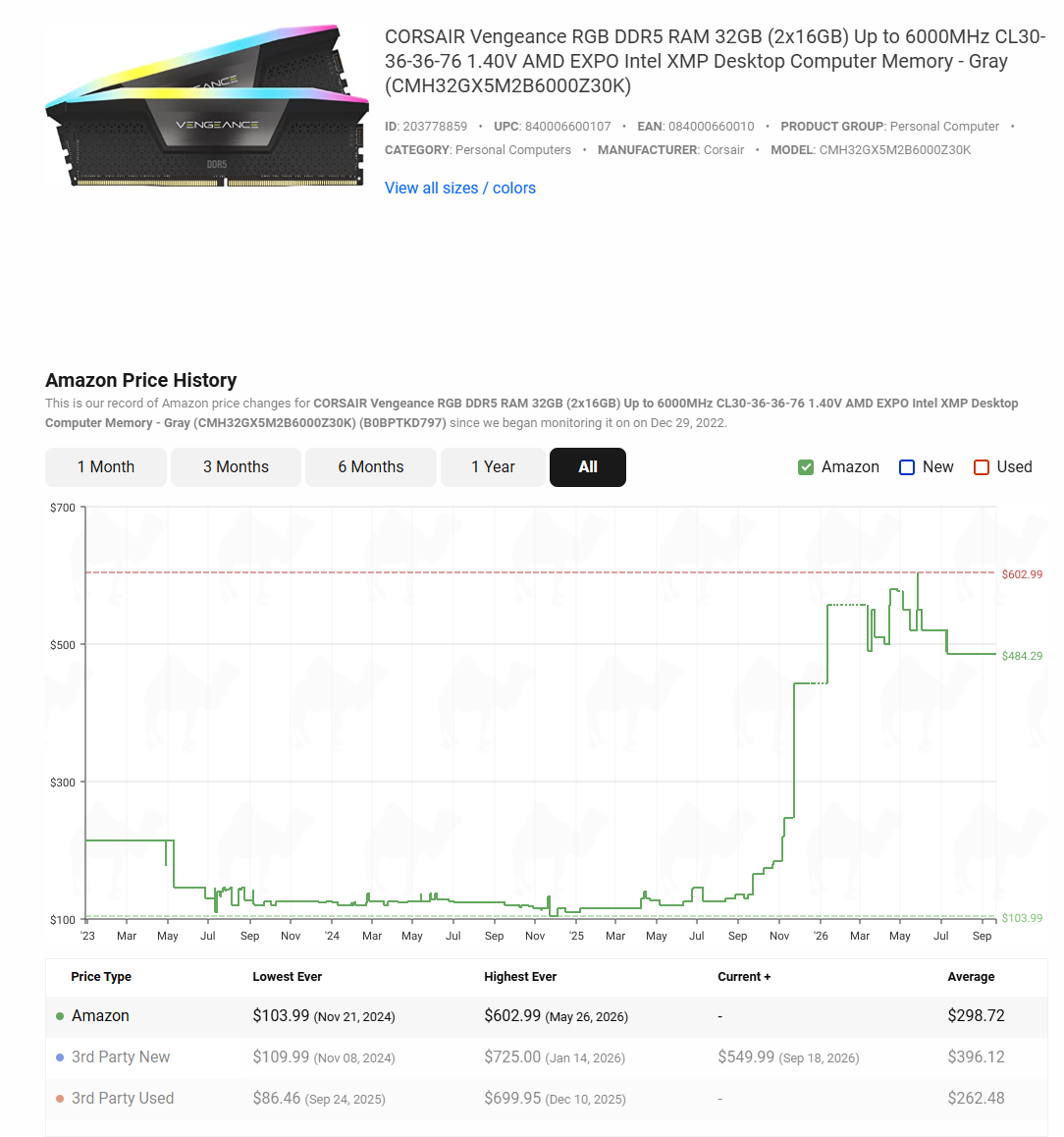
The AI boom has driven shortages for various PC components, beginning with GPUs in late 2022, before expanding to memory chips by late 2025. This made memory prices climb 500% in 12 months, although the increases have finally cooled as consumers refuse to absorb further hikes.
Some memory companies like SK Hynix are saying that the shortage will be worse next year and that it won’t be until 2030 before pricing will start to normalize. The Adata chief even said that the DRAM shortage would last another 10 years. This is plausibly true, especially as HBM demand from AI hyperscalers remains strong, and the various memory chip fabs under construction aren’t expected to come online until the 2030s.
However, Chen disagreed with this take. He said that the major memory suppliers naturally want to keep their margins as high as possible for longer, and the reason memory makers keep coming out and saying "the price uptrend will continue into 2027" is that antitrust rules prevent them from coordinating prices directly, so they use public statements to send a kind of "signal" to one another “so they keep putting out the message: let me tell you, prices won’t come down until the year 20-whatever.”
The Acer chairperson argued that there’s already ample memory and SSD supplies, while the purported CPU shortage is now limited to specific models: "No. How could it stay short forever? Chinese capacity keeps coming onto the market. The supply shortage problem has already completely disappeared."
Chen also expects the cost of the SSDs and memory Acer holds in 2027 to be lower than this year. If that gets reflected in end product prices, he sees a possibility that prices at least stop rising and stabilize in the second half of next year. The Acer CEO said prices could be raised further in Q1 27 as well. But since this is a period of pricing chaos, he expects the size of the increases to gradually shrink. He estimates component prices could peak around the middle of 2027, when the capacity that chipmakers have added is expected to start running in earnest.
After that, prices would stabilize, and whether they can actually come down in the second half remains to be seen. He admitted, though, that nobody can know the exact timing of the reversal. Chen said PC selling prices coming back down is strictly "a hope."
He also added that Chinese memory makers churning out cheaper alternatives would disrupt the market - something that SK Group Chairman Chey Tae-won feared. In fact, Acer, alongside HP and Asus, has started using CXMT chips in some of its products, while some Lenovo models sold in Germany were found to have YMTC SSDs.
Nevertheless, he said that price increases are becoming their own trend, saying that SSDs, PCBs, and fiberglass cloth used in motherboards are seeing their own hikes. “A lot of people come and tell us they want to raise prices, and we find it a bit baffling — this needs to go up, too?” Chen said to the reporters.
He wrapped up by saying this chain of price hikes creates inflation (according to Goldman, rising memory prices will push core PCE higher by 0.5%) which in turn pushes central banks to raise rates, and that "this is not a normal phenomenon."
As Tom's Hardware summarizes, the overall tenor from Chen is good news for long-suffering PC enthusiasts if computer manufacturers could finally lower prices after years of shortages and expensive parts.
Certainly happy to take advantage of the soaring profit margins, China's best IPO of the decade, DRAM chipmaker CXMT, said on Sunday its fifth-generation technology platform had entered mass production, a claimed breakthrough that could help China build a stronger competitor to Samsung Electronics, SK Hynix and Micron Technology in the global market for memory chips.
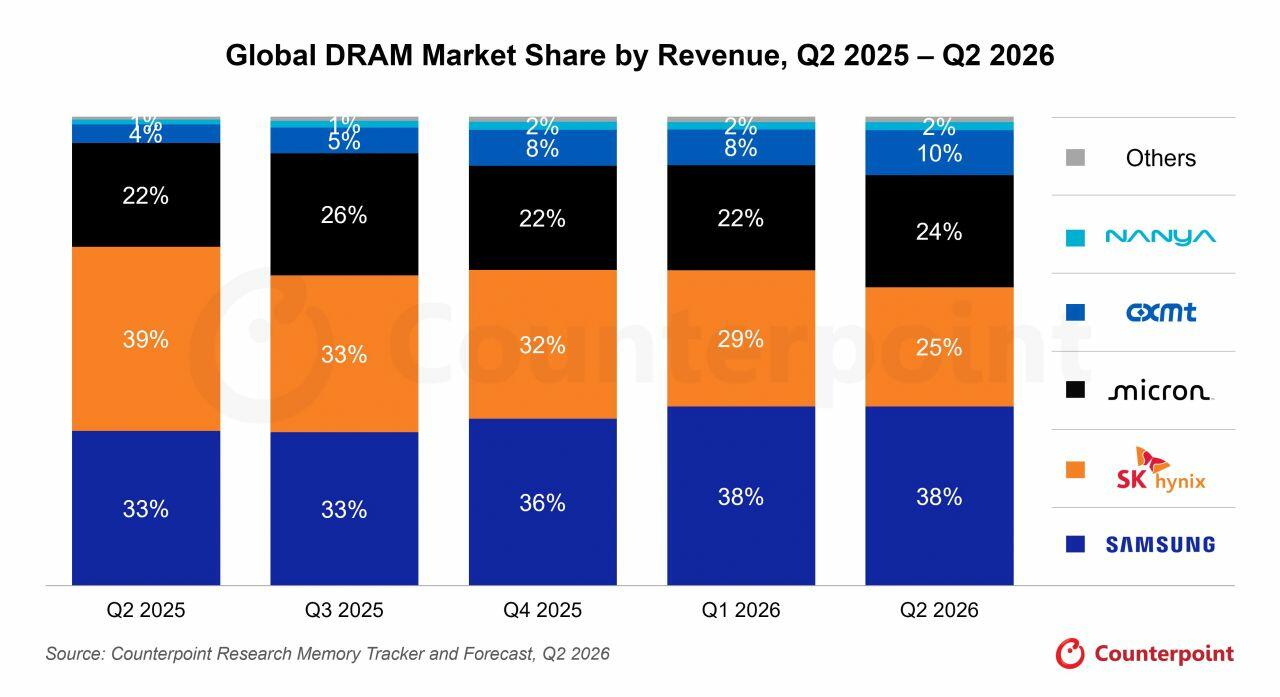
The new platform is designed to make more powerful memory chips at lower cost and with less power use, Reuters reported. CXMT, which earlier this year listed on Shanghai's STAR Market, said it would give electronics makers an additional source of supply for chips used in smartphones and other devices. The company is currently the 4th largest DRAM maker in the world - but rapidly growing - after the Big-3 cartel of Samsung, SK Hynix and Micron.
CXMT, China's leading producer of DRAM, said the new platform packs the tiny structures that store data closer together, allowing more memory to fit on each chip and more individual chips to be made from each silicon wafer.
The Hefei-based memory-chip maker said it had reduced the spacing of key features in the part of the chip that stores data to 11.95 nanometres, or about 12 billionths of a metre.
It achieved this using "quadruple patterning," a process that repeats several manufacturing steps to produce finer circuit patterns.
"Our process capability is now on par with the most advanced mass-produced nodes out there in the industry," Luo Xiaodong, CXMT's vice president and head of its marketing centre, said at the 2026 World Manufacturing Convention in Hefei.
CXMT also unveiled two 24-gigabit LPDDR5X products made on the new platform. LPDDR5X is a power-saving type of DRAM used mainly in smartphones and other portable electronics. The products each hold 50% more data than CXMT's previous equivalent products and are already in mass production, the company said. They are offered in two package formats for different smartphone and portable-device designs.
CXMT said the platform can produce at least 50% more gross chip dies per wafer than its fourth-generation platform, using an 8-gigabit-chip baseline. That measures the potential number of chips made from a wafer before defective units are excluded, rather than the proportion that pass final testing.
CXMT said it developed the platform using computer simulations and joint work with Chinese chip-equipment makers on critical production steps.
The advance comes as Beijing seeks to reduce reliance on foreign semiconductor technology and US export controls since 2022 have restricted China's access to certain advanced chipmaking equipment and related software.