
Vice President JD Vance said Tuesday that about 750,000 people on Affordable Care Act plans were never entitled to the coverage, and that pulling their subsidies will save taxpayers $2.2 billion. Mehmet Oz, who runs the Centers for Medicare and Medicaid Services, stood with him. The savings number is an administration estimate. The Congressional Budget Office has not scored it.
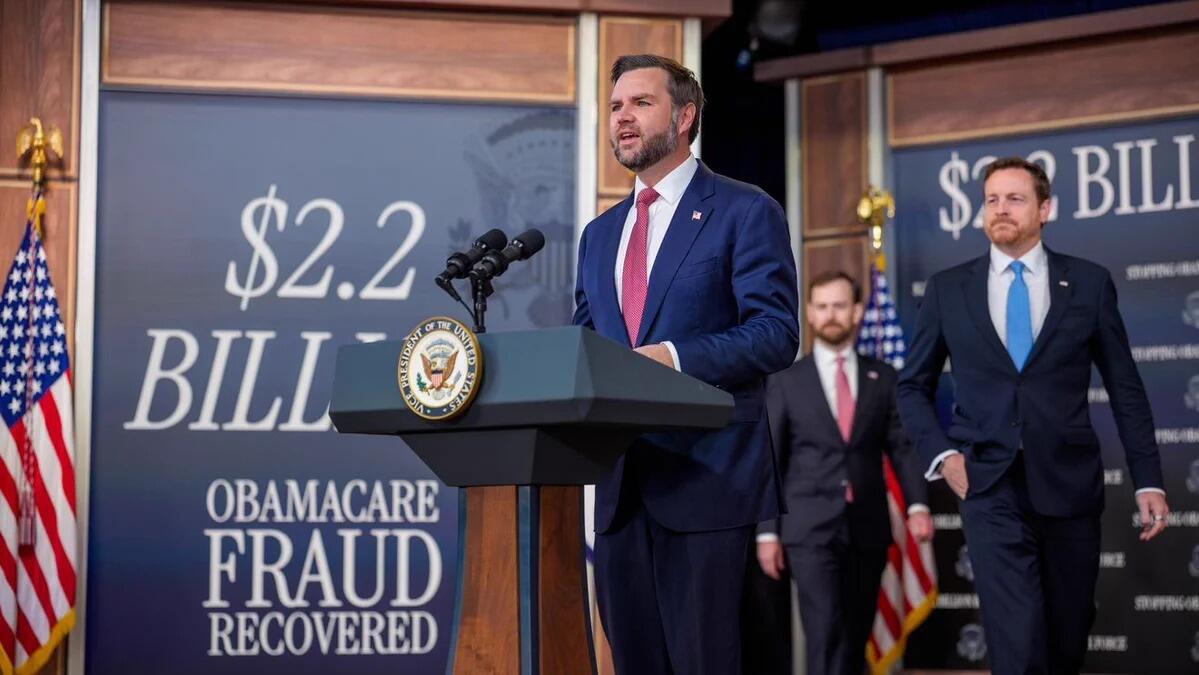
CMS had already acted. Rulemaking documents posted Tuesday in the Federal Register say the agency canceled 315,000 marketplace policies on Aug. 31, covering roughly 760,000 people, which the rule describes as unauthorized enrollments submitted through agents and brokers. Vance's 750,000 and the 760,000 covered lives are the same purge, counted two ways.
Officials also plan another pass at about 419,000 current enrollees, checking legal residency first and income second. "We are actually making sure that people receiving Obamacare subsidies are actually entitled to receive them," Vance said. "Amazingly we weren't doing that before."
Brokers are next. CMS sent notices of intent to terminate to 569 agents and brokers who filed statistically implausible rates of 2026 applications without identifying information, such as a Social Security number. A separate interim-final rule freezes new agent and broker registrations until Feb. 1, 2027, before the usual comment period runs. Administration officials said 40 brokers accounted for about 50,000 suspect enrollments and $45 million in subsidies. The National Association of Benefits and Insurance Professionals said a blanket freeze punishes licensed agents who did nothing wrong and will leave consumers with fewer people to call during open enrollment.
Centene fell as much as 3.9 percent on the first headlines. Molina dropped as much as 3.5 percent, Elevance 1.9 percent, UnitedHealth 1.4 percent. Those firms write a large share of exchange business. Federal premium tax credits are paid to the insurer, not the enrollee.
How The Administration Is Using The Word
Part of the case is conventional fraud. Brokers collect commissions from insurers. After Congress fattened the premium tax credits, a lot of low-income plans carried a $0 net premium, so a policy could be opened without the customer ever seeing a bill. CMS recorded roughly 275,000 complaints in an eight-month stretch of 2024 from people who said they had been enrolled or switched without consent. In February, a brokerage president and a marketing-company CEO were sentenced to 20 years each for a scheme that sought more than $233 million in subsidies. HHS has separately said more than a million marketplace enrollments listed no Social Security number.
The rest is a verification net the last administration loosened and this one is pulling tight: income attestations, immigration paperwork, employer coverage, automatic re-enrollment onto free plans.
The Government Accountability Office has found the same weak controls and has not signed off on the claim that millions of current enrollees are fake. GAO flagged at least 160,000 federal-marketplace applications in plan year 2024 for likely unauthorized changes, about 1.5 percent of the relevant pool. It found about 68,000 Social Security numbers used for more than a year of subsidized coverage in 2024; one number appeared on 125 policies. About $94 million in subsidies went out on numbers that matched the death file. Undercover testers got fictitious applicants approved at very high rates, and most of the 2025 fakes were still drawing subsidies months later. GAO has described that work as a set of risk indicators, not a census.
HHS and the Paragon Health Institute produce the bigger tallies. Paragon compares people who signed up claiming income between 100 and 150 percent of poverty - the band that unlocked the largest subsidies - with Census estimates of how many people in that band could even qualify. Whatever is left over gets labeled improper. HHS instead measures how many enrollees in that band filed no claims, against historical norms. HHS put the peak at 5.6 million in 2025 and said 2.6 million are still on the books. Paragon's 2026 figure is about 6.2 million, or 27 percent of open-enrollment selections, with a possible price tag of $25 billion.
Census income is not the projected income the marketplace uses. The survey misses low-income households. People with no claims get counted as phantoms; they are also just people who did not go to the doctor, or who bought a bronze plan with a deductible they never hit. In June, a federal judge in Maryland vacated most of a 2025 rule the administration had justified with Paragon-style estimates, ruling that CMS had overridden the statute. CMS's own paperwork this week floated a different improper-spending figure for 2026: up to $6.6 billion.
Enrollment Was Already Falling
Exchange enrollment ran from about 12 million early in the Biden term to a peak near 24 million once the extra subsidies landed and verification eased. Congress let those add-on credits expire. Premiums jumped, in some markets doubling. By February, effectuated enrollment was about 19.2 million, down 13 percent from a year earlier and the sharpest drop since the exchanges opened.
The White House credits integrity work. KFF and the Center on Budget and Policy Priorities credit the price spike. A phantom account that never should have existed and a family that quit after the bill hit $200 a month both show up as cancellations.
Open enrollment starts Nov. 1. Midterms are Nov. 3. Earlier this month Trump told a Republican midterm convention in Dallas that his "Great Healthcare Plan" would "stop all government payments to the big insurance companies."
Some of the 760,000 were never patients. They were names on a file, opened without their knowledge. Killing those policies stops a check to an insurer and a commission to a broker. Some of the 419,000 in the next pass will lose coverage because they cannot produce papers on the new timeline, including people who were eligible. Democrats have been saying that out loud for months: fraud talk as the instrument for a coverage cut Congress already started by killing the extra subsidies.
CMS has stopped payment on the August book and is closing the broker door. It has not released a table that splits the 760,000 into fictitious accounts, unauthorized switches, income or immigration mismatches, and eligible people who missed a form. Without that, $2.2 billion is still an estimate and 750,000 is a cancellation count.