
Donald Trump gave Xi Jinping the full state-visit treatment in Washington, but markets were more interested in what the two leaders did not deliver.
After three days of ceremony, an unusually warm presidential welcome and repeated pledges to stabilize relations between the world's two largest economies, the main economic outcome was a two-month extension of the existing U.S.-China trade truce, pushing its expiration from November 10 to January 10, 2027.
That averted an immediate return to escalation, but fell short of the longer runway many investors had expected.
Following the meeting, China's CSI 300 fell 1.7% on Thursday, its worst session in a month, while the Shanghai Composite lost 1.2%. On Friday, with the mainland shut for the Mid-Autumn holiday, the Hang Seng dropped another 1.7% to a two-month low, with technology and AI shares leading the decline. The yuan also gave back part of its pre-summit advance as the dollar strengthened.
The reaction was notable because expectations were hardly euphoric going in. The summit had been billed primarily as an exercise in stabilizing a relationship still divided over tariffs, advanced technology, rare-earth supplies, Taiwan and Iran. Even against that modest bar, the two-month extension came in short: Wall Street had generally been discussing three to six months, while some investors had hoped for a one-year rollover.
Barclays senior China economist Yingke Zhou summed up the meeting as "more signaling, less substance." Zhou's broader point was that Washington and Beijing appeared focused on preventing another breakdown in relations rather than resolving the disputes that produced the truce in the first place.
The Deal Wasn't Nothing
The White House said the two governments formally operationalized their previously announced Boards of Trade and Investment. Under the Board of Trade, officials reached consensus on recommendations for more favorable tariff treatment covering roughly $30 billion of non-sensitive goods in each direction, including U.S. agricultural products and medical devices and Chinese consumer goods. China also committed to importing at least 10 million metric tons of U.S. coal in both 2027 and 2028.
U.S. Trade Representative Jamieson Greer said Friday that the two sides had reached agreements allowing certain products to remain outside future tariff disputes and promised significantly more detail on Monday.
"We're in a managed trade situation," Greer said, adding that the administration would release "a lot more details" about the negotiations.
That means Monday's announcement could materially change the initial assessment of the summit. A detailed list of tariff exclusions, purchase commitments and implementation dates would give businesses something they can actually model.
But the official fact sheet also made clear how much remains unfinished.
Rare earths are the most obvious example. Washington said the two governments "continue to work" on U.S. concerns about shortages of rare earths and other critical minerals - careful language that confirms the supply issue remains unresolved. Chinese shipments of rare-earth magnets to the U.S. had already fallen sharply in August, and Beijing's export-licensing regime continues to give it substantial leverage over Western manufacturers.
There was no broad settlement on advanced semiconductors. No breakthrough on Taiwan. And although the two countries have agreed to establish what the White House calls a "Super Intelligence Dialogue" and an emergency-communication channel, the details remain thin enough that markets have little basis yet for pricing an investment impact.
Rare Earths And Taiwan Are Still There
The rare-earth issue may be the clearest test of whether the current detente has changed the balance of leverage.
China remains dominant in both mining and, more importantly, processing of rare-earth materials, while U.S. officials have complained that deliveries have not fully met earlier commitments. The White House's own language after the summit indicates that Washington is still seeking more reliable shipment levels.
Taiwan is similarly unresolved. Xi pressed Trump during the visit to take a harder line against Taiwanese independence. At the same time, Washington has been weighing another arms package for Taipei worth roughly $14 billion. Secretary of State Marco Rubio said during the visit that delays in arms sales to Taiwan reflect concerns about U.S. weapons production.
Whatever the eventual timing of that sale, the important point for markets is that the summit did not remove Taiwan from the bilateral risk ledger.
The same is true of AI. Both sides agreed to continue talks, including work on an incident-communication channel, but they remain competitors in advanced chips, models and computing infrastructure.
Sixty Days Of Visibility
For companies exposed to U.S.-China trade, January 10 is better than November 10. It gets the current arrangement through the Christmas import season and prevents an immediate reopening of the tariff war.
But sixty days is not much planning horizon for a manufacturer deciding where to build a plant, sign a multiyear sourcing contract or commit billions of dollars in capital.
And the tariff burden has not disappeared. The latest Penn Wharton Budget Model data put the effective U.S. tariff rate on Chinese imports at roughly 23%, compared with about 7% overall. China still faces the highest effective rate among major U.S. trading partners.
That helps explain why investors distinguished between stability and resolution.
There is a constructive side to that. China's export sector has remained remarkably resilient, and keeping the truce intact removes the immediate threat of another tariff shock. U.S.-bound manufacturers, electronics suppliers, appliance makers and auto-parts exporters all benefit from having the deadline pushed into next year.
A Summit Built Around Stability
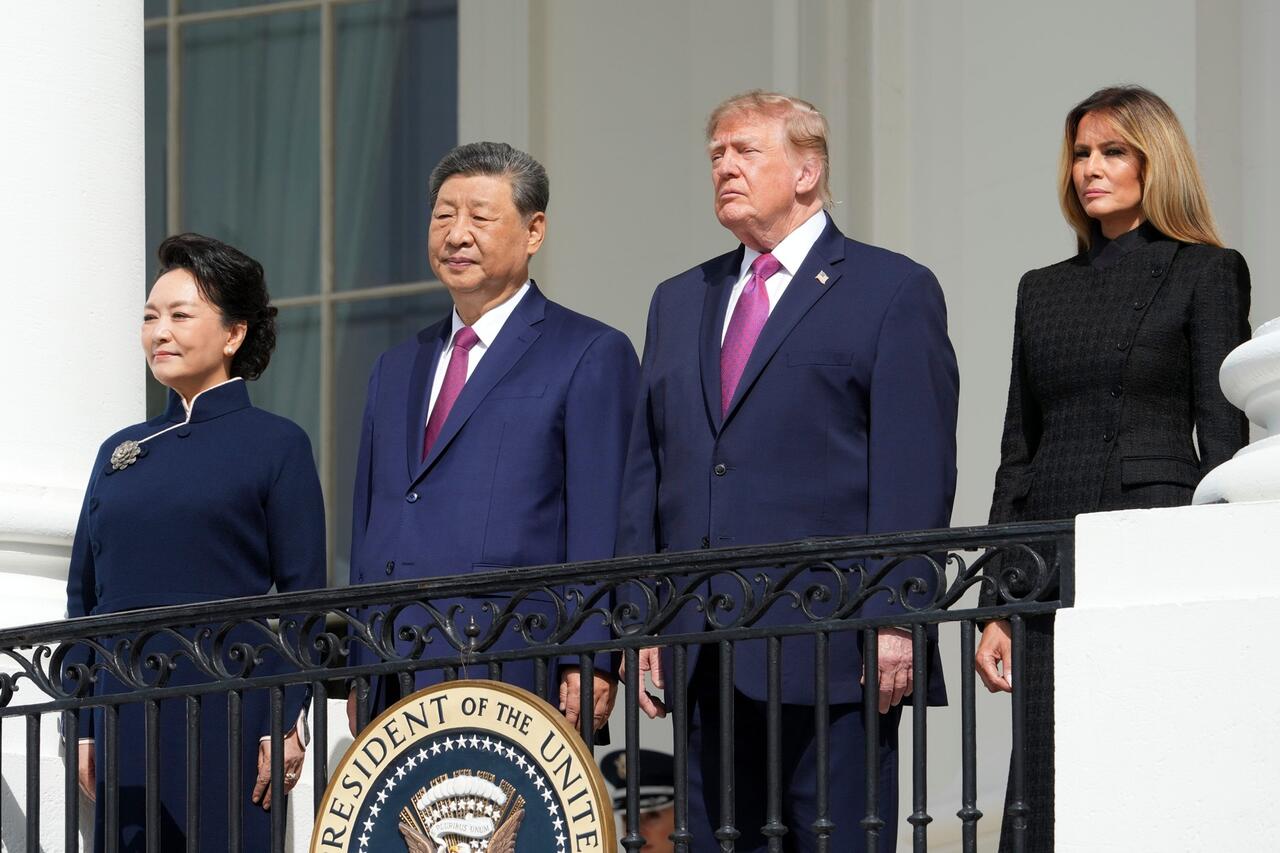
Trump personally greeted Xi and Peng Liyuan at Joint Base Andrews, an unusual gesture for a visiting head of state. The White House staged a formal arrival ceremony and military flyover, followed by bilateral meetings, a state dinner, tea and a visit to the National Archives. Xi repeatedly called for a stable long-term relationship and said the U.S. and China could avoid the so-called Thucydides Trap of conflict between a rising and established power.
China also revived one of its oldest diplomatic tools: pandas. Beijing agreed to send two giant pandas to Zoo Atlanta. Ping Ping and Fu Shuang arrived in Atlanta on Sunday.
But the composition of the summit showed the limits of the commercial thaw.
The American side brought a who's who of technology and finance, with executives from Nvidia, AMD, OpenAI, Google, Microsoft, Amazon, Meta, Apple, Tesla and major Wall Street firms involved in the broader visit. Xi's official delegation, by contrast, was dominated by government officials rather than Chinese CEOs - a contrast Barclays cited in arguing that Beijing approached Washington primarily as a strategic dialogue rather than a corporate dealmaking exercise.
Washington and Beijing appear to have decided that keeping the relationship inside guardrails is itself valuable. What they have not done is settle the economic and geopolitical disputes inside those guardrails..
What To Watch Monday
First, Greer's trade details. The White House has already disclosed the framework for preferential treatment of about $30 billion in non-sensitive goods. Monday should show how much of that framework is operational - which products qualify, when tariff treatment changes and what purchase commitments accompany it.
Second, mainland equities. China's markets were closed Friday, leaving Hong Kong to absorb the final day of the summit in thin holiday trading. Monday will be the first full onshore session able to react to the completed visit and whatever additional trade details Washington releases.
Third, the yuan. Beijing guided the currency stronger ahead of the summit before allowing some of that move to reverse as the dollar rallied. With the diplomatic event now over, traders will be watching the PBOC's daily fixing for clues about whether authorities still prefer gradual appreciation or are prepared to tolerate more two-way movement.
The Washington summit therefore leaves investors with a peculiar combination: less immediate danger, but few reasons to declare the underlying dispute settled.
Tariffs remain elevated. Rare-earth supplies remain an issue. Taiwan remains unresolved. AI competition remains intact. And the new trade deadline arrives less than four weeks after the leaders are expected to meet for the fourth time this year.
Washington bought another sixty days of stability. What happens inside those sixty days will determine whether it bought anything more.