
By Haley Zaremba of OilPrice.com
Space-based solar power just got another powerful vote of confidence. The United States Department of Defense just inked a contract with solar energy company Overview Energy to “design, build, and test a homing beacon that will enable its space-based solar energy system to accurately beam power from orbit to receiving solar arrays on Earth,” according to a brand new report from Interesting Engineering.
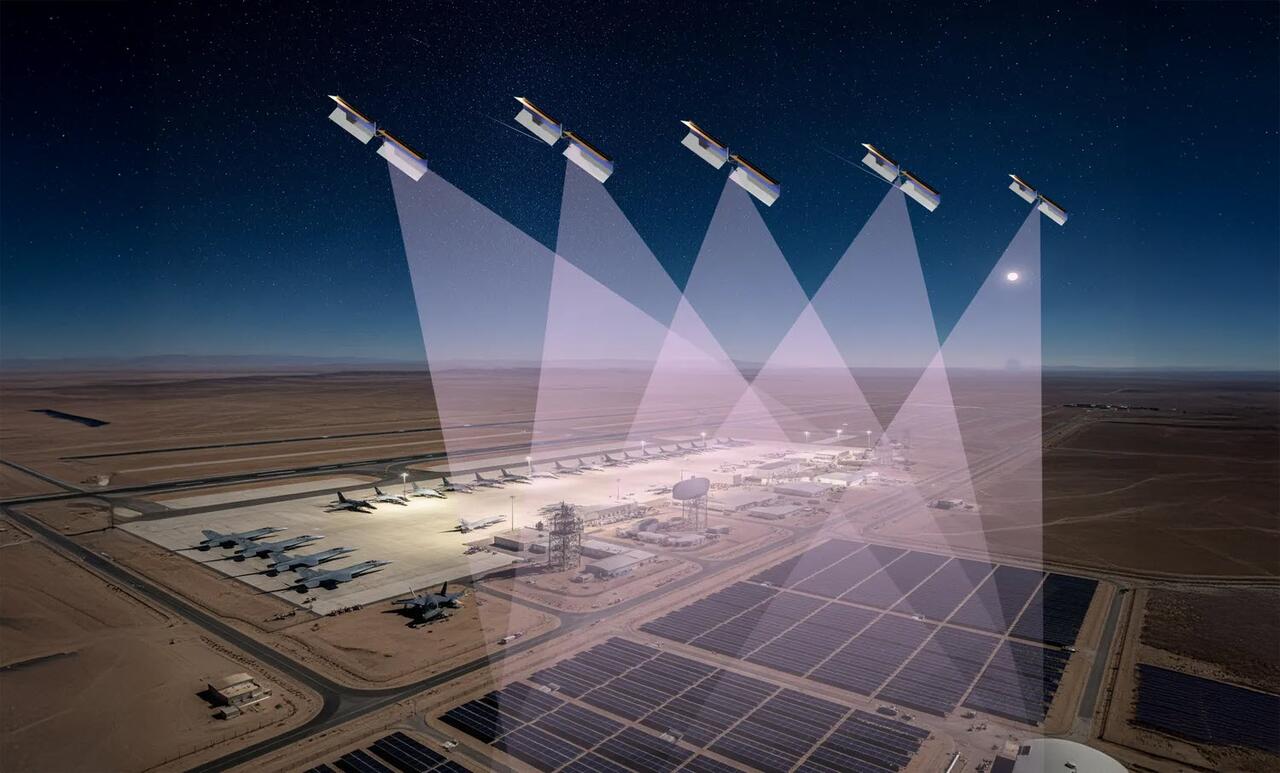
The idea is that solar panels would orbit the Earth, collecting sunlight straight from the source and then beaming it back down to Earth either through powerful lasers or microwave beams, depending on the technology being applied.
Putting solar panels into outer space would yield a litany of benefits. Critically, unlike terrestrial models, the sun would never set on these solar panels, allowing them to generate clean energy 24 hours a day, seven days a week. This would solve an enormous issue in the clean energy sector, which is seeing increasing instances of wasted energy and even negative energy prices as peak production hours and peak demand hours are inevitably misaligned, and energy storage capacities have lagged far behind productive capacity.
And intermittency is not the only major challenge to the traditional solar power sector that space-based solar would be able to sidestep completely. Industrial-scale solar farms take up enormous tracts of land, and are therefore facing increasing legal challenges to secure appropriate plots for development. A single large-scale solar farm can take up thousands of acres. According to a 2022 insight report from strategy & management consulting firm McKinsey & Company, utility-scale solar farms require ten times as much space per unit of power as coal- or natural gas–fired power plants, at minimum. And that’s counting the land used to produce and transport the fossil fuels. Jettisoning those solar panels into space is one way of solving that problem.
Plus, the power from space-based solar panels would be dispatchable. Since solar satellites can view entire quadrants of the globe, they can beam energy when and where it is needed most with an enormous degree of accuracy. All of these factors serve to make the technology highly attractive to the Department of Defense, which wants to use space-based solar power for remote military bases. The first demonstration of the technology is planned for 2028, with deployment of the planned geosynchronous Earth orbit (GEO) satellite constellation slated to begin in 2030.
“The connection between space and the ground is the most critical element of space solar energy, especially for warfighters who depend on power at precise locations,” Darko Filipi, Overview Energy co-CEO, was quoted by Interesting Engineering.
The United States military is not the only major investor to sign a massive contract with Overview Energy. The four-year-old startup inked a deal with Meta – the megacompany behind Facebook, Instagram, and more – earlier this year, agreeing to provide up to 1 gigawatt of space-based solar energy to the tech giant – equivalent to the output of a nuclear reactor.
However, both of these contracts are based on a nascent technology and the complete space-to-ground system has yet to be demonstrated from orbit. But the leaders of Overview are confident that their big gamble will pay off in spades. “We really believe that we are able to provide utility-scale power with this technology,” Filipi recently told the Washington Post.
However, not everyone is so optimistic. “The technology may work,” Amory Lovins, a Stanford physicist and co-founder of the energy think tank RMI, told the Washington Post. “But I have serious doubts the economics do.” He pointed to the many other forms of clean, abundant, proven, and round-the-clock power alternatives, such as nuclear and geothermal, that can produce electricity much more cheaply and with more proven and established technologies.