
Friday's diesel deal between Trump and Putin wasn't only about diesel. It was also about Kyiv.
Hours after Zelensky accused Washington of using Ukraine's negotiators as a "smokescreen" for a backroom deal with Moscow, Axios reported that Trump decided to let Russia sell diesel after Zelensky ignored half a dozen US requests to stop attacking Russian oil refineries. The alleged source was a US official with direct knowledge, who did not hold back:
"Zelensky is misreading the room. By continuing to hit refineries, he is eroding the good will that he has built with Trump over the last six months."
In other words, the sanctions waiver was as much a message to Kyiv as a gift to Moscow. So how did we get to this latest geopolitical twist, what is Trump actually got for lifting sanctions (spoiler: less than nine days of fuel), and why is the deal is on a collision course with the one Ukrainian policy Kyiv says it won't give up. Let's dig in.
"Half A Dozen" Requests
The backstory is familiar to regular readers. One month ago, Trump - freaking out about soaring diesel prices - told reporters that Zelensky "has to stop knocking out diesel fuel in Russia," and a day later he announced a truce that never really happened:
Trump says "Ukraine has agreed not to hit Russian Energy targets. Russia has agreed to do, likewise! The World’s Diesel price rise is mostly caused by the Russia/ Ukraine War, not Iran."
— zerohedge (@zerohedge) September 14, 2026
A few hours later, Kyiv kept hitting refineries anyway. Just last weekend Zelensky vowed to hammer more of them, and on Thursday Ukrainian drones set Russia's largest refinery at Omsk ablaze, more than 1,500 miles from the border. Axios notes the strikes were "highly effective and caused an energy crisis in Russia," prompting Moscow's diesel export ban, which then "added more pressure to global diesel markets under strain from the war in Iran."
The core disagreement is about symmetry. Zelensky told Trump, Witkoff and Kushner that he would stop hitting Russian refineries if Russia stopped hitting Ukrainian power plants. Trump wanted Ukraine to stop unilaterally, according to the official, and "didn't see the attacks on refineries as equivalent to Russian strikes on Ukraine's power grid." Or, as the official put it: "The attacks on the refineries cause pain in Russia, but it causes pain for the U.S., too."
Then there is what happened in Miami. During eight hours of talks on Friday, Witkoff and Kushner told the Ukrainian delegation that Trump was expected to call Putin and lift sanctions on Russian diesel, because Kyiv had ignored repeated requests on strikes "which were directly affecting U.S. consumers." A Ukrainian official claimed the envoys also threatened that Trump could cut Ukraine off from US intelligence if it kept ignoring him. The US official denied that, saying the envoys merely reminded Kyiv that the US provides munitions and intelligence, so Ukraine "shouldn't take actions that hurt American consumers." That is a fine distinction, and Kyiv is unlikely to see the difference.
So was Ukraine's team a "smokescreen," as Zelensky charged? Not quite: the US delegation told them what was coming. But the decision was clearly made before they sat down. Zelensky's reaction, in a statement reported by Politico:
"At this very moment, while our team is talking with the American team in Florida, at this very moment, the President of the United States is talking with the leader of the Kremlin... and has an agreement under which America is allowing Russia to export diesel fuel. That means more money for this war... I believe our team is simply being used as a smokescreen, and that is certainly not fair."
He went further in an interview with Axios, calling it "not fair and not honest" and "a happy birthday present for Putin" (who turned 74 on Wednesday), and told reporters it was "a weak decision by strong partners."
And the payoff from Putin? So far, none on peace. During the 90-minute call he declined to commit to resuming talks with Ukraine. Kremlin adviser Yuri Ushakov said Ukrainian strikes on Moscow and other cities during Russia's parliamentary elections had "thwarted the possibility of an immediate resumption of the negotiation process," adding: "The president said, we will think about when these negotiations can be resumed." That is the kind of non-answer that tends to precede more non-answers. The US official still thinks Putin "is open to a discussion on ending the war," and says Washington wants a "new proposal that will be good enough for him." Witkoff and Kushner may visit Moscow and Kyiv next week, though Axios notes it's unclear how Friday's blowup will affect those plans.
What Trump Got: 4.8 Million Tons, Mostly "Thereafter"
Here's what Trump posted on Truth Social shortly before Friday's close:
"I have just concluded a highly successful discussion with President Vladimir Putin, of Russia, wherein it was agreed that Russia will immediately supply over 300,000 Tons of Diesel Fuel to the American and Global Marketplace, another 500,000 Tons during the month of November, and 1,000,000 Tons immediately thereafter."
Another 3 million tons would follow "within a short period of time," depending on "the condition of their Diesel Refineries." That condition is the whole point, as we explain below. Then came the usual all-caps flourish: between "our TOTAL CONTROL of the Strait of Hormuz, and this great announcement on Russian Energy, Diesel Prices for Americans and, indeed, the World, will be COMING DOWN, IN RECORD NUMBERS, AND FAST!"
*TRUMP SAYS PUTIN AGREED TO RELEASE DIESEL INTO GLOBAL MARKET
— zerohedge (@zerohedge) October 9, 2026
Minutes later, Treasury said OFAC was "immediately issuing a temporary general license to allow the supply of Russian diesel to the global market." General License 135 authorizes the sale, delivery and import (including into the US) of Russian-origin diesel until April 7, 2027. That is six months, and according to Fortune it is the first diesel waiver since the war began to run longer than the standard 30 days. The EU and UK sanctions are unchanged, so Europe, the region that actually imports diesel, can't legally buy a drop of it.
Moscow confirmed the terms. Deputy PM Alexander Novak said Russia was ready to supply 300,000 tons in October, 500,000 in November and 1 million in December, and that "in the long run, this volume could reach three million tons per month." The Kremlin's readout said "the Russian side reaffirmed its readiness to supply oil and oil products to the American and world markets," with no dates attached. Something to look forward to in 2027, perhaps.
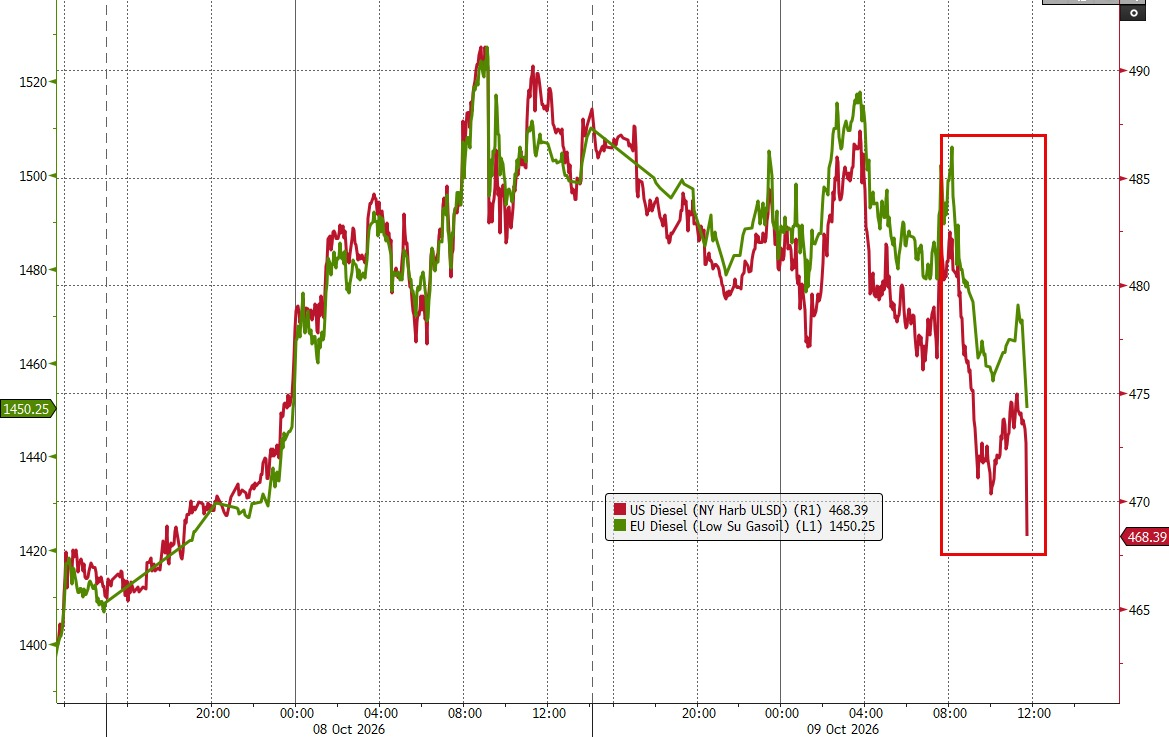
The algos loved it. As Goldman's US rates desk wrote in its Friday wrap (available to pro subs), "Before the close, headlines hit the tape that Russia would release diesel supply into the market, driving down diesel prices and leading to a modest rally in the front end." Both US and European diesel futures slid, with NY Harbor diesel down about 4.5% to $4.67/gallon per the FT, and WTI fell about a buck to $91.
Do The Math: Less Than Nine Days Of Fuel
Now for the arithmetic. At roughly 7.45 barrels per ton, the "immediate" 300,000 tons is about 2.2 million barrels. The US burns roughly 4 million barrels of distillate a day, so October's tranche covers about half a day of American demand. Add November and December and the first 1.8 million tons cover about 3.4 days. Even if the 3 million tons conditional on refinery health actually arrive, the full 4.8 million tons (about 36 million barrels) cover less than nine days of US consumption.
That is the best case. Trump's own post says the fuel is going to the "American and Global Marketplace", so the US share will be smaller.
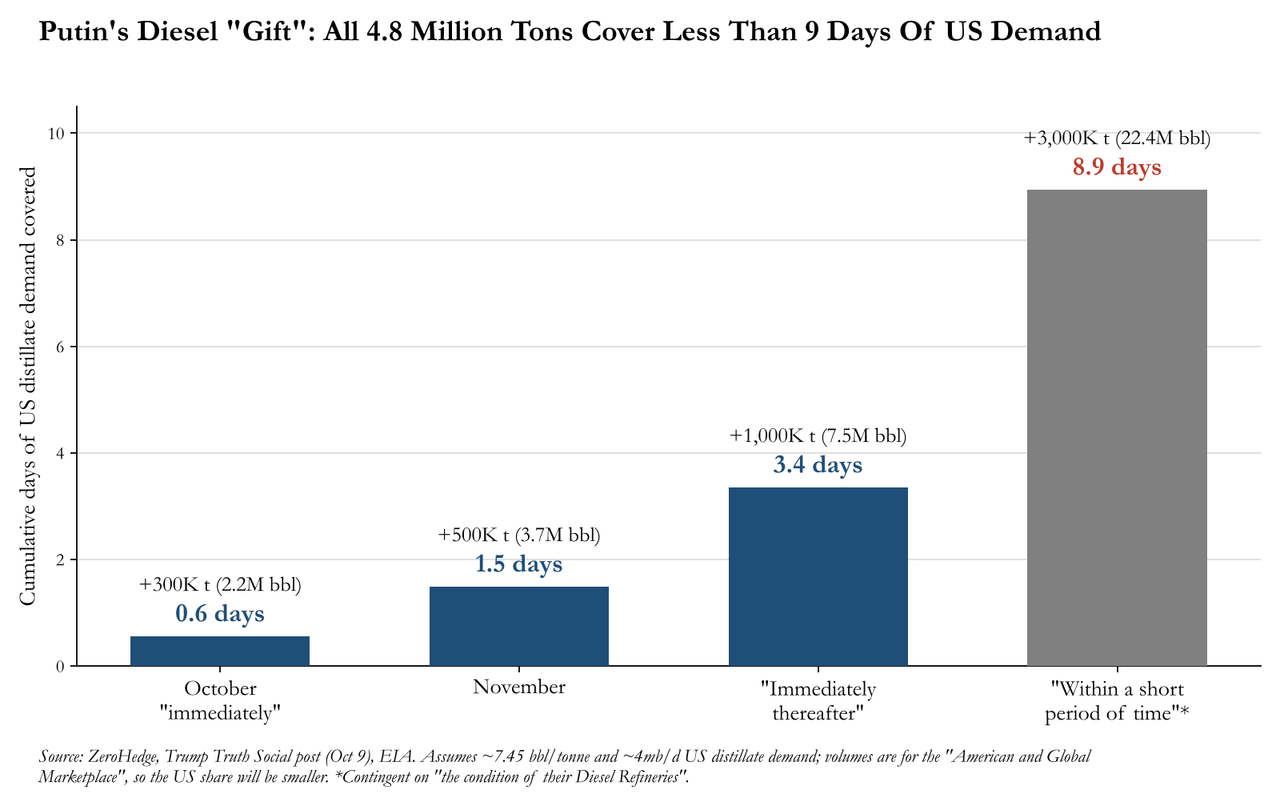
For context, the Omsk refinery that Ukraine hit on Thursday produced roughly 8 million tons of diesel in 2024 (per Bloomberg). That is about 670,000 tons a month. Put differently, the entire "November tranche" is less than one month of output from a single plant that was on fire the day before the deal was announced.
The industry isn't buying it either. The FT reports that Russia is running its refineries at about 60% of capacity because of Ukrainian strikes, and quotes Kpler's head of policy and geopolitical risk Michelle Brouhard: "The thing that I'm most curious about is: where is the diesel going to come from? Russia doesn't have an export problem. It's got a refinery problem." Rapidan's Bob McNally added that Moscow had already "been leaning toward a slight easing of its diesel export ban for logistical reasons." So Trump may have paid a six-month sanctions waiver for barrels Russia was about to sell anyway.
Brouhard also warned that the deal could end up removing diesel from the market. Because the headline knocked diesel down relative to crude while freight costs are at records, "Refinery margins are now negative, which means refinery runs in Asia probably are going to come off . . . which means we're going to lose some diesel." Mission accomplished.
Why Russia Can't Spare It (And Why Trump Wants It Anyway)
The irony is that Russia isn't exporting diesel because it can't. As regular readers know, Moscow banned diesel exports back on July 8 to avoid domestic shortages after a wave of Ukrainian drone strikes on its refineries, and extended the ban through Oct. 31 last week. The IEA estimates Russian diesel output is down about 30%. In other words, Putin has just promised to export fuel his own motorists are queuing for, under a ban his own government imposed. That's either a remarkable act of generosity or a remarkably cheap promise (we know which way we lean).
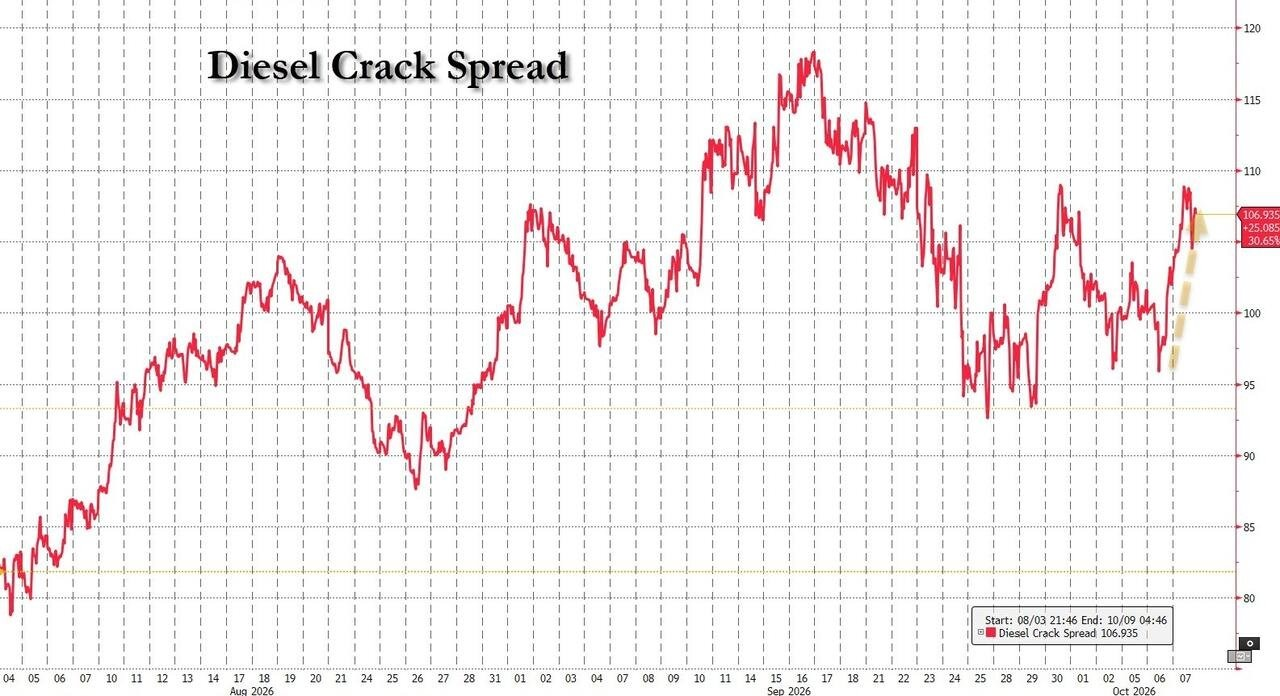
The reason for the urgency is simple: diesel is still near record highs with less than four weeks until Election Day. AAA's national average was $6.23/gallon on Friday, down only modestly from the record $6.52 on Sept. 22. Goldman's commodity desk wrote last weekend in its Weekly Commodity Thoughts (available to pro subs) that the global distillate market "has been the most distressed area of the entire energy complex with gasoil cracks (gasoil vs. crude) trading to over $100/bbl in late September." That only eased after "recent US political pressure and threats to implement a diesel export ban" pushed the G7 into a 100mb emergency release. We covered that at the time under the title "Trump's Diesel Threat Worked." Goldman's desk was not impressed with the fix:
"However, while prices have moved lower the release does little to solve the structural issue has been caused by continued curtailment of Middle East exports and widespread damage to Russian refinery infrastructure."
JPMorgan's commodities chief Natasha Kaneva was blunter about the G7 headline in her latest diesel note (available to pro subs): "the headline 100 million barrels does not represent 100 million barrels of new intervention ... much of Friday's announcement represents the completion of the earlier IEA release rather than a new injection of barrels." Sound familiar?
The market had the same reaction to the G7 release. As we noted on Wednesday, diesel crack spreads "quickly shot up back over $100, as market laughs at the emergency release of 100MM barrels."
The Market Already Priced It (Sort Of)
The hedge funds saw this coming. Goldman's Robert Quinn wrote earlier this week (and available to pro subs) that in the week through Sept. 29, managed money sold $2.4 billion of gasoil, the largest amount in 18 months, split equally between liquidation and new shorts. That followed a run in which specs "purchased in all but 1 week for a cumulative +$4.3bn" from late June to mid-September. And on Oct. 6, three days before Trump's post, "October Gasoil reached intraday lows of -5.3% on reports that Russia may lift the country's ban on diesel exports for some producers in October."
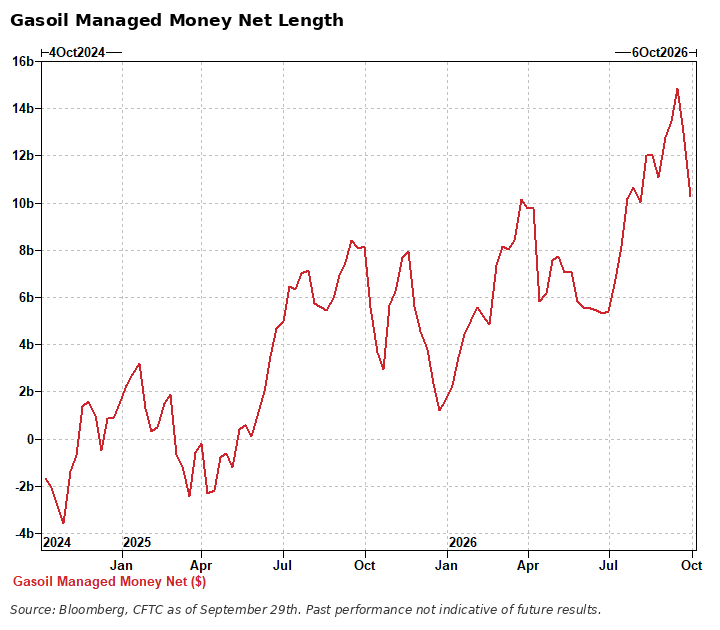
Translation: a good chunk of the "Russia relief" was in the price before Friday's headline. That leaves little room for another leg lower, and plenty of room for a squeeze if the barrels don't show up.
It's The Midterms, Stupid
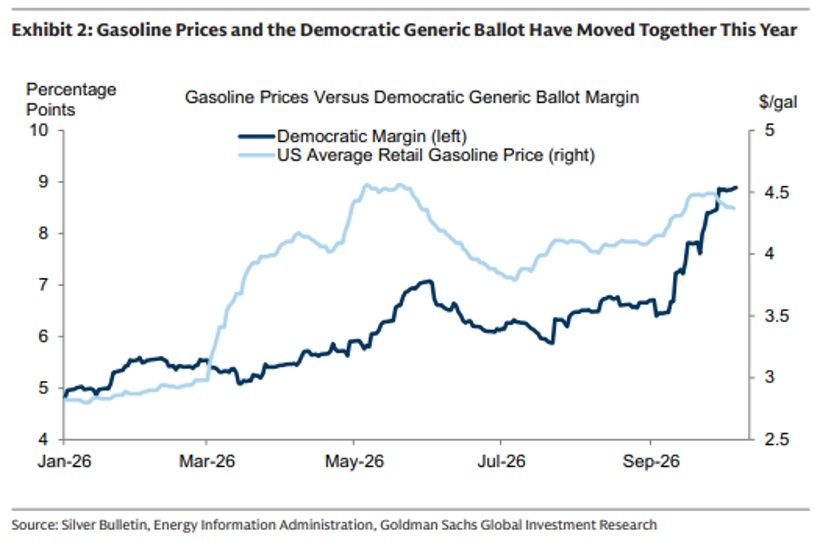
Why burn this much goodwill with Kyiv over nine days of diesel? Because fuel prices are what's moving the ballot. Goldman's political economists Alec Phillips and Abhay Duggirala wrote in their latest US Election Monitor (available here for pro subs) that "Gasoline prices and the Democratic generic ballot have moved together this year - the Democratic lead widened gradually after the gasoline price spike at the onset of the Iran war." Democrats now lead the generic ballot by an average of 8.9pp, and "Inflation and the economy rank highest for voters, and Trump's net approval on both is deeply negative."
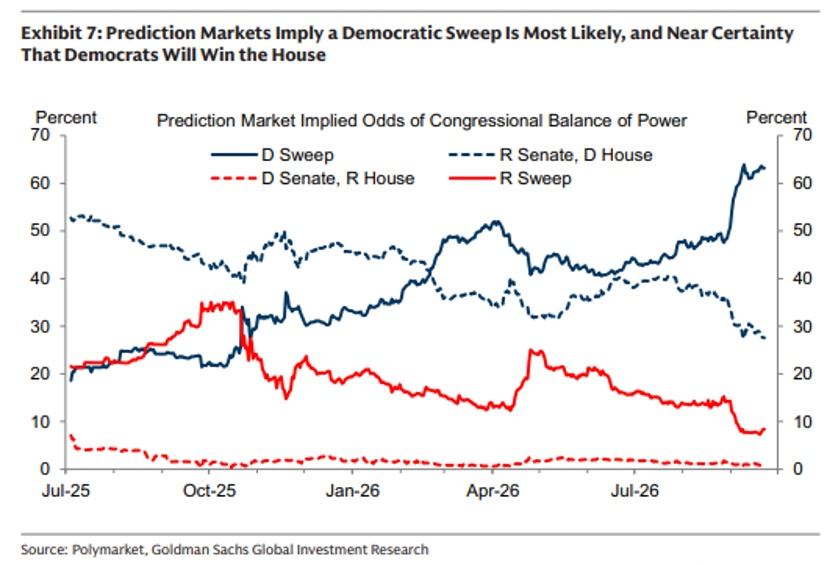
Prediction markets have already reached their verdict: using Polymarket data, Goldman notes markets are "now pricing a roughly 65% chance of a Democratic sweep and less than a 10% chance that Republicans retain their House majority."
Against that backdrop, everything the White House did on diesel this week makes sense: the red-dye diesel waiver on Monday, the export-ban threats (which, as Goldman modeled, would knock just $0.25/gallon off retail diesel per week, before pushing gasoline higher), the decision not to strike Iran until after Nov. 3, and now Putin's diesel. JPMorgan's Market Intel desk summed up the shift in a client call this week: "why diesel, not crude, may now be the more important inflation signal." For a White House facing 25 days of voter anger at the pump, a Friday afternoon price dip is worth a lot. The fact that it rests on a sanctions waiver and a promise from Putin is the problem.
Bottom Line
The new Axios details turn the diesel deal from a pump-price gimmick into a test of wills with Kyiv. Trump has now tied the price Americans pay for diesel to whether Ukraine keeps burning Russian refineries - that way he has a clear scapegoat when Diesel prices keeps rising. Kyiv's answer came within hours, and it was not the "symmetrical" one Zelensky had floated. A senior Ukrainian official told the FT that the long-range drone strikes on Russian energy facilities will continue:
"We will burn [Russian] refineries."
Which is why the deal looks doomed from the start, which ironically is just what Trump wanted as there is little chance diesel sustains a price drop for the next several weeks. As one widely shared take on X put it within minutes of the announcement, before Axios confirmed the motive:
The idea of this is not to bring diesel prices down. The idea is to stop Ukraine from striking russian refinaries and safe russian energy sector. Now every strike on russian refinaries by Ukraine will be treated as attack on American energy supply. https://t.co/ZCuGEfe0fR
— ✙ Constantine ✙ (@Teoyaomiquu) October 9, 2026
That is now, more or less, the White House's position.
The next Ukrainian drone that hits a Russian refinery will be hitting a supply chain the US president just put his name on. We expect a Truth Social broadside at Zelensky the moment that happens, along with blaming the Ukraine president for all US inflationary woes, which much to the deep state's disgust, would leave Washington defending Putin's export capacity against its own ally, weeks before an election.
As for the barrels, we'll believe them when we see them in New York Harbor. Russia's export ban still runs through Oct. 31, its refineries are running at about 60% of capacity, and Kyiv has said outright that it will keep burning them. The most likely outcome? Putin sends out a diesel tanker, Ukraine drones the refinery that filled it, and the "deal" quietly dies, with both sides blaming Zelensky. Until then, it has done what it was designed to do: produce one good headline for the pump-price chart, and put Kyiv on notice that going forward Z will be the scapegoat for American runaway energy inflation.
Much more in the full Goldman Weekly Commodity Thoughts, Quinn's "Managed Money Gasoil Sentiment Shifting?" note, the GS US Election Monitor and JPMorgan's diesel note, all available to pro subs.