
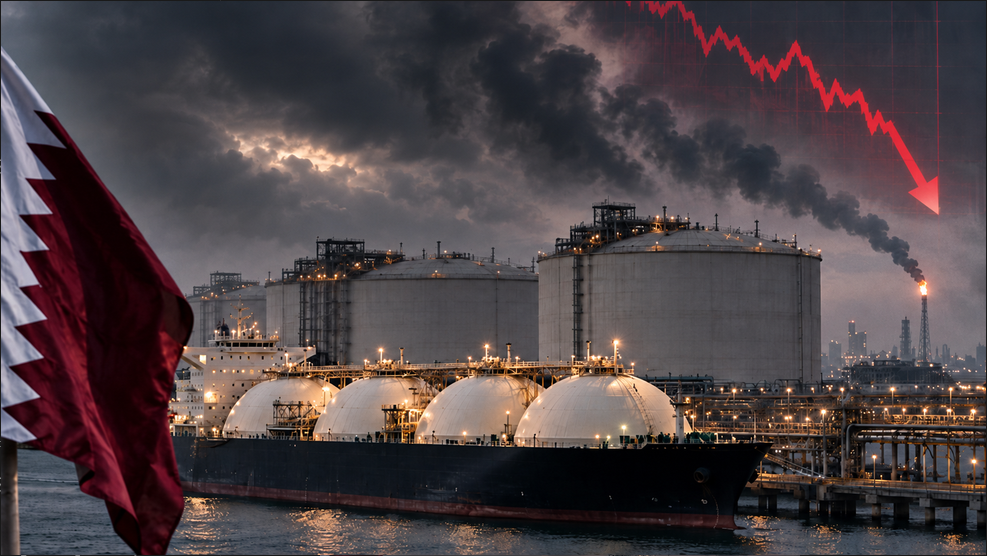
Qatar's government revenue fell 42% in the first half of 2026, Emir Sheikh Tamim bin Hamad Al Thani told the Shura Council on Tuesday, October 13. The figure puts an official number on the damage that the Iran war and the closure of the Strait of Hormuz have inflicted on what was previously the world's second-largest liquefied natural gas (LNG) exporter. Public spending also fell 14% over the same six months, the emir added as he opened the council's annual session in Doha.
"It is only natural that the crisis would have a negative impact on public finances," the emir said, according to TRT World. Still, he emphasized that the government will not cut essential services or alter its development goals. He credited the financial cushion Qatar built before the war–larger reserves, lower public debt, and conservative oil-price assumptions–and pointed to roughly QR221 billion ($60.7 billion) in projects and investments planned over the next five years.
Quarterly figures show just how fast the budget shortfall grew. According to Finance Ministry data carried by the state news agency QNA, the second-quarter deficit hit QR21.2 billion (on QR25.6 billion in revenue against QR46.8 billion in spending)–roughly double the first quarter's QR10.3 billion gap. That brings the first-half deficit to about QR31.5 billion, already 1.4 times the QR21.8 billion shortfall projected for all of 2026.
Second-quarter revenue plunged 57% compared to a year earlier, when the deficit was just QR800 million, AGBI reported. Drawn up in December, the 2026 budget had assumed oil at $55 a barrel, total revenue of QR199 billion, and spending of QR220.8 billion.
The financial hit stems directly from damaged energy infrastructure. In early March, an Iranian drone strike forced the massive Ras Laffan gas complex to shut down, prompting state-owned QatarEnergy to halt LNG production and suspend its contract obligations to buyers–a legal move known as force majeure, as we reported at the time. As we noted in June, the Washington Post reported that the strikes also ended secret Qatari efforts to keep the complex off Iran's target list.
Subsequent Iranian missile strikes on Ras Laffan knocked out two of Qatar's 14 gas-processing units–wiping out 12.8 million tons of annual output, or 17% of its export capacity–along with one of its two gas-to-liquids plants. QatarEnergy warned at the time that the units would take three to five years to repair, costing an estimated $20 billion a year in lost revenue, and suspended long-term supply deals with buyers including Italy's Edison and South Korea's KOGAS, Reuters reported. "For production to restart, first we need hostilities to cease," QatarEnergy chief Saad al-Kaabi said.
An October 15 Reuters investigation revealed the root of the delay: the strikes destroyed two "cold boxes," the specialized core equipment used to super-chill natural gas into a liquid at Ras Laffan. Across the region, Reuters tallied at least 135 missile and drone attacks hitting 84 or more infrastructure sites since the war began.
There are minor signs of recovery in other areas of processing. On October 8, Shell announced it had partially restarted the Pearl gas-to-liquids plant, allowing it to slowly rebuild inventory, though actual shipments still depend on regional security. Repairs to the plant's damaged second processing unit are expected to wrap up in early 2027.
Seven months into the conflict, however, very little gas is leaving the country. Qatar exported 1.6 million tons of LNG in September–its highest monthly total since the war began, but still less than a quarter of its pre-war average, with about a third of that staying inside the Gulf for Kuwait. Data firm Kpler projected on October 12 that October shipments would drop to just 0.6 million tons, according to Reuters.
The supply crunch is rippling through Europe. Edison said on September 28 that QatarEnergy had extended its supply suspension to early December, bringing the Italian utility's total disrupted shipments to 35 cargoes since April. The uncertainty prompted French energy giant EDF to pause plans to sell a stake in Edison, CEO Nicola Monti told Reuters on October 14. Monti said he hoped deliveries would resume in early 2027, but admitted there is "no visibility at this stage."
Last week, at least 12 empty QatarEnergy tankers–capable of holding about 1.1 million tons of gas, or 2% of the world's LNG shipping fleet–were massing off the coast in an apparent bid to load up and make a run through the Strait of Hormuz. In his speech, the emir condemned the strikes as an Iranian attack on Qatari sovereignty, while Tehran maintains it was only targeting US interests, Euronews noted.
To plug its budget gap, Doha has returned to the bond market. In September, Qatar sold $3 billion in five- and 10-year bonds–its first international public debt sale since November–drawing over $7.7 billion in buyer orders, Bloomberg reported. The same month, credit agency Fitch removed Qatar from its downgrade watch list, citing a lower risk of further severe damage to its gas plants.
Meanwhile, the broader economy is feeling the squeeze. National Planning Council figures released on September 30 via QNA showed Qatar's oil and gas sector shrank 50.7% year-over-year in the second quarter, while the rest of the economy grew 2.6%. The emir noted that non-energy industries now account for roughly 80% of overall economic output. Still, the IMF now expects Qatar's economy to shrink 15.6% this year–nearly double the 8.6% drop it projected in April–before rebounding 18.8% in 2027 if the Strait of Hormuz reopens. The fund released the downgraded forecasts on the same day as the emir's speech.
Despite the disruption, the emir said work on the North Field expansion–a massive project aimed at boosting Qatar's LNG capacity to 142 million tons a year by 2030–is still moving ahead on schedule. Qatar Chamber chairman Sheikh Khalifa bin Jassim Al Thani praised the government's handling of the crisis, telling The Peninsula that protecting essential services despite plunging revenues proves the state's commitment to stability.