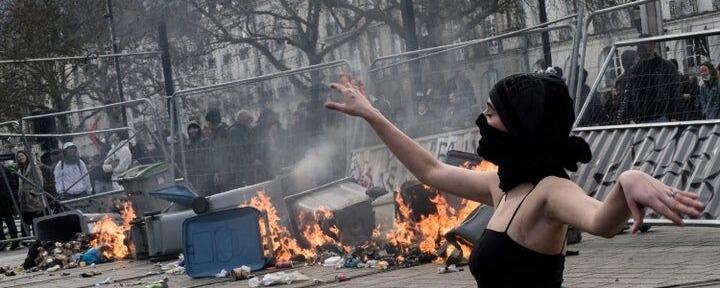
Every time political anger spills into French streets - whether over pension reforms, fuel taxes, police shootings, or the annual ritual of Saint-Sylvestre on New Year's Eve - the post-mortem follows a familiar script. The Ministry of the Interior tallies the arrests, insurers calculate the millions in property damage, and municipal crews sweep up the melted asphalt before morning commuters arrive. The rioters - who kicked this off in working-class banlieues (which has high concentrations of North African and sub-Saharan immigrants) are burning whatever they can get their hands on; cars, tires, plastic bins, buildings, etc.

And, as one might imagine, this is extremely toxic.
Over the past decade, an average of 35,000 to 40,000 vehicles have been intentionally torched across France every year, punctuated by massive spasms of civil unrest - such as the June 2023 riots, which saw more than 12,000 vehicles burned, or New Year's Eve 2025/2026, when 1,173 parked vehicles were reduced to ash overnight. When you strip away the political theater, France's recurring protests function as unlicensed, open-air hazardous waste incinerators operating at breathing height in the country's most densely populated neighborhoods.
In the European Union, an industrial waste incinerator is legally required to burn materials above 850°C inside sealed chambers equipped with rapid gas-quenching towers and multi-stage chemical scrubbers. A burning Peugeot or stuffed municipal dumpster on a narrow street in Paris, Lyon, or Marseille smolders in an oxygen-starved state between 250°C and 450°C - the exact temperature sweet spot for cooking up some of the deadliest carcinogens and "forever chemicals" known to science.
Unlike a wildfire, whose immense heat lofts smoke miles into the sky, a street fire has a weak heat plume that gets trapped between mid-rise apartment blocks. Caught in street-level wind tunnels, the smoke pools for hours. Within 50 meters (164 feet), it delivers a choking, acidic shock; out to 300 meters, it seeps through apartment window air vents (bouches d'aération) from the ground floor to the sixth story, coating balconies, playgrounds, and parks in oily black fallout; out to several kilometers, it merges into a toxic citywide haze.
The result is a slow-motion public and ecological health crisis - one that poisons residents, first responders, family pets, and urban wildlife long after the flames are put out.
Tires
A standard set of four passenger car tires contains nearly 90 pounds (40 kilograms) of synthetic petroleum-based rubber, heavy industrial oils, and chemical preservatives added to keep tires from cracking in the sun and street air. Stacking tires onto protest barricades or burning them on a car axle is essentially lighting a barrel of crude oil mixed with rubber cement in the middle of a residential street.
Because open tire fires burn poorly, they pump out thick, oily black clouds packed with Benzo[a]pyrene - the same cancer-causing tar found in cigarette smoke and chimney soot - alongside 1,3-butadiene (an industrial gas used to manufacture synthetic rubber, carpet backing, and shoe soles) and 6PPD-quinone (a toxic byproduct created when tire rubber preservatives react with the air). Pound for pound, a burning tire releases up to 1,000 times more cancer-causing tar than the tailpipe of a modern car.
TOXIC FALLOUT PROFILE //
BURNING TIRES
A 90 lb (~40 kg) tire-rubber burn: smoke hazards and a related runoff contaminant.

Benzo[a]pyrene
PAH [1]
COMBUSTION POLLUTANT
HUMAN & ANIMAL IMPACT
DNA-damaging carcinogen
Can damage DNA once activated; risk depends on dose and duration.
PERSISTENCE & SCALE
Binds to soot and dust
Can build up in soil and sediment; varies with sun and microbes.
1,3-Butadiene
Volatile gas [2]
COMBUSTION POLLUTANT
HUMAN & ANIMAL IMPACT
Linked to leukemia
Known human carcinogen; workplace exposure tied to leukemia.
PERSISTENCE & SCALE
~6-hour air half-life
Estimated breakdown time in air; reach depends on wind and fire.
6PPD-quinone*
Byproduct [3]
RELATED RUNOFF HAZARD
HUMAN & ANIMAL IMPACT
Highly toxic to coho salmon
Linked to urban-stream salmon deaths; human effects under study.
PERSISTENCE & SCALE
Road runoff to waterways
Tire-wear residue washes into streams; fire release not established.
Fine & ultrafine soot
PM2.5 & PM0.1 [4]
AIRBORNE PARTICLES
HUMAN & ANIMAL IMPACT
Deep-lung & heart effects
Can worsen asthma and affect the heart; some can reach the blood.
PERSISTENCE & SCALE
Downwind transport
Can settle nearby; reach depends on wind, weather and fire.
*6PPD-Q is a related tire-runoff hazard; it is not a confirmed tire-fire smoke emission. 40 kg is an illustrative scenario, not a measured emissions estimate; emissions and risks vary with combustion and exposure.
SOURCES: [1] EPA / ATSDR: PAHs · [2] ATSDR / NCI: butadiene · [3] EPA: 6PPD-Q · [4] EPA: particle pollution
EFFECT ON HUMANS & ANIMALS: Benzo[a]pyrene is a top-tier human carcinogen. Once breathed in on fine soot or absorbed through the skin, the body converts it into compounds that permanently damage DNA and switch off the body's natural tumor-fighting genes, driving lung and bladder cancers, while 1,3-butadiene attacks bone marrow to trigger leukemia. Because heavy tire soot settles onto sidewalks and grass within 50 to 300 meters and sticks around for months, neighborhood dogs, cats, and ground-feeding birds continuously swallow and inhale toxic doses through their paws, fur, and feathers. A 2026 study by researchers at York University and Environment and Climate Change Canada (Environment International) found that airborne tire preservatives break down into chemical cocktails that trigger aggressive inflammation in human immune cells in the lungs. Recent toxicological research on human liver cells and 2026 studies in Environmental Science & Technology showed that tire-derived 6PPD-quinone damages human liver tissue and causes mass die-offs in fish when rainwater washes street runoff into local rivers - though French public health agencies still have not officially linked urban tire-fire hotspots with local cancer or veterinary illness spikes.
Cars (Seats, Dashboards & Wiring)
A modern car is built with 250 to 350 kilograms of plastics, foams, and synthetic fabrics. The seat cushions are made of polyurethane foam - the same spongy material inside living-room couches and memory-foam mattresses - while the miles of electrical wiring behind the dashboard are wrapped in PVC (the same chlorinated plastic used to make household plumbing pipes, vinyl window frames, and shower curtains).
When a car is torched, the smoldering seat cushions vent lethal clouds of hydrogen cyanide - the same chemical released by the World War II poison gas Zyklon B - while the melting PVC wiring reacts with the copper wires inside it to cook up chlorinated dioxins and furans, the infamous class of ultra-toxic "forever chemicals" found in Agent Orange. According to European emission inventory figures and Germany's official tailpipe inventory factors, torching a single car releases about 0.048 mg of dioxins and furans (in toxic equivalents) - as much as an ordinary passenger car would emit driving roughly 8 million kilometers, or 200 laps around the Earth's equator.
TOXIC FALLOUT PROFILE //
TORCHED CAR INTERIORS & WIRING
What burning seats, dashboards and wiring can release - and why the fallout lasts.

Chlorinated dioxins
PCDD/F [1]
PERSISTENT POLLUTANTS
HUMAN & ANIMAL IMPACT
7-11-year body half-life
Accumulate in fat; can disrupt hormones and development. TCDD: known carcinogen.
PERSISTENCE & SCALE
~8 million km of driving*
One car fire's tailpipe-dioxin equivalent: ~200 laps of the equator.
Hydrogen cyanide
HCN [2]
CHEMICAL ASPHYXIANT
HUMAN & ANIMAL IMPACT
Starves the brain and heart
Stops cells using oxygen; severe exposure can cause rapid collapse and death.
PERSISTENCE & SCALE
50 ppm danger benchmark
NIOSH immediately-dangerous level; exposure varies with smoke, time.
Hydrogen chloride
HCl [3]
CORROSIVE GAS
HUMAN & ANIMAL IMPACT
Burns eyes and airways
Turns to hydrochloric acid in moisture; high levels can burn airways.
PERSISTENCE & SCALE
1.4 kg in a car-fire test
Measured in one whole-car test; varies with PVC content and fire.
Particulate fallout
PM2.5 [4]
AIRBORNE PARTICLES
HUMAN & ANIMAL IMPACT
Deep-lung & heart effects
Can worsen asthma, affect the heart, and settle into soil and water.
PERSISTENCE & SCALE
~2.3 kg per car fire
EEA whole-vehicle PM2.5 estimate; 95% uncertainty range 1-5 kg.
*Illustrative: 48 µg I-TEQ per car fire ÷ 6 pg I-TEQ/km = 8 million km. I-TEQ weights dioxins by toxicity. Factors cover whole vehicles, not interiors alone or a fixed 45-minute burn; actual emissions vary. Dioxins can persist in soil for years to decades; the body half-life describes slow clearance, not a fixed residence time.
SOURCES: [1] WHO / EEA / UBA · [2] ATSDR / NIOSH: HCN · [3] ATSDR: HCl · [4] EEA 2023: car-fire factors · Calculation: UBA 2025 · HCl test: SP/RISE
EFFECT ON HUMANS & ANIMALS: Within 50 meters of a burning car, cyanide gas and airborne hydrochloric acid (a harsh, corrosive acid used in industrial concrete cleaners and swimming pool treatments) burn the airways and starve the heart and brain of oxygen. Further out, dioxins settle into neighborhood dirt and courtyard dust, where they take 10 to 25 years to break down. Once inside the human body, dioxins lock into body fat and liver tissue - the body needs 7 to 11 years to clear even half of them - scrambling hormones, promoting cancer, and crossing the placenta to stunt fetal growth. Paris-region soil is already so heavily contaminated that, after a 2023 study prompted by concerns over the Ivry waste incinerator found dioxins, PCBs and PFAS in backyard eggs across the capital and its inner suburbs, the Regional Health Agency (ARS) of Île-de-France warned residents of the roughly 400 communes of the greater Paris area not to eat eggs from their own hens [1]. The agency tied the contamination to dense, long-industrialized urban soil rather than any single source - and every torched car adds straight to that toxic soil bank. Research led by Inserm and Université Paris Cité has shown how prenatal exposure to urban air pollution damages the placenta and harms fetal development, while a 2024 French Senate investigation and ANSES occupational risk reports documented surging rates of bladder, prostate, and blood cancers among French firefighters (sapeurs-pompiers) routinely exposed to urban fire smoke - even as high civilian cancer and infant mortality rates in arson-heavy suburbs like Seine-Saint-Denis remain officially blamed on highway traffic rather than recurring street fires [2].
Electric & Hybrid Vehicles (Lithium-Ion Batteries)
As France's car fleet goes electric, street arson has acquired a nasty new chemical edge. An electric vehicle's battery pack is essentially a giant, thousand-pound version of the rechargeable battery in a smartphone or laptop, packed with chemical fluids that carry electric charge and hundreds of pounds of mined metals.
When a lithium-ion battery catches fire and enters "thermal runaway" - an unstoppable, self-feeding chemical meltdown - its internal battery fluids vaporize into clouds of corrosive hydrogen fluoride gas (a tissue-eating industrial acid used to etch glass and strip rust off stainless steel) alongside invisible metallic dust made of cobalt, nickel, manganese, lithium, and antimony (heavy metals used in industrial alloys, magnets, and ammunition). Putting out a single burning EV takes up to 30,000 liters of water - roughly ten times more than a gas-powered car - turning city streets into rivers of toxic metallic runoff.
TOXIC FALLOUT PROFILE //
EV & HYBRID BATTERY FIRES
What happens when a lithium-ion traction battery enters thermal runaway on a city street.

Hydrogen fluoride
HF / fluoride [1]
CORROSIVE / SYSTEMIC
HUMAN & ANIMAL IMPACT
Lung & electrolyte injury
Severe exposure can injure lungs and skin and disrupt heart rhythm.
PERSISTENCE & SCALE
More fluoride than gas cars
Substantially higher concentrations in tested EV fires (FSRI).
Cobalt, nickel & manganese
Co / Ni / Mn [2]
METAL PARTICLES
HUMAN & ANIMAL IMPACT
Lung & ecological hazards
Metal dust can injure lungs; deposits can expose soil, aquatic life.
PERSISTENCE & SCALE
Elements don't biodegrade
Can persist in soil and sediment; form, concentration set the risk.
Antimony & lithium
Sb / Li [3]
SMOKE & RUNOFF
HUMAN & ANIMAL IMPACT
Lung, heart & aquatic harm
High antimony-dust exposure can harm lungs and heart; runoff tested toxic.
PERSISTENCE & SCALE
Up to ~30,000 L of water*
Tesla Model 3 guidance; runoff can carry metals, other contaminants.
Mutagenic organics
Smoke extracts [4]
LAB MUTAGENICITY
HUMAN & ANIMAL IMPACT
Mutations in bacterial tests
Most EV smoke extracts were more mutagenic than the gas-car sample at equal mass.
PERSISTENCE & SCALE
Needs targeted testing
Human risk not measured; routine ATMO PM readings miss mutagens.
NIOSH 2026 case: Seconds to 5 minutes of exposure; four firefighters still off duty about 11 months later. The mixed plume was not chemically measured; the injuries cannot be assigned to HF alone.
*Model 3 guidance: 11,356-30,283 L for battery-fire extinguishment/cooling; chemistry, fire conditions and water needs vary.
SOURCES: [1] ATSDR / FSRI · [2] Vehicle-fire study · [3] ATSDR: antimony · [4] Mutagenicity study · NIOSH case report · Tesla Model 3 guide · ATMO index
EFFECT ON HUMANS & ANIMALS: Hydrogen fluoride gas passes straight through the lungs and skin into the bloodstream, where it strips vital calcium and magnesium out of the body - a chemical reaction that can trigger fluid in the lungs, permanent airway scarring, and cardiac arrest. Meanwhile, heavy metals never break down in nature; they stay in urban dirt and river mud forever, poisoning earthworms, insects, and the city songbirds that feed on them. A November 2025 Fire Safety Research Institute (FSRI), NIOSH, and Duke University study and a February 2026 FSRI follow-up study confirmed that burning EVs release substantially higher airborne levels of corrosive fluoride and heavy metals than gas vehicles, and that chemicals in vehicle fire smoke have a higher potential to cause genetic mutations in bacterial tests than smoke from burning wood, household trash, or crude oil. Furthermore, a September 2026 CDC/NIOSH investigation found that California firefighters who breathed battery fumes for just seconds to five minutes while cleaning up a crashed Tesla - with no flames even visible - suffered lasting lung injuries. One firefighter required oxygen after his blood oxygen plunged to 86% just from walking, four developed new high blood pressure within a month, and four were still unable to work about 11 months later - an acute toxic hazard that France's fixed city air monitors cannot even detect on riot nights.
Plastic Dumpsters & Barricades
The signature fuel of French street protests is the green 660-liter wheeled municipal dumpster. The bin itself is molded from thick HDPE plastic - the same heavy-duty plastic used to make milk jugs, laundry detergent bottles, and plastic patio furniture - and is typically stuffed with household trash, old electronics coated in chemical flame-retardants, and treated construction lumber.
Melting and burning thousands of these giant plastic vats on the pavement releases concentrated fumes of benzene (a toxic petrochemical solvent found in gasoline, paint strippers, and industrial glues), formaldehyde (the pungent preservative used in embalming fluid and pressed plywood), and brominated furans (toxic cousins of dioxin formed when flame-retardant electronics burn). Worse, these chemicals hitch a ride on ultrafine soot - microscopic specks of carbon 1,000 times thinner than a human hair.
TOXIC FALLOUT PROFILE //
PLASTIC DUMPSTERS & BARRICADES
What burning 660-liter HDPE trash bins, electronics, and treated wood can release at street level.

Benzene
C6H6 [1]
KNOWN HUMAN CARCINOGEN
HUMAN & ANIMAL IMPACT
Bone marrow & blood cancer
Long-term exposure can cause acute myeloid leukemia; high short-term doses affect nerves.
PERSISTENCE & SCALE
Exposure follows the plume
Depends on wind, fire heat and nearby buildings; no fixed street footprint.
Brominated dioxins & furans
PBDD/Fs [2]
DIOXIN-LIKE COMPOUNDS
HUMAN & ANIMAL IMPACT
Fat accumulation & toxicity
Some build up in body fat; animal studies show thyroid, reproductive and developmental harm.
PERSISTENCE & SCALE
Contaminated soot & dust
Varies with compound, surface and sunlight; no universal lifespan established.
Formaldehyde
HCHO [3]
AIRWAY IRRITANT / CARCINOGEN
HUMAN & ANIMAL IMPACT
Eye, airway & cancer hazards
Irritates eyes, nose and throat; chronic inhalation can cause nasal cancers and leukemia.
PERSISTENCE & SCALE
Poor ventilation raises risk
Can build up in enclosed spaces; outdoors, varies with wind and fire.
Soot & "pyroplastics"
Smoke + solid residues [4, 5]
PARTICLES & HEAT-ALTERED PLASTIC
HUMAN & ANIMAL IMPACT
Lung & hormone activity tests
Plastic-smoke particles inflamed mouse lungs; burnt-plastic extracts activated hormone receptors in cells.
PERSISTENCE & SCALE
Mutagenic smoke*
Per kg burned, flaming plastic caused more bacterial mutations than plywood or cardboard (EPA).
Laboratory comparison: Flaming plastic had the highest mutagenic particulate emissions per kg among the wastes tested.
*Bacterial mutation assays; cell and animal findings identify hazards, not a measured human cancer risk from a specific street fire. 660 L is bin capacity, not an emissions inventory; contents, combustion, weather and ventilation determine exposure.
SOURCES: [1] CDC: benzene · [2] WHO/IPCS · [3] EPA: formaldehyde · [4] Kim et al. 2021 · [5] James et al. 2025 · HDPE combustion · ATSDR · NIST: smoke
EFFECT ON HUMANS & ANIMALS: Benzene is rapidly absorbed through the lungs, and long-term exposure attacks the bone marrow, causing leukemia, while ultrafine plastic soot is so microscopic that it bypasses the lungs' natural filters completely - traveling directly up the nasal nerves into the brain, where it fuels brain inflammation and cognitive decline. Because heavy plastic smoke hugs the ground, family pets and urban wildlife breathe the thickest part of the plume. U.S. EPA open-burn pit studies and 2024 human airway studies in Chemical Research in Toxicology proved that smoke from flaming plastics inflicts far worse lung cell damage, airway breakdown, and DNA mutation pound-for-pound than smoke from burning wood or cardboard. Similarly, a 2025 study in ACS Environment & Health revealed that melted plastic crusts left behind after fires ("pyroplastics") are loaded with toxic tars that hijack hormone and metabolism receptors in both humans and fish - yet French city halls continue to treat torched dumpsters as a routine street-sweeping chore rather than a neighborhood poisoning event.
The Convenient Blind Spot
France's national air quality monitoring network (ATMO France) and emissions inventory agency (CITEPA) pride themselves on data showing that overall French fine-particulate pollution has fallen by nearly 60% since 2000 thanks to stricter car exhaust filters and factory rules. That national success story is precisely what hides the neighborhood catastrophe.
Fixed air-quality stations measure general background air high above the ground over 365 days; they do not go street-by-street on riot nights to measure cigarette-grade tars, dioxins, or battery metals pooling inside an apartment courtyard. Until French public health authorities start testing the blood and lungs of the residents, children, and animals living inside those 300-meter blast zones, the country's favorite form of political expression will remain a silent, slow-motion environmental disaster.
References & Sources