WHEW — this is a long one!
When I started putting together this issue of ROM, I was seeing a lot of headlines and social media posts about stuff that, frankly, bummed me out. Surely exaggerated claims that it's joever for the Switch 2 ("Nintendo's worst nightmare!") because you can emulate it now (AI). A dozen new recomps a day (AI). A launcher for said recomps (AI). Play this or that in your browser (AI).
Instead of trying to pick apart the kinda-yuck from the very-yuck, I decided to do something else this issue instead: ignore it all and write about something completely different.
This week, even more than usual, is about carrying the torch for human ingenuity, steadfast effort, and collaboration. When I saw that three really noteworthy fan translations had all come out since last issue, I decided to feature them all, and speak to the people who made them without surrendering their brains. Hope you enjoy.
The Big Three
1. Where nobody dared to go, the love that we came to know: They called it (The Legend of) Xanaduuuu
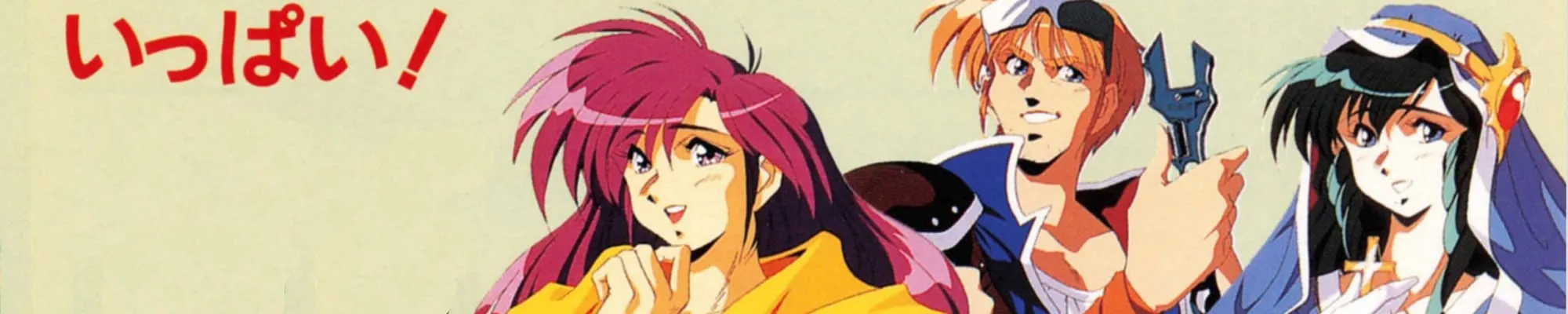
In the span of two years from the summer of 2015 to 2017, a thread on the PC Engine Fans forum accrued more than 600 posts about The Legend of Xanadu II, a 1995 Nihon Falcom RPG that had proven a beast of a game to hack. Halfway through that span, though, Xanadu had seemingly been conquered, with most of the posts devoted to redoing the pixel art title screen with new English lettering that matched the exact vibe of the original Japanese. The translation of Xanadu II, and its much larger predecessor released in 1994, seemed to no longer be in doubt.
"No problems so far ... once the voice-over is recorded, processed and inserted, it shouldn't be too long before we can release these (well, that means *hopefully* this year from my POV)," wrote hacker Elmer, in September 2016.
10 years and one month later, it finally happened: The Legend of Xanadu is here, and Xanadu II will follow soon. But you have to go back half a decade further to see where the project really began.
legend-of-xanadu-translation / legend-of-xanadu1-english · GitLab
GitLab.com
In 2011, young translator SamIAm, who'd just graduated from college with a degree in Japanese a few years before, bought a PC Engine and a copy of The Legend of Xanadu II. It was a system he'd long coveted.
"When I was a teenager and I was starting to study Japanese, one of the most exciting things was looking at all of the software that came out only in Japan and discovering what at the time was like hidden treasure," he says. "And the PC Engine had loads of it. I had played a lot of the Super Nintendo RPGs, stuff like Chrono Trigger and Final Fantasy VI. And I had also tried some of the fan translations that had come out, mostly on emulation. That scene was just getting going in the late '90s, and I was really impressed with what I saw. I knew that it was something that I wanted to do someday."
Partially drawn to Xanadu II's fantastic artwork, SamIAm found a willing partner for hacking the game: EsperKnight, a longtime translation scene figure who I spoke with at length about their work on the remarkable RPG Linda Cube Again. They seemed to be making fast progress at first, and were able to dump some of the Japanese text out of the game. Sam started translating — but when Esper tried to reinsert the new English script into the game, everything started breaking, and he didn't know how to fix it. When real life distractions for Esper like a new job and a young family reared their head, the project fizzled out.
So did progress on another game SamIAm and EsperKnight had hoped to translate: Chōjin Heiki Zeroigar, a 1997 shmup for the PC-FX. That's where things sat until Elmer entered the picture in 2015.
"Sam had made a bunch of posts about the work, and I could see that he was an intelligent, well-spoken fellow, Elmer says. "He was just stuck, not through his own unwillingness or inability to do it. And I thought that Zeroigar in particular would be fun to work on. And, you know, this guy needed help."
Today, Elmer is a retired game programmer with time on his hands to hack even the most confounding decade-old games. He started his career in the early 1980s, and still remembers how impressive the PC Engine and its CD add-on were when they arrived on the scene later in the decade.

"It was just night and day versus everything else that was out there at the time," he says. "Just seeing this thing, hearing actual music for the first time out of a home computer, instead of beep beep bop, hearing voices, was incredible. Hearing voices and then seeing something that, from a console point of view, looked very much like arcades at the time. So it was amazing. Always had a love for it, never got to program on it."
For the rest of us, that missed opportunity in Elmer's career turned out to be a good thing — the PC Engine is one of the few consoles he "never signed an NDA on."
"So I'm allowed to mess with it as much as I like."
Hundreds of hours of hacking on Xanadu across months of effort in 2015 eventually gave Elmer the confidence to promise that a fan translation would truly be possible. It was his first time hacking a PC Engine game, and it wasn't an easy starting point. But his experience from decades in the industry gave him the baseline skills he needed.
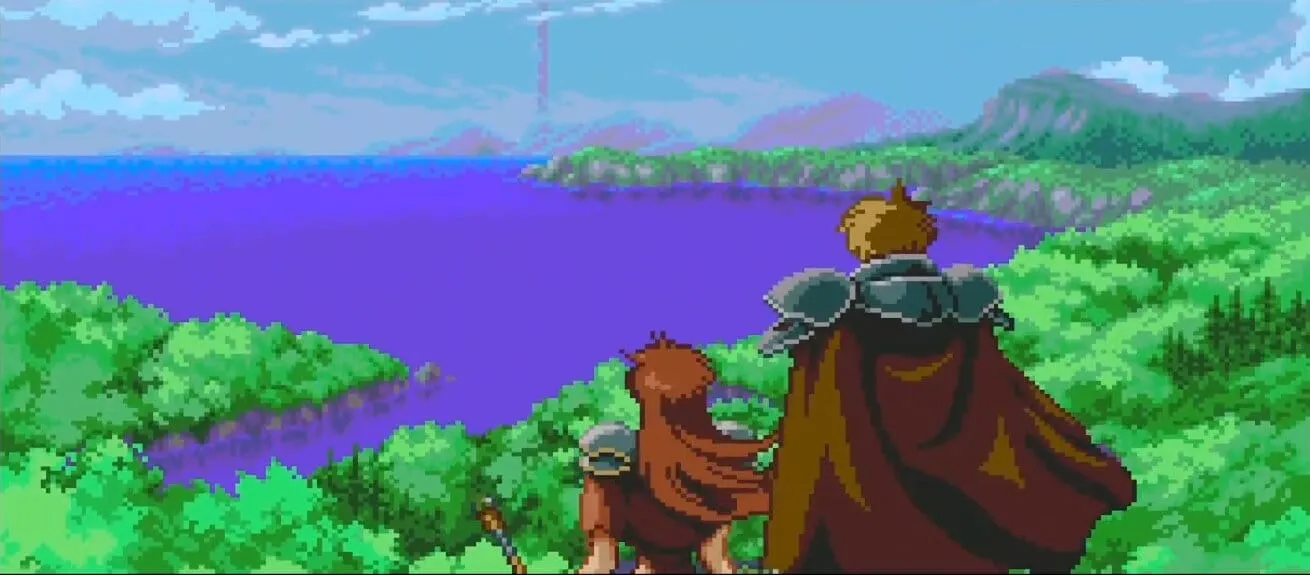
"Most of the PC Engine games that I've seen that were produced by Hudson for their RPGs tended to use large blocks of memory that stored strings — you would get a string block followed by a string block followed by a string block followed by a string block, all separately in their own big huge chunk of memory with no code or anything. So once you found out where the first block was and where the last block was, how much extra memory you've got for your translation, just take those, decompress them, and then you can change them to your heart's content.
"Falcom's engine was very, very, very different. It looks like the whole thing was put together in an assembler. So it's mixing code and strings willy-nilly. They often did put chunks of their script at the end, but it's only small parts of it. And because it's executable as well, the script can call assembly language functions and then come back into the script. Since it's all interleaved, it's not easy. So I had to write a complete script decompiler and another recompiler for it all afterwards."
Using emulator Medanfen, Elmer set to work figuring out exactly how the Xanadu games loaded their data, then faced down the challenge of how to fit his code changes and the inevitably more voluminous English text into the game's very limited memory. That required implementing his own compression method more efficient than the one Falcom used, shrinking the entire game's code down to make more space. Here's an excerpt from his development blog in late 2015:
The script table that is used to locate each item's description has been moved into some of my extremely-precious free space in the CD Boot Code section. That means that it is always available for reference/modification, which is needed for when the Game Code loads the level-specific item descriptions and overwrites some of the table entries.The item descriptions themselves have been moved into the bank of extra memory that I've freed by recompressing all of the game's data (the META_BLOCKs) with the more-efficient SWD5 compression.
I've written some new code that's been added to the Boot Code itself to actually load those item descriptions and then copy them into that bank.
All the "names" and "common" scripts are still in the Game Code overlay, and now that the item descriptions have been removed from it, there's plenty of room in the overlay for the larger translations.
FYI ... the current English translations that have been inserted are sometimes taking up to 50% more space than the original Japanese scripts.
Finally, Elmer had a proof of concept: He'd give Sam a bit of text to translate and then insert it into the game to prove it was working. That back-and-forth kept them motivated to make more progress. But once the tools were in place to dump all the text, those hundreds of hours of hacking culminated in a baton passing. "I literally dumped hundreds of files on Sam and walked away," Elmer says with a chuckle.
"I probably shouldn't say this, but I did a lot of the work on the translation while I was at my job"
At that point it was clear they'd be able to tackle both games, with the plan to release Xanadu I first. That would mean a whole lot more text to get through: about 240,000 Japanese characters for the first, and another 95,000 for Xanadu II. Along the way Sam also realized he'd need to throw out much of the work he'd done for Xanadu II when he and EsperKnight first attempted it, as many of his assumptions about details referencing the first game's plot weren't quite right.
Looking back, Sam says, he'd probably translate the Xanadu games by playing through them on one monitor and referencing the untranslated script on another. But back in 2015 he was just focused on the raw text files.
"I probably shouldn't say this, but I did a lot of the work on the translation while I was at my job, during downtime, which I had a lot of," says Sam. He was living and working in Japan at the time, so text files full of Japanese text and little bits of code didn't exactly draw scrutiny. Then he could run a small script inserter code that Elmer had created to insert the text into the game. It worked.
Sam wrote a complete script, translating both games line-by-line. Then he played through them slowly, tweaking English lines as he went and reinserting them until he was happy with how they looked — avoiding single words dangling on extra lines, for example — and how naturally they read in English. That process took months, and he'd occassionally deliver a new chapter to Elmer to play through and test as well. Along the way Elmer also made improvements to the hack, like a variable-width font with some nice, subtle drop shadowing that made the text more legible.
With a first English draft complete, one major piece of the project still loomed over Sam: Recording an English dub. The Xanadu games have quite a few cutscenes, and those cutscenes flexed the impressive-at-the-time power of the PC Engine to include voiced dialogue in Japanese. Your first reaction to the idea of creating a fan dub might be eww, don't waste your time — just let me listen to the Japanese voices with subtitles! But the problem was, those cutscenes didn't include text accompanying them.
With some audio editing experience and copies of the soundtrack CDs, Sam reckoned he could create a dub that would be quite easy to insert into the game, swapping out the audio files like-for-like. They put out the call for volunteer actors.
"It just always seemed to be the only sane way to do it," Elmer says.
But a decade later, with the patches still unfinished, they decided to do it the insane way instead.
"Amazingly enough, I didn't expect it, but there were ways to make memory available. There were ways to add code into each of the visual cutscenes"
"We did get a bunch of very talented people who were very willing to help us, and did," Sam says. "But how did we end up doing it the insane way? Well, it's harder to do a dub than it might seem. We were depending on a lot of people... I should have taken it upon myself to be stricter with people and tell them that if they weren't in a position to actually record for us, we needed to move on and find someone else."
Despite the best intentions of Sam and the volunteers, recording progress stalled out; Sam also had his first kid in 2016, and a second joined the family three years later. Even with much of the game translated and essentially "done," minus some needed polish, the cutscenes were too important to simply not translate. Time slipped by. While Xanadu was in stasis, though, other things were happening in the PC Engine translation scene.
"There are a couple Discords I'm part of, and I'd see people working on translations," Elmer says. "The translator Supper, it was just a shock when he did his first translation with [cutscene] subtitles, and I'm going why would you do that? How did you do that? I remember looking at it and thinking, 'okay, maybe I should take a look at Xanadu and see if it's possible, because it's obvious the dubbing has hit a roadblock. This would be a way to get the project finished.
"Amazingly enough, I didn't expect it, but there were ways to make memory available. There were ways to add code into each of the visual cutscenes. And the one thing that really surprised me was there were just about palette entries that I could use to display sprites. I thought they pretty much filled up the entire VRAM and used the entire palettes, but they hadn't."
With that breakthrough, adding subtitles for the cutscenes essentially became a tedious exercise in timing when the text should display alongside each bit of voice acting, and tweaking the timing of the cutscenes themselves to, for example, pause for an extra second or two between speakers so that the text is on screen for long enough. Sam would record clips of himself playing and then count the frames to determine exactly how a piece of a scene needed to be retimed.
"Falcom, in 1993, had limited tools and time and so what they had made was actually kind of rough in spots if you looked at it closely," Sam says. "There were places where the portraits were popping up a half-second early or late. But in those days it was all amazing anyway.
Since September 2025, the duo have been hard at work subtitling all those cutscenes and playing through the game for additional polish; in just the last few months they invited a small group of playtesters to help find sneaky typos and other issues.
Alongside the excitement of collaborating again and finally approaching the finish line was a near-daily stress over the idea that, in Sam's words, "we might get beaten to the punch." Last September the news broke that a publisher, Edia, had licensed several of Nihon Falcom's '90s games, including the Legend of Xanadu RPGs, for modern ports between 2026 and 2028. It was possible those releases would only be in Japanese — but it was possible that Edia could produce its own official English translations, too.
Sam and Elmer were also afraid that someone could drop a slapdash AI translation at any point, too. "We don't want to be taking the stage after some slop translation," Sam says bluntly.
"One of the things that attracted me to doing this was having had all those years of real deadlines [in game development], the idea of going way back in time, and taking all the time you need to do the absolute best job that you can do," says Elmer. "Literally throwing decades worth of experience, all the tricks that you can possibly do to make something look good — that made the project fun, from my point of view. And I believe people see that on the screen."

Elmer pushed the LoX I translation live on October 27, marking the finish line for a project Sam had started tinkering with just a few years after college.
Even after all this time, both still light up when they talk about the Xanadu games themselves — not a guarantee for hackers or translators, especially after such a lengthy process.
Here's Sam:
"All this time, I've felt like Legend of Xanadu really is a good game. And I've always believed in it. I think it's a really remarkably well-written JRPG. You know, I spent a lot of years playing a lot of 16-bit JRPGs, not just the heavy hitters like Chrono Trigger and Final Fantasy, but all sorts of stuff. I really think that they did a remarkable job in composing the words and the story. They had a writing team of six people, and I don't know what their process was, but they made something unique. This game has a thousand little interesting conversations, and that's where the real richness of it is, I think. They made so many characters and situations that are charming and memorable and endearing.That's always helped a lot. It's made it easy to come back to it. And I feel lucky to be able to have touched it somehow.
It doesn't work the same way as a Squaresoft game, where it builds towards this huge apocalypse and you go through deep personal crises. It's all just a sort of lighthearted, but at times still serious, adventure where you just get to encounter a wide variety of characters. I do think Legend of Xanadu 1 is extremely well written and I hope that the translation gets some of that across."
Legend of Xanadu director Yoshio Kiya, one of Falcom's first game developers, "brought about this first wave of action RPGs, not just for Falcom but really in all of video gaming," Sam adds. "He was a big star of this first generation, and Xanadu [released in 1985] was his first major project at Falcom; he made a few games after he left Falcom when [Legend of] Xanadu was finished, but this was his last really big project. I would try to get people excited about the game by explaining that this is the last masterpiece of one of the early gaming's real masters."
"I've heard it described as the best of early [Falcom]," Elmer adds. "They threw in absolutely everything that they'd learned over a decade of development of RPGs. It was the last game of classic Falcom, where all the techniques, everything was thrown in. And then Yoshio Kiya left, and it was the second generation of Falcom, and you get a very different game in Falcom than in [Legend of] Xanadu II... I can see the passion the developers put into it, so I'm very happy that more people will have a chance to play it. I look forward to hearing the comments from people about the differences in the games and what they like about the different styles and the different choices the developers made."
The Legend of Xanadu II patch still needs a bit more testing before it's ready to go, but its release should be measured in weeks, not years. Just in time, perhaps, for a cozy back-to-back playthrough over the holidays. This close to the finish line, it seems like the odds are low that even a rabid vibecoder could beat them to the punch with a slop translation.
"I don't think we have to race," Elmer says. "But I think we should. Because it's been... these things have been cooking a long time."
💸
2. Lovingly crafting The Curse of Ogaeritō
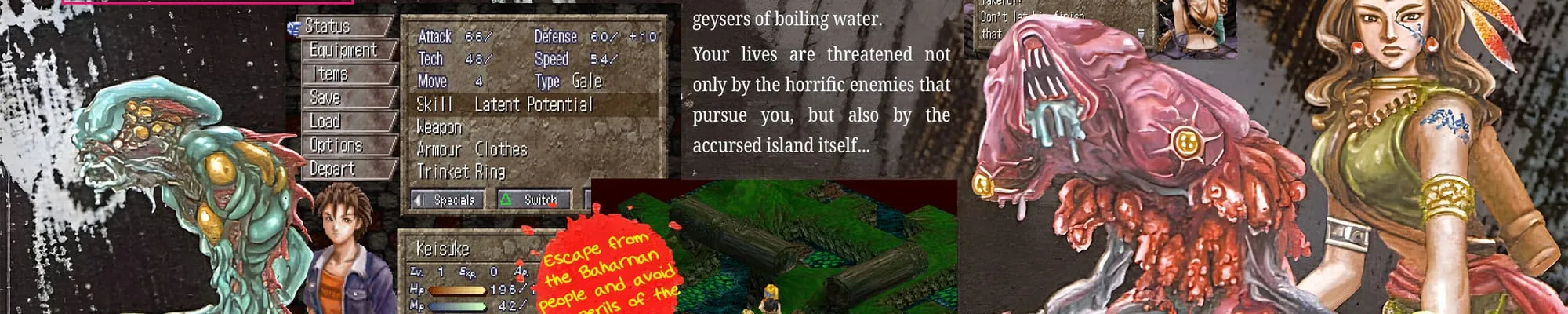
"I'm always looking for weird and obscure games, particularly PS1 ones," says Chapu, the romhacker behind Tiny Bullets, Wonder Trek, and several more fan translation patches. He's had a prolific two years since arriving on the scene, hopping from one project to another with a decade-and-a-half career in software development backing him up. With The Curse of Ogaeritō, a Lovecraft-inspired JRPG, he's tackled his most ambitious so far, with a couple return collaborators: Translator whowasphone404 and graphics editor vervalkon.
Whowasphone404 appeared in ROM just a few months ago for Zool, another RPG, though he tells me that after getting his start as a fan translator with visual novels, he was originally apprehensive about taking on the more complex genre.
"I was initially reluctant because translating RPGs is more difficult than translating horror visual novels," he says. "With an RPG you have single words (usually item and stat names) and lines that are seemingly unconnected. Often it is hard to tell what they refer to, and where exactly that word will appear. This often results in odd translations." But after working together on Misfortune: A Story of Suspicious Friendships, Chapu knew that Whowasphone404 was a sucker for horror, and brought up one of those obscure PS1 games he remembered reading about on RPGamer years ago. And that's how Ningyo no rakuin ended up with its first English release.
GitHub - ChapuTranslations/NingyoNoRakuinEnglishPatch: Code and assets to translate the PS1 game "Ningyo no rakuin" from Japanese to English.
Code and assets to translate the PS1 game "Ningyo no rakuin" from Japanese to English. - ChapuTranslations/NingyoNoRakuinEnglishPatch
Whowasphone404 has been into Lovecraft's fiction in particular since playing GameCube horror game Eternal Darkness, and went the extra mile for this translation by referencing the H.P. Lovecraft Archive for common words and phrases that would make the English text feel particularly authentic. The game doesn't attempt to depict Lovecraft's cosmic horror, instead "preferring to just throw lots of different entities from the mythos at the player."
"I do believe the moody graphics and music manage to capture the atmosphere of his stories quite well," he says. "The game opens in a rainy jungle at dusk, and the player often feels outnumbered and overwhelmed by the enemies. The story takes some very dark turns, with some quite shocking imagery for a PS1 game. So there is a lot for JRPG and Lovecraft fans to enjoy. The story is mainly concerned with how a Japanese high school student would cope with the moral consequences of being forced to kill in order to save his girlfriend. Female characters and romance are notably absent from Lovecraft’s work, which makes The Curse of Ogaeritō an interesting take on the mythos. Setting the story on an island with “barbaric native rituals” might bring Lovecraft’s hideous views on race to mind. But the writers carefully avoided such issues by making Takeru, the native leader of South Baharnan village, the moral compass of the story."
Limited character space for item names and such made for a challenge adapting the Japanese text to Lovecraft's flowery prose, so Whowasphone404 scoured the archive for inspiration, and shared a few of his favorite adaptations:
For example, there is an attack called Blinding Sand. A direct translation of the description would be “Attacks by targeting the opponent's eyes.” But I thought such a generic line of text would be disappointing for a player to read, especially in a game based on the works of H.P. Lovecraft. So using the Archive, I found the following sentence in his story The Nameless City (1921): “I heard a moaning and saw a storm of sand stirring among the antique stones though the sky was clear and the vast reaches of the desert still.”Using that, I wrote a revised description for the attack: “A cloud of moaning sand assails the eyes.” Of course, translating the game in that way took twice as long, but I think the result was worth it. Certainly an LLM could never produce such a translation.
There are also several drinks which increase a character’s stats. These were easy places to include some deeper references. Items generally have two lines, one for a physical description and one to describe the in-game effect. However, the original Japanese was often repetitive, with both lines giving the exact same information. For example:
Fainting Cure
1 - Treats fainting symptoms.
2 - Effect: Cures faintingSo I was able to use the first line to make the translation more Lovecraftian whilst saving the second line to inform the player about what use the item has. Here are some first line retranslations:
Direct Translation
Sacred Alcohol of Stamina - Sacred alcohol that boosts staminaLovecraftian Translation
Van Buren Coffee - This exceedingly delicious, stamina enhancing coffee was brewed by a beloved grandfatherReasoning
Whipple Van Buren Phillips was Lovecraft’s grandfather who took care of him after his parents died and introduced him to horror literature. He was very active in his local community and must have had a great deal of stamina to also take care of young Howard. However, he was a Mason who took a vow against drinking alcohol, so “Van Buren Wine” would have been wrong. Lovecraft himself was an avid coffee drinker, so I thought this was the next best choice.
While developing the patch to implement Whowasphone404's work, Chapu primarily used PCSX-Redux, the emulator he believes has the most "modern and modular" debugging tools: "You can have subwindows with different tools open up at the same time. You have everything you need: from basic things like registers, breakpoints, instruction disassembly, and RAM viewers to super specific stuff like full GPU debugging, a local web server, Lua scripting integration and a tons more." He pairs that with Ghidra and psx_ldr for disassembling PlayStation code.
Just like with the challenge Elmer had to contend with in The Legend of Xanadu, the text in Ogaeritō wasn't simply stored in clean strings of Japanese, but had other code mixed in telling the game how to display it. "Common is games not using simple pointer tables to reference the text, but rather convoluted systems, usually involving sub-segments with some semantic meaning (e.g. cutscenes, item descriptions, character names, etc.) which are referenced by offsets from a starting point, or have their sizes stored and used to calculate where each one starts," Chapu says.
In this case, "each main block of dialogue text was structured in a variable size of sub-segments, the amount of which was stored at the beginning of the main block, followed by their offsets/sizes. So when reinserting the translated text I needed to recalculate those offsets to keep everything working."
Chapu shared what the translation process looked like once he was able to dump the game's text:
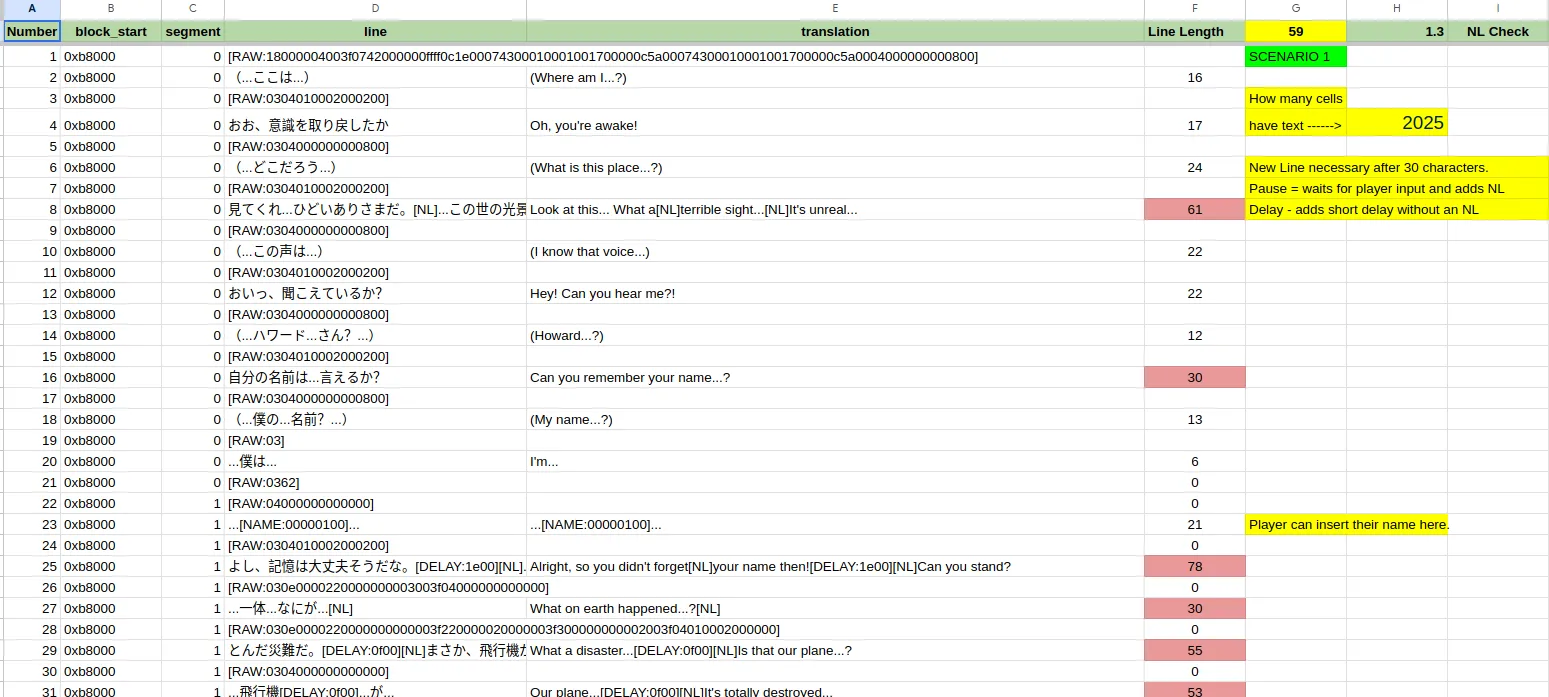
The bits in brackets represent bits of interpeted code that would trigger a new line or a delay before the next text would start printing on screen.
Even though Ogaeritō was relatively simple to hack compared to some games we've featured in ROM before, "every game is different and poses its own unique set of challenges and learning opportunities," Chapu says:
One good example that comes to mind is this: during battles, certain spells will give characters status ailments ("poisoned", "terrified", "paralysed", etc.), which display a beautiful animation with the corresponding name. This name is a compressed TIM image. The compression itself was a pretty straightforward implementation of LZSS (an extremely common compression algorithm for PS1 and other consoles in the same era, due to the fact that it has zero memory footprint during decompression and it's lightning fast), but the compressed blocks were stored basically in back-to-back CD sectors in the main data file. So, of course one of the modified images was slightly larger than its original Japanese counterpart, which made storing even the compressed data in the alloted space impossible. I had to debug until I found where the table that stored the sector numbers where each compressed image was stored and modify the values just to make room for it. I learned a ton about CD sectors and timestamps in the process, so it was great!
Those new skills will no doubt come in handy with future PS1 games, and we're blessed to have a group putting in this kind of work while AI translations flood the scene. Here's the least scary thing about The Curse of Ogaeritō: the sign-off Whowasphone404 put together for the patch's announcement post.
This complete English patch of the game was completed by the following people;
- Chapu - Programming
- LaytonLoztew - Playtesting
- vervalkon - Graphics
- whowasphone404 - Translation
This translation was completed by human minds and human hearts across the globe.

The accursed, soulless influence of LLMs will not be found within.
3. The time has come for Time Twist

Remember that episode of the original Star Trek in which Kirk and crew have to defeat Jack the Ripper? Who, it turns out, was not just a serial killer in 19th century London, but an immortal entity that'd spent millenia hopping between bodies to go on endless murder sprees? Well, the 1991 Nintendo co-developed adventure game Time Twist isn't quite that story, but it does involve a kid getting his body stolen by a demon, then traveling back in time and posessing people during famously fraught historical periods.
Joan of Arc shows up for 15th century French witch trials; Hitler makes a deal with the devil while you're trapped in a Nazi POW camp; even the KKK are here when you arrive on a southern plantation during the American Civil War. Can you imagine 2026 Nintendo making a game with the Ku Klux Klan in it?
Well, 1991 Nintendo didn't exactly make a game iwth the Ku Klux Klan in it, either — Time Twist was primarily developed by Pax Softnica, which the company had collaborated on more closely for two previous Famicom Disk System adventure games. But Time Twist does feature Shigeru Miyamoto's name redacted from the final shipping credits, and director Keiji Terui (who also wrote the backstory for the original Legend of Zelda) said that Miyamoto's request for "a unique and ambitious work" is what ended up inspiring the time travel plot.
GitHub - romh-acking/time-twist-fds-en: A complete English translation of Time Twist for the FDS
A complete English translation of Time Twist for the FDS - romh-acking/time-twist-fds-en
"While playing this game, it's amazing Nintendo put their name on it," writes hacker FCC in the readme for their new English translation patch, released this past week. It's been in the works for more than a year, and is the first human translation of a game that's long been a target for folks who know about the obscurities of the Famicom Disk System.
A little over a year ago, a video from YouTuber Dungeon Chill raised Time Twist's profile, causing a bit of discussion as well as inspiring some AI-coded translations. They were, unsurprisingly, not great: FCC explained they "ran into the FDS's harsh RAM limitations and had some major problems such as crashing and dropping dialogue lines."
He wanted to do better.
"It was an attractive target for both being wild as a game and for being a challenge to hack," he told me.
"I have experience hacking various other Famicom and Famicom Disk System games. This is the only one that had to have some sacrifices to the script for the sake of space. All my tools were custom-done, except for the assembler. Hacking games is always a unique challenge, but for the FDS more so. Everything is stored in RAM, so you have to get creative while understanding the FDS's limitations."
FCC started hacking Time Twist last year, and got to the point where he could dump the original Japanese text and re-insert it for dialogue, but not for menus. Referencing one of the AI patches helped him discover the bit of code he was missing. And by the time he resumed work, something fortuitous had happened: aspiring translator Sudgy had released a complete English script for Time Twist.
"When I returned, I was pleasantly surprised I could use an already translated script," FCC said. "I imported the script and made adjustments to fix mistranslations, formatting, and fit in the space constraints."
Sudgy is candid about their current localization skills, writing: "I am using this project as part of my process of learning Japanese, and as such, the translations are not professional in any way, and there might be mistakes. I feel like a lot of the fine nuance present in the original Japanese is lost in my translations (especially things like accents), although the general idea is still there." So we can imagine that were Nintendo Treehouse to localize this game today, they'd likely take plenty of liberties with the original script and embellish it in ways that suit the English audience. On the other hand, given the limits of an 8-bit system, Time Twist's text is pretty simple compared to the verbose prose of modern games — and also there's zero chance Nintendo will ever translate or re-release this game for the next 1,000 years.
Given those points, I think FCC and Sudgy's work here is a great way to experience a truly Twisted bit of Nintendo history.
Patching In

Eden inches towards Switch 2 emulation – In an update on Discord, one of Eden's developers wrote "As the Switch 1 and Switch 2 are architecturally very similar, we are accepting patches that allow Switch 2 games to run. Due to the relative immaturity of the surrounding exploits and tooling, don't expect any major breakthroughs or significant developments for a while." I'll be looking into this more in the weeks ahead, but for now, if you see an emulator promising full-on playable Switch 2 games right now: probably BS!
Azahar disavows Anbernic's RG DDS – Emulation has a tough enough time standing apart from piracy when hardware companies aren't promoting it directly, so I get why Azahar decided to make this public statement: "It has come to our attention that handheld manufacturer Anbernic has been promoting their latest handheld device, the RG DDS, using unofficial piracy-focused forks of Azahar, and has been openly featuring these forks in their advertising material," the 3DS emulator team writes. "We have decided that we will NOT be officially supporting this device or others from this manufacturer." Ayaneo Thor stays winning, I guess?
Xemu sees a flurry of graphical fixes, from Blade to The Godfather – Okay it's not just movie games: Xemu has been getting patches left and right this month, with graphical fixes for dozens of games. The emulator also supports Vulkan 1.4 now, nipped a memory leak in the bud, and fixed a performance regression specific to AMD drivers on Windows.
PCSX2 adds custom settings icon – A nice little UI improvement for the PCSX2 emulator: any games that you have custom settings configured for gets a little gear icon. Helpful if you have a lot of games installed and don't remember offhand which ones you've tinkered with!
Core Report

Jotego doubles down on quality in the AI era – "As more and more people are using AI to produce cores, I feel less pressure to publish new cores and more freedom to do research and validation work," the FPGA developer writes. "We are re-evaluating how the work gets executed and we are adjusting out setup, including computers, arcade PCBs and the several FPGA platforms to execute a workflow with a higher standard of quality and accuracy." Lots more details in the Patreon post. He's also going to be moving some work-in-progress to a private Github because "some people have copied files from contributors while they were in the merge-queue of GitHub in order to get two minutes of fame." Cool. Cool cool cool.
Console Mode adds playtime, USB disc dumping, and more – Taki's MiSTer UI has seen a major 1.2 update and then several more incremental ones in the past week or so, adding the ability to dump PS1 discs from a USB disc drive, playtime to the game list display, and improved 1080p performance. The biggest add of them all may be 1.2.3's introduction of themes: "Theme can restyle every screen. Lower Third is included, pick it in Settings > Display > Theme." A few bugs have been squashed, too.
Cruis'n without a bruisin' – David Haywood highlights that MAME contributors mourinx and R.Belmont have "greatly improved" the racing game's performance. I'm more of a World guy but I wouldn't turn my nose up at any Cruis'n.
Translation Station

What, you want more!? Okay, one more.
Cabal Translations goes for a retranslation of Kunio-kun's dodgeball debut – Redubbed Fiery High Dodgeball Club, the Famicom "Super Dodge Ball" as represented here should be much more faithful to the original game. Check out the classy font work here compared to the original, too.
Good pixels

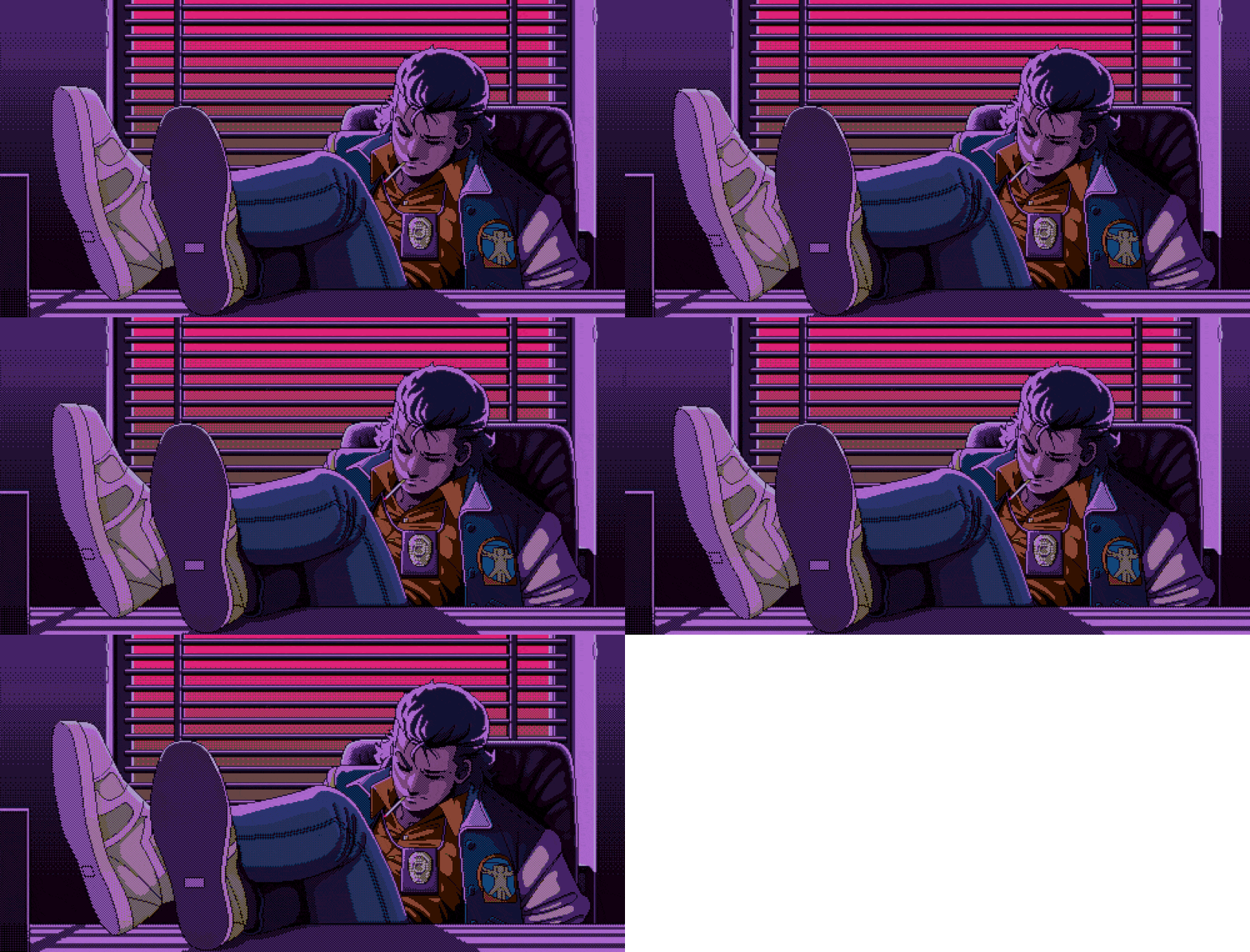
Finally, courtesy of Elmer, let's close this thing out with a bunch more screenshots from Legend of Xanadu I & II.
Sign up for Read Only Memo
Videogame emulation news and exclusive interviews, from the aesthetics of razor sharp scanlines to the wild technical challenges of making yesterday's games run on tomorrow's hardware.
No spam. Unsubscribe anytime.