Find, build, and load time-series datasets through one shared format.
Note
TimeNet is a pre-release project. Its public API and the TimeF format can change before 1.0.



Time-series datasets use many incompatible layouts. TimeF gives them one storage format. TimeNet provides one API to find, build, download, and load them.
TimeNet handles the data layer. Model training, inference, and evaluation stay in your chosen framework.
TimeNet Online Hackathon is live. Pick a time-series problem, onboard a dataset in TimeNet format, then train or fine-tune a Temporal AI Model (e.g. OpenTSLM) to explore what it can do. Choose any use case, from forecasting and classification to explanation, reasoning and beyond.
Register here: challenge.timenet.ai

TimeNet needs Python 3.11 or newer.
uv add 'timenet[cli]'
uv tool install timenet-connectors
timenet-build build timenet/hello-world
The build lands in the local registry at ~/.timenet/registry/timenet/hello-world/1.0.0/. Load it
with Python:
from timenet import TimeNet

dataset = TimeNet().load("timenet/[email protected]")
dataset.describe()

signal = dataset.records[0].signals[0]
values = signal.to_numpy()
TimeNet() reads the local registry first, and the local registry holds this exact version.
So the example works without registry credentials or network access.
See the Get started guide for installation options and a longer example.
A connector converts a raw source into a TimeF version. The version contains:
manifest.json, which identifies the dataset and lists its filescontrol.duckdb, which stores the hierarchy and relationships- a Parquet or Zarr values plane, which stores Signal values
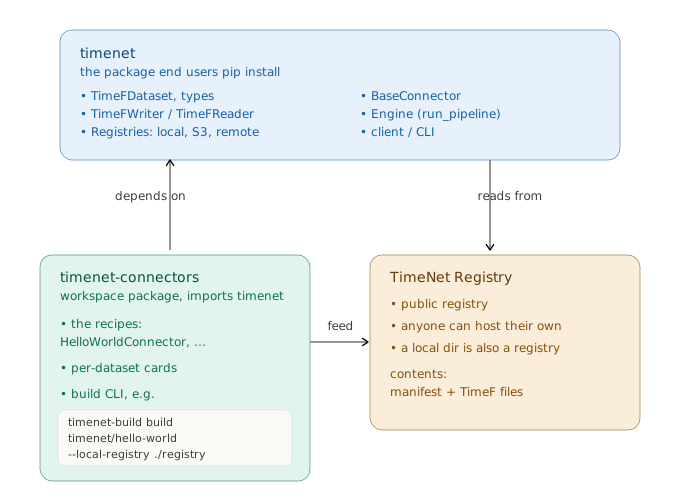
A registry stores immutable TimeF versions. The client reads a version without importing its connector.
The repository is a uv workspace with two packages:
| Package | Purpose |
|---|---|
timenet |
The TimeF model, reader, writer, registries, SDK, and consumer CLI. |
timenet-connectors |
Dataset connectors and the timenet-build producer CLI. |
Read the architecture guide for the complete design.
TimeNet uses the MIT License.
This license covers the TimeNet code, not the datasets that connectors fetch. Each dataset keeps its upstream license and access terms. Read the dataset licensing guide before redistribution.