Welcome! It’s another Sunday edition of the Animation Obsessive newsletter. This is our slate today:
As a reminder, our eight-day sale runs through the end of Monday (November 9):
Now, let’s go!
This summer, the files showed up on the Internet Archive. Then a social media user found them. By all appearances, they’re 3D models of the Giant from The Iron Giant (1999) — real ones, used in the production.
Artists quickly started to animate them. And the Giant came alive again.
The Iron Giant was one of Hollywood’s best animated movies of the ‘90s. Brad Bird already had respect in the business (he was key on The Simpsons), but this project made his name as a feature director. Its concept had rolled around at Warner for a while, partly formed, before Bird pitched his own take in ‘97. The core of that pitch: “what if a gun had a soul and chose not to be a gun?”
From the beginning, Bird intended the gun — the Giant — to be “a 3D character living seamlessly in a 2D world.”
Bird is a lifelong fan of hand-drawn animation; he’d learned the form at CalArts and Disney in the ‘70s. “I think for me it’s even more magical [than computer graphic animation] because it announces its artificiality in every frame,” he’s said. But he didn’t discount the new medium. Toy Story really, really impressed him:
… I just flipped over it. It was everything that I had been waiting for our generation to do. It honored everything that the old guys taught us that matters, which is: character, and story, and character, and character, what is your character thinking, what is your character feeling, character, character, character, character, character — that’s the reason you do character animation, that’s the beginning and end of it. … Toy Story was both absolutely fresh and absolutely classical.
Which was his thinking with The Iron Giant, too. Bird wanted to channel the old lessons in its characters, and even the Giant needed to belong to that world. “The CGI had to be as emotive as the 2D animation,” he said.
Pairing 2D and 3D artwork wasn’t new when The Iron Giant got going. Disney did it throughout the ‘90s. Bird had his own ideas, though. “I’m a big fan of CGI, but I had trouble in the ballroom scene of Beauty and the Beast,” he said, “because it felt like a computerized ballroom with 2D characters in it.”
The goal this time was to make every element fit together on screen, both aesthetically and emotionally.
Lots of technical invention was involved. Crewmember Brian Gardner built a system called “Gartoons” that allowed the Giant’s simulated lines to wobble and vary in thickness, among many other things. The artwork needed irregularity to capture that more hand-drawn look. In a lot of ways, the team was emulating Japan’s mechanical animation, as Bird admitted:
... we wanted to pretend that we had the best, most exacting artists hand-drawing this giant. I told the team, “There are these amazing Japanese animators who hand-drawn these meticulous vehicles in space, and they’re pretty accurate. That’s how our giant should look.”
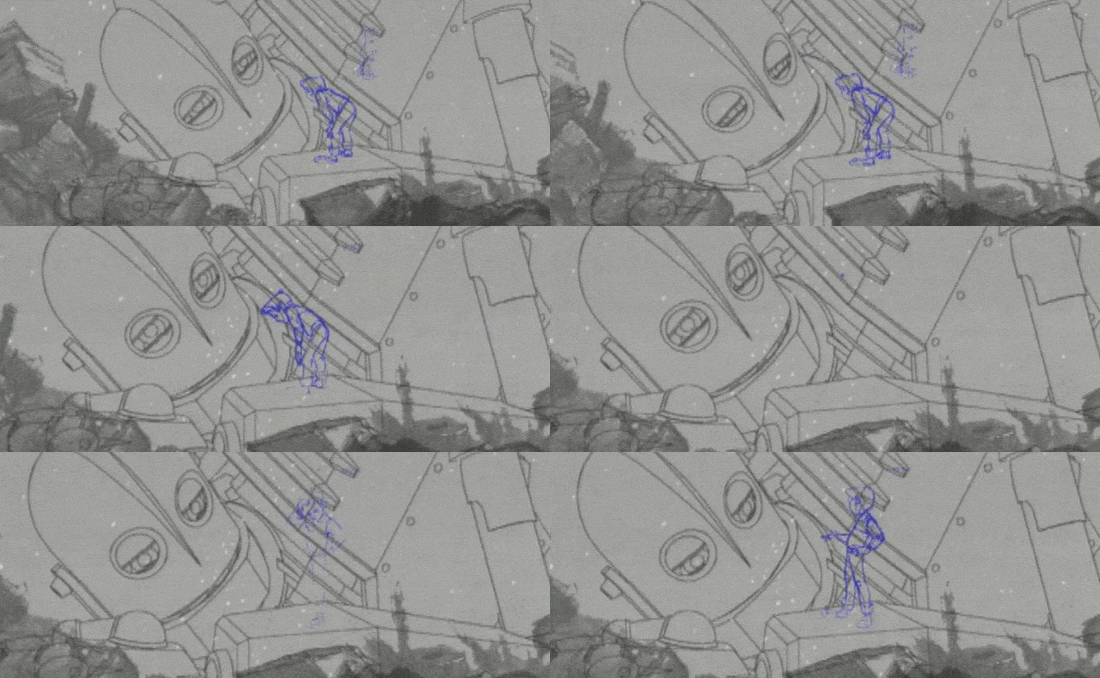
Making the 3D parts interact tightly with the 2D characters — which were drawn physically, with pencil and paper — was all-important. The movie wouldn’t work if Hogarth and the Giant couldn’t touch. So, Gardner made it possible to print the 3D animation frames onto paper with peg holes, to guide the 2D staff.
That said, meshing the two halves wasn’t only down to technical solutions. A good deal of the work lay in design and animation.
The Giant’s final design, based on a train, came from Joe Johnston (Star Wars) and the team’s artists Mark Whiting and Steve Markowski. The character ended up with “minimal shapes,” simplified lighting and a pretty small color palette. Which helps to match him up with the 2D art — he looks like he’s “from a different planet, not a different movie.”
His design also needed acting capabilities. And Whiting’s concept art suggested that the Giant’s face could emote through its eye shutters and mouth, especially when combined with camerawork.
“If you’re shooting up at him, it’s gonna give him more of a sad face, because the curve is gonna be going down,” Whiting said. “If you’re shooting down on him, it’ll look a little more like he’s smiling.”
Reportedly, the film’s several Giant models were all constructed by artist Hiroki Itokazu. The ones on the Internet Archive (copied from a disc tied to Brian Gardner’s name) would be his work. They’re remarkable, and very ready to spring to life.
Yet figuring out the Giant’s movement in the first place, and bringing it up to the quality of the 2D animation, wasn’t straightforward. Steve Markowski, head of the 3D animators, said that the “biggest challenge was getting a lot of emotion and acting out of a big metal character.”
Markowski’s background was mainly in 2D; the same went for his crew. They relied on that experience here. Animation was done on Silicon Graphics computers with the beta edition of Maya (the software didn’t hit retail until 1998). Markowski noted that, with Maya, it was “easy to make the interface simple for a 2D animator who’s not trained in 3D and not real technical.”
Perfect smoothness wasn’t the major thing for the Giant’s movement. In fact, even the 2D animators didn’t focus on it above all. As Bird said:
People … get very impressed by how smooth the movement is, and how many little lines you can see; that’s nice but that’s not the main meal. The main meal is the quality of movement in terms of character. I wouldn’t mind if the film were even a little rougher and cruder if I could tell the characters each had their own vocabulary of movement.
Again, there was a technical side to ensuring that “the Giant felt as warm as the 2D did,” to quote Bird. Gartoons added those wobbly lines, and it allowed the digital colorists to work with the Giant much like they worked with the 2D art. It enabled frame-rate modulation, too. Here’s Bird:
The computer wants to animate everything on ones, which is 24 drawings a second. Whereas 2D animation mixes it up ... Slow movement works fine on twos [12 drawings a second] and in many cases looks a little more stable, if it is really slow. … The great Disney animation goes back and forth very artfully between ones and twos. … [S]o when the Giant was doing slower movements, we tried as much as possible to make it go on twos, so that it felt like it was in the same universe as the 2D.

Still, as with all parts of the Giant, software couldn’t solve everything. The 3D animators needed to deliver acting, which they did.
In late 1998, the team watched the “souls don’t die” sequence in rough-animation form, with no color. “The Giant is trying to process what death is, and he’s literally lying on top of scrap metal — dead machines, and by the end of the scene, he’s rolled over on to his back and is looking up at the stars,” Bird explained.
Even with this massive character, the performance was already subtle, touching: the searching eye movements, the slight opening and closing of the jaw. The Giant was left to sell the scene even more than Hogarth was. And it worked. “Everyone in the room was crying,” Bird remembered. “And it was like... if it has that kind of effect now, at that level of completion, we’re gonna be just fine.”
Back in 1999, not everyone could tell where the 2D drawings ended and the 3D models began in The Iron Giant. It’s a bit more obvious with today’s eyes. Even so, the effect of the film is still right there. Hogarth and the Giant feel like they belong together in the scenes — in their interactions, designs, colors. And both of them feel alive.
Every year, it gets easier to learn and make animation by yourself. Guides multiply, and a certain free program grows stronger and stronger — namely, Blender.
There’s an open door, and self-taught animators are stepping through. One of them is Steve Grossman, a senior audio programmer at PlayStation (in California) who has a side project in music. Recently, he spent a year making his own music video. And he learned animation, Blender, Procreate and DaVinci Resolve to do it.
Look at Me! is the title. By email, Grossman tells us that its intro shot was “the very first thing [he’d] ever made in Blender” — he had to redo it four or five times.
Grossman wanted his video to put across the feelings of “loneliness, detachment and madness” he got from social media, all inside a virtual space “constantly melting and folding in on itself.” These are discordant images in the glitch- and net-art (or even Brian Tessler) vein. Grossman cites Tame Impala and Tool videos, and Silent Hill’s “symbolic character designs,” among the influences.
“The main aesthetic inspiration was this visual of me looking into a digital dimension from the outside world,” he explains. Footage of him seems to reach out “from across a void.”
Grossman kept changing his process as he learned and tested stuff — he was a first-timer at most of this. In general, he filmed greenscreen footage of himself that he passed between DaVinci Resolve and Blender a few times, building up layers of effects. A lot of Blender and Procreate animation filled out the rest. The early part with the robot was especially tricky: he was “very new to weight painting,” and nailing the environment wasn’t simple, either.
Throughout the project, he leaned on his sketchbook. “Try to solve as many problems as you can on paper,” Grossman recommends now. After testing with sketches, he’d do trial runs in Blender, and then maybe go back to sketching, and so on. “[A]ll my favorite ideas come from this back-and-forth exploration,” he adds.
In our correspondence, Grossman makes it clear that he isn’t big on GenAI and kept it out of this project. He feels there’s “a tendency to shortcut the creative process” right now. The Look at Me! video looks this way, with these weird and compelling visuals, specifically because of the learning and problem-solving he did along the way. Those things affected him personally, too. As Grossman puts it:
Looking back on having created this video completely on my own, I wouldn’t want to miss out on those experiences. As dramatic as it may sound, I truly feel like the experience of creating this video changed me as a person.
Next February, Look at Me! will screen in Los Angeles at “Night of Shorts Night.” You can find it on YouTube in the meantime:
In America, Texas elected a new Attorney General — Nathan Johnson, composer for the English dub of Dragon Ball Z.
The Japanese animator Kazuya Kanehisa made an ad for the bookstore Honmachi Bunkado, in his Showa-era style.
A Mexican animated feature, La Venganza del Charro Negro, just became the country’s biggest film of the 2020s. It’s pulled in more than 208 million pesos (roughly $11.2 million) since October 22.
In China, a Bilibili user went viral with a narrated, no-visuals version of Frozen for the blind. Find it here.
Rintaro directed the animated sections for a new documentary in Japan.
The Mexican film Chronicles of the Caribbean (1982) is close to fully restored and is set to reemerge soon.
An animation worker was suspended from his job for attending the protests in France. The union SNTPCT argues that he did nothing illegal, and it’s pushing for his reinstatement.
In Chile, the excellent Scarlet Tamagotchi was nominated in three categories (including Best Short Film) at the national Pedro Sienna Awards. Trailer here.
Britain’s MAF revealed its online screenings for this year, including a making-of-Wildwood talk.
Also in Britain, animator Jason Ramasami will premiere his film Seed in late November, at the Hyde Park Picture House. We saw an early cut last year and liked it quite a bit — one to watch.
Meanwhile, a documentary about the long-running Quickdraw Animation Society in Canada debuts at the Globe Cinema in mid-November.
Finally, we wrote about the shorts program that powered Cartoon Network in the ‘90s, and changed American animation.
That’s our issue for today! Hope you’ve enjoyed. As we wrap up, here are a few personal thoughts from the two of us:
John: This past Tuesday, as we waited for the good news from the election, we went to see a movie at the theater. It was a fun break from my routine — we caught Wildwood. The film hasn’t blown up at the box office, and I’ve seen blame placed on the marketing, but I don’t really agree. Laika is fighting uphill. Its last two features were flops, one of which (Missing Link) would’ve killed most studios its size, and it hadn’t released anything new since before the pandemic. Wildwood isn’t doing enough to offset its huge budget, but it’s drawn a surprising number of viewers, and its distributor seems happy. Reversing Laika’s long downward trend in popularity is pretty impressive in itself.
Jules: This week I got the opportunity to participate in an authors’ fair at my local library. It was very educational and a lot of fun in general, but something that stuck out to me was that almost everyone who came up to my stand, from all walks of life, said that the kids they knew loved anime. Thinking back, I remember now how frequently I’ve heard anime brought up by parents or grandparents in the weekly painting club I go to. Anime was already extremely popular when I was younger, but I’m curious to see what happens to it next, in a world where it’s so ubiquitous that it’s nearly the new default.
Until next time!