Field notes · all posts
Our last post was about the day where we actually recorded the ATC audio, but in this one, we'll take a look at how we go from raw ATC audio to complete album. I'm going to follow one track all the way through, because it has the most interesting prompt and because it took seven tries to get right.
Let's take a look at how Archer Avenue for the MDW album came together.
A quick note on how the work is split between myself and AI, since people are always curious. I do the recording, the listening and the deciding. Claude Code does the parts that are scripts: splitting the radio into channels, laying the calls onto the music, and rebuilding a track when I leave a comment. The beats themselves come from Suno. More on all of that below.
Start with the place, not the music
For a new airport album, I start by asking Claude Code to go research the airport and the neighborhoods around it: what music is significant to that city or that part of it, who lives in the surrounding area and mostly, what the place really "sounds like". For Midway that meant neighborhoods with bungalows on the southwest side, Chicago house, blues and soul, the Orange Line, and a dusk-to-night feel because that's when I was there.
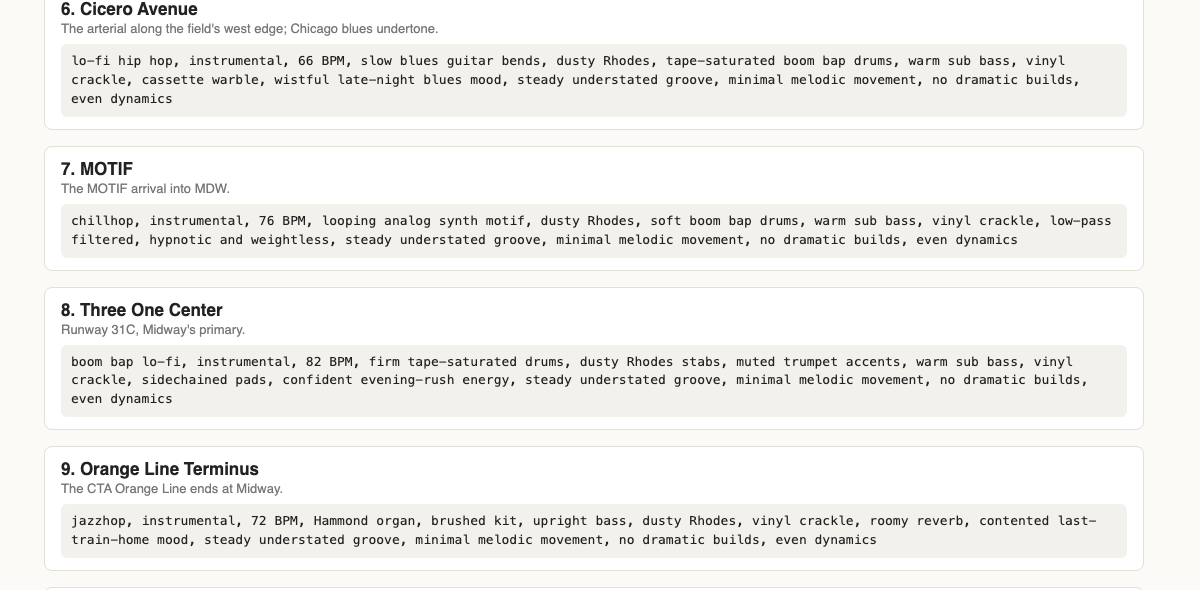
From there, we generate an "album kit", which is a concept for the whole album and about twenty candidate tracks, each with a title taken from the airport itself (a navigation point, the name of a taxiway, a nearby street, or something a controller might actually say) and style prompts for each one, written for Suno. The idea is that every airport gets its own set of styles instead of the same lo-fi beat with a different cover. Here's the one for Archer Avenue, the diagonal street that runs southwest through Archer Heights and Garfield Ridge:
lo-fi hip hop, instrumental, 71 BPM, soft nylon-string guitar accents, slow bolero-style rhythm on soft boom bap drums, dusty Rhodes, warm sub bass, vinyl crackle, tape hiss, warm corner-taqueria evening, steady understated groove, minimal melodic movement, no dramatic builds, even dynamics
Every prompt in the kit make sure to include "even dynamics" because this is background music and we don't want any huge volume spikes.

Suno generates two copies of each track for us to review
I paste the prompts into Suno and get back two versions of each track (four for the ones I think will be the headliners). Everything lands in one playlist, and then the real work begins: me listening to each track, comparing the duplicates and deciding which version is better, and generally cutting the album down from 20+ tracks to between twelve and fourteen.

This is the most opinionated part in the process, where I'm listening for things like: is there a hook and is it musically interesting without being busy? The sweet spot is something that's pleasant to actually listen to but can also fade into the background, because that's how I use all of these tracks. I want a couple of cool moments per track, I don't want it to sound like every other track on the album, and it still has to fit the background-music shape. For the MDW album, I started with twenty-one prompts and ended up with thirteen tracks on the album.
I then download the tracks I want to keep as WAV files and, just like that, we've got the music and the radio calls, but they're still not synced together.
Splitting a recording into channels
The radio signal we recorded at every airport isn't actually audio (yet). Instead, it's a slice of the radio spectrum, with every frequency from the entire airport sitting somewhere inside it. Using Claude Code, I built a pipeline that turns that into something usable by finding the signals that were actually active, demodulating each one into its own channel, cutting each channel into individual transmissions wherever someone was speaking up, scoring each clip by how clean it is, and running Whisper over the whole thing so we have a rough transcript to search.
For Midway that came out to about 1,700 transmissions across sixteen channels. Some of those channels are gold and others are forty-five minutes of the automated weather broadcast (repeated over and over) because I had the monitor misconfigured, which is a lesson in and of itself.
Pairing a song with a frequency
Each track on the album uses a single frequency across the entire track to avoid the problem of it sounding like just random radio calls. If you're going to feel like you're listening in, you need to stay on one frequency and hear both sides of the conversation.
Claude Code proposes these pairings based on real stats around how much clean voice a channel has in a given stretch, how often the conversation flips between controller and pilot, etc. Then, I override it when I disagree. Archer Avenue's radio calls are the approach controller lining arrivals up for the runway and handing them to tower, which is fitting for a track named after a street underneath the final approach.
The build
Originally, I was using GarageBand to import the radio calls, trim them to the length of the song, and nudge things around. But after doing one track that way, I started thinking about whether we could do it with a script instead. The answer was yes, and the script is what every track has been built with since. This script has some relatively specific rules, though:
- Use the transmissions in the order they happened, and prefer exchanges where you hear both the call and the readback. A pilot transmitting into the void is a last resort.
- Never go more than about twenty seconds without a call, and don't let replies come back unnaturally fast.
- Level each speaker separately so no single call jumps out. Because this is background music, we want to make sure there are no crazy volume jumps.
- Run the channel's own hiss quietly under the whole track so the radio coming in and out of silence is less noticeable.
- Master every track to the same loudness, with the music and the radio kept as separate stems so the player on this site can give you a slider for each.
A full build takes about thirty seconds per song and the first version of Archer Avenue came out with seven radio exchanges back and forth.
The review page
Next, I have to review every track to see how it sounds. I quickly realized that it would be very slow to copy/paste timestamps of every edit I want for every track, so I asked Claude Code to build me a SoundCloud-style review page where you can leave comments at a specific timestamp.

My comments are usually pretty consistent: "the radio is too loud here", "It's loud and then suddenly quiet", "not enough voices in this stretch", etc. The one I wrote most on Midway was some version of "the music is nice and then the tower comes in and takes me out of it the groove." Claude Code reads the comments, works out what they have in common, changes what I asked for, and then builds a new version for me to listen to without reshuffling anything. This loop then repeats until I'm happy with how all the tracks are built.
Seven versions of Archer Avenue
Midway took the most rounds of review, and Archer Avenue went through all seven of them. The first version was fine musically, but had a sharp squeak every time the tower spoke. I assumed it was the recording, but it turned out to be a capture glitch: a short chirp and a burst of white noise that hit every channel at the same instant. Because the build was leveling each speaker up to voice volume, it was leveling the glitch up with them.
So version two ducked the bursts back down to the static floor. Version three notched the whistle out and leveled controllers and pilots separately. Version five got rid of the whistle's overtones, which I could still hear over the static. Version six fixed clicks in the static that we had introduced ourselves. None of this is glamourous and honestly, the track sounds the same to most people between version one and version seven, but it's important to me that a semi-trained ear listen to these things so it's the best we can be.

The rule I ended up writing down, after I'd argued myself out of making every track perfectly even, was this: not absolute evenness, not absolute randomness. If you were sitting there in a perfect world hearing both sides of the frequency, this is what you'd be hearing.
Titles, track order, and album art
Based on the radio calls, we're constantly shifting around titles until the last possible moment, but once all that's locked in, we need some album art.
The art follows the same logic as the music: it comes from the place the album was recorded. Each cover is a vintage travel poster built around the airport's actual runway layout, in a color palette that represents the area. O'Hare is the Chicago flag, and Midway is the Orange Line. Then the album goes to DistroKid for distribution on Spotify and everywhere else, the long mixes go up on YouTube, and the player on this site gets the two stems that people can mix on their own.

Take a listen
If you want to hear Archer Avenue, it's track thirteen on the Midway album, on this site, Spotify or YouTube. Happy listening!