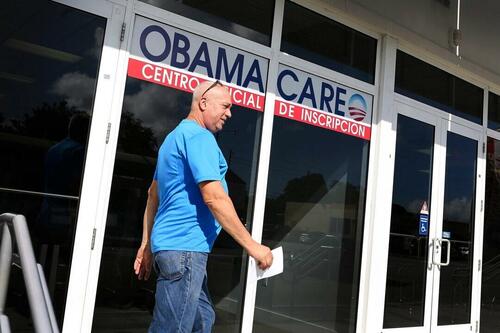
Obamacare remains on center stage nearly a week after the government shutdown ended on Nov. 12.
The health coverage program, formally known as the Affordable Care Act Health Insurance Marketplace, was a driver of the government shutdown as Democrats demanded that temporary enhanced subsidies for the program be made permanent.
The shutdown ended only after Senate Republicans agreed to hold a vote on the matter, though they did not guarantee an outcome.
Democrats generally favor making the enhanced subsidies permanent.

Republicans, including President Donald Trump, have proposed alternatives they say will give Americans greater control over their health care spending and lower premiums.
Trump made it extremely clear what his preferred approach is this morning in a FULL CAPS post on Truth Social: (emphasis ours)
THE ONLY HEALTHCARE I WILL SUPPORT OR APPROVE IS SENDING THE MONEY DIRECTLY BACK TO THE PEOPLE, WITH NOTHING GOING TO THE BIG, FAT, RICH INSURANCE COMPANIES, WHO HAVE MADE $TRILLIONS, AND RIPPED OFF AMERICA LONG ENOUGH.
THE PEOPLE WILL BE ALLOWED TO NEGOTIATE AND BUY THEIR OWN, MUCH BETTER, INSURANCE. POWER TO THE PEOPLE!
Congress, do not waste your time and energy on anything else.
This is the only way to have great Healthcare in America!!!
GET IT DONE, NOW.
President DJT
Lawrence Wilson explains below, via The Epoch Times, why Obamacare is a hot issue right now and what both sides are proposing.
Premiums Continue to Rise
Commercial health insurance premiums have risen every year since 2008, according to Health System Tracker, a data collection site run by the nonprofits The Peterson Center on Healthcare and KFF.
Obamacare premiums have also risen nearly every year since the program began in 2014, with the exception of 2020–2023. Those were the first years of the enhanced premium subsidies, authorized by Congress as a temporary response to COVID-19 health emergencies.
The enhanced subsidies allowed people making more than four times the federal poverty level to buy subsidized coverage. They also capped the out-of-pocket premium costs at 8 percent of a person’s household income, with the government paying the rest. The enhanced subsidies are set to expire at the end of 2025.
Rates have risen each year since 2022 and will increase about 26 percent in 2026, on average, for the Benchmark Silver plan.
Direct Payments to Consumers
Trump floated the idea of giving low- and middle-income Americans a direct payment of $2,000 rather than providing a subsidy that is paid to insurance companies.
That would allow people to purchase their own insurance, Trump said in a Nov. 8 social media post. The president added that this would avoid putting more money into a health coverage system that, he said, provided inferior health coverage.
The White House is in discussion with lawmakers about the idea, Trump told reporters on Nov. 14.
“I’ve had personal talks with some Democrats,” he said, adding that the plan would allow consumers to negotiate their own price with an insurer.
Sen. Rick Scott (R-Fla.) is drafting legislation for a similar plan now. His plan would send money directly to individual Health Savings Accounts, much like Trump suggested.
“They can use it to spend on healthcare, so they can buy direct health care, or they can buy insurance, or [use it for] a co-payment or deductible,” Scott told Reporters on Nov. 10.
Consumers could use the funds to buy any plan authorized by their state’s insurance commission, he added.
Scott and some other Republicans believe the enhanced subsidies drive up the cost of health insurance for everyone while masking the increase to consumers.

Sen. Bill Cassidy (R-La.) speaks during a hearing with Health Secretary Robert F. Kennedy Jr. on Capitol Hill in Washington on Sept. 4, 2025. Madalina Kilroy/The Epoch Times
“Insurers get paid no matter what—and taxpayers get stuck with the tab,” Sen. Bill Cassidy (R-La.) said in a Nov. 7 speech.
Increasing federal payments in the hope of decreasing costs is “like putting a band-aid on a broken bone,” Cassidy said.
“Instead of paying insurance companies to manage our money, let’s trust Americans to manage their own care—with a pre-funded Federal Flexible Spending Account,” he said.
A Flexible Spending Account is similar to a Health Savings Account but is not owned by the individual and does not roll over from year to year.
Addressing Fraud and Abuse
Republicans generally have been reluctant to extend the enhanced subsidies without also addressing abuse of the Obamacare system, which they say rose dramatically after those subsidies were introduced.
The expiration date indicates that the subsidies were not considered a long-term solution, Dr. Mehmet Oz, administrator of the Centers for Medicare and Medicaid Services, said in a Fox News interview on Nov. 16.
“It creates incentives for fraud,” he said.
Data indicates that 4.4 million people are enrolled in Obamacare, apparently without their knowledge, Dr. Oz said. He noted that, unlike 80 percent of health insurance holders, this population has never used their coverage for a doctor visit, prescription, or any other medical service.
“There are discussions around extending the subsidies, if we deal with the fraud, waste, and abuse,” Dr. Oz said.

Administrator for the Centers for Medicare & Medicaid Services Mehmet Oz speaks during an event in the Oval Office of the White House in Washington, DC, on Oct. 16, 2025. Kevin Dietsch/Getty Images
Temporary Extension
A bipartisan group of House members has introduced a bill to extend certain tax credits for Obamacare enrollees, which are set to expire at the end of the year.
The bill, sponsored by Rep. Jen Kiggans (R-Va.) and Tom Suozzi (D-N.Y.), would extend the “enhanced” premium tax credits for one year, avoiding an abrupt end to a financial benefit many Americans have come to rely on.
“While the enhanced premium tax credit created during the pandemic was meant to be temporary, we should not let it expire without a plan in place. My legislation will protect hardworking Virginians from facing health insurance bills they can’t afford, thus losing much-needed access to care,” Kiggans said in a statement.
Sen. Jeanne Shaheen (D-N.H.), a retiring lawmaker who helped negotiate the end of the shutdown, voiced optimism that a bipartisan solution is possible.
“I think there are a number of them who are very serious [about working to lower health coverage costs],” Shaheen told reporters on Nov. 10. She added that any solution would have to address the expiring subsidies.
Separately, a group of 32 bipartisan House members wrote to Senate leaders asking that they be included in any discussions on the upcoming health care reform vote.
“If we work together, our hope is that the bill will not only achieve a sixty-vote majority in the Senate, but will also then move to the House for immediate consideration and passage,” the group wrote, led by Kiggans and Josh Gottheimer (D-N.J.).
Adding Income Cap
Reps. Sam Liccardo (D-Calif.) and Kevin Kiley (R-Calif.) have introduced legislation to control the cost of extending the enhanced subsidies by imposing an income cap on recipients.
Currently, anyone earning over four times the federal poverty level can qualify for the subsidy. This proposal would cap enrollment at six times the poverty level, or $192,900 for a family of four.
“This will provide short-term relief while we tackle broader reforms to lower the cost of care,” Kiley said in a Nov. 10 statement.
The plan would save approximately $5 billion over two years, the congressmen estimated.
The Senate is expected to vote on changes to Obamacare by mid-December.
That gives the 20 states and the District of Columbia that operate their own Obamacare marketplaces, plus the federal marketplace, about two weeks to make adjustments to their subsidy offers before 2026 coverage begins. Annual enrollment for Obamacare has been open since Nov. 1.
Any solution approved by the Senate must then pass the House and be signed by the president to become law.
Loading recommendations...