From the icy crusts of distant moons to the oceans beneath their surfaces, the solar system is teeming with hidden water.
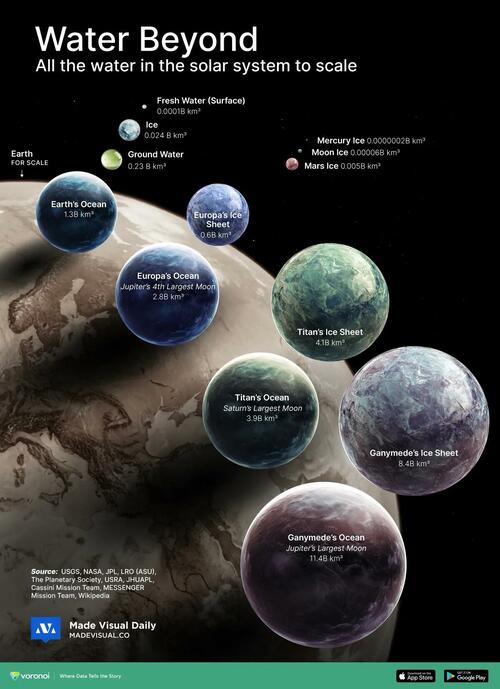
This visualization from Made Visual Daily, via Visual Capitalist, compares all known and estimated bodies of water in our solar system, including those beneath the surface, on a volumetric scale.

The data comes from sources including USGS, NASA’s Ocean Worlds program, and a variety of planetary science missions, like Cassini and MESSENGER.
Comparing Water Volumes in the Solar System
Below is the full breakdown of water volumes by celestial body or source:

Earth’s ocean holds 1.3 billion km³ of water, but that’s dwarfed by subsurface oceans on other moons. Ganymede, for instance, is believed to host 11.4 billion km³ in liquid water beneath its ice shell—nearly nine times the volume of Earth’s oceans.
The Surprising Abundance of Extraterrestrial Water
When thinking of water in space, Mars or icy comets may come to mind, but some of the most significant reservoirs lie within the interiors of moons orbiting the gas giants. Jupiter’s Europa, with its estimated 2.88 billion km³ ocean, and Saturn’s Titan, with nearly 4 billion km³ beneath its surface, are standout examples.
These “ocean worlds” are central to current astrobiological research. According to NASA’s Ocean Worlds program, the presence of water increases the potential for life, making these moons high-priority exploration targets. Missions like Europa Clipper and Dragonfly are being developed to investigate these alien seas further.
How Do We Know There’s Water Out There?
Scientists use a combination of techniques to detect extraterrestrial water: gravitational field measurements, ice-penetrating radar, and spectroscopy are just a few. For instance, the Galileo and Cassini missions provided crucial insights into the internal oceans of Europa and Titan.
More recently, researchers have proposed new techniques to identify liquid water on exoplanets, using infrared signals from water clouds or oceans to analyze distant worlds.
Reframing Earth’s Place in the Water Hierarchy
While Earth is often dubbed the “blue planet,” it’s far from the wettest body in the solar system. Including underground and frozen sources, Earth’s total water volume still trails several icy moons.
This context reshapes how we think about planetary habitability. As our understanding grows, it’s increasingly likely that life-supporting conditions may exist far from the traditional “habitable zone” around stars.
Check out similar space explorations like Top 10 Star Systems with Earth-Like Exoplanets on the Voronoi app.
Loading recommendations...