Authored by Simon Watkins via OilPrice.com,
Trump designates Saudi Arabia a “major non-NATO ally,” marking a dramatic turnaround from years of strained relations marked by an oil price war and diplomatic freezes.
In return, Washington expects Saudi Arabia to align more closely with U.S. interests.
The U.S. expects Riyadh to help keep prices within a “Trump Oil Price Range” of roughly $40–80 per barrel.
From the beginning of Donald Trump’s first term in office in 2017 to the start of his second term earlier this year, the relationship between the U.S. and Saudi Arabia shifted between tense and downright hostile.
Those years included an Oil Price War, the de facto Saudi leader labelled a murderer, and all lines of communication between the two sides grinding to a complete halt.
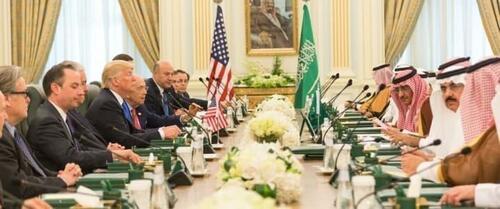
However, as Trump and Crown Prince Mohammed bin Salman (MBS) sat next to each other at a black-tie dinner at the White House last week – with the former designating the latter’s country as “a major non-NATO ally” -- all this must have seemed a distant past, and as L.P. Hartley put it: “They do things differently there”.
So, how does the future for the world’s top superpower and one of its top hydrocarbons powers look from here?

It is apposite to note here that this is not a meaningless designation from the U.S. for Saudi Arabia. Only 19 other countries -- Argentina, Australia, Bahrain, Brazil, Colombia, Egypt, Israel, Japan, Jordan, Kenya, Kuwait, Morocco, New Zealand, Pakistan, the Philippines, Qatar, South Korea, Thailand, and Tunisia – have such a standing in Washington’s eyes. Taiwan also has the same de facto designation, but does not officially enjoy the label, given the U.S.’s complicated ‘One China’ policy. Saudi Arabia’s new-found status also brings with it a host of economic and military advantages in its dealings with the U.S. and its allies, according to the State Department. These include eligibility for ‘loans of material, supplies, or equipment for cooperative research, development, testing, or evaluation purposes’, as well as for being a location for the placing of U.S.-owned War Reserve Stockpiles.
Saudi Arabia will also now be able to enter into agreements with the U.S. for its security forces’ training on a bilateral or multilateral basis, will be eligible for the priority delivery of ‘excess defence articles’ (including C-130 Hercules aircraft or frigates, at low or zero cost), and for the purchase of depleted uranium ammunition.
It will also be entitled to enter into agreements with the U.S. Department of Defense for research and development projects on defence equipment and munitions, and to procure explosives detection devices and other counter-terrorism research and development projects, among many other advantages. In short, Saudi Arabia is officially now regarded by the U.S. and its allies – including NATO members – as ‘one of ours’.
That said, this unofficial designation – and the official ‘major non-NATO ally’ counterpart – comes with its own obligations for Saudi Arabia. Beginning from a broad perspective, the Kingdom will be expected to tilt more towards the interests of the U.S. and its allies than those of the China-Russia bloc, regardless of the issue, and regardless of what has gone before. The years of cosying up with China after the devastating financial impact of the 2014-2016 Oil Price War of OPEC members, led by Saudi Arabia, on the U.S. and its allies -- analysed in full in my latest book on the new global oil market order – are expected to count for nothing going forward. Nor is the adjunct relationship normalisation deal brokered by China between Saudi Arabia and Iran, as the same highly-placed Washington-based legal source exclusively told OilPrice.com last week. “In any direct conflicts of interest like this, we [the U.S.] expect Saudi to be on our side from now on,” he underlined. A firmer line from Saudi Arabia is expected by the U.S. to be drawn on the issue of the Kingdom’s earlier drift towards the formal economic, political, and security cooperation structures with China and Russia at their centres. This particularly applies to the Shanghai Cooperation Organisation (SCO) which Saudi Arabia joined as a ‘dialogue partner’ in March 2023.
And Saudi Arabia’s continued support for the ongoing expansion of China’s multi-generational power-grab project, ‘The Belt and Road Initiative’ is also expected by Washington to be toned down.
This equally carries through into Saudi Aramco’s dealings with China, which had been characterised by chief executive officer Amin Nasser in the comment: “Ensuring the continuing security of China’s energy needs remains our highest priority – not just for the next five years but for the next 50 and beyond,” as also fully detailed in my latest book.
Instead of its formerly Sino-centric posture, Saudi Arabia is now expected by Washington to adopt an actively positive stance in the rollout of Trump’s broader vision for the Middle East. Just as in his first presidential term, this involves building out ‘relationship normalisation’ deals between key Arab states and the U.S.’s longstanding core ally in the region – Israel. This ‘Abraham Accords’ initiative had seen some success in that first term in office, with notable signatories being the UAE and Bahrain, before Trump’s tenure was cut short by his loss to Joe Biden in November 2020. However, there had been signs from MBS even then that he might look favourably on the Kingdom signing such a deal, albeit at a point after King Salman’s death. Given Saudi Arabia’s diplomatic and mediatory stance during the recent Israeli attacks on Hamas and Iran – themselves a response to the murder, torture and rape of hundreds of Israeli citizens by Hamas on 7 October 2023 – Washington is quietly confident that an ‘Abraham Accord’ by whatever name will be reached between Saudi Arabia and Israel in the near future. Indeed, Saudi Arabia (alongside Qatar – another ‘major non-NATO ally’, and Oman) reportedly relayed messages between Tehran and mediators from the U.S.-Israeli side, helping to shape ceasefire conditions.
The final part of Saudi Arabia’s obligations from the U.S. side will be full cooperation on the oil price.
Specifically, Washington expects active assistance in the oil markets to keep oil prices within the ‘Trump Oil Price Range’, as fully analysed in my latest book on the new global oil market order.
Suffice it to say here, this sits roughly between a Brent price floor of US$40–45 per barrel (pb, the breakeven price plus a bit of profit for the bulk of U.S. shale oil producers) and a ceiling of US$75–80 pb (which ties into historical data showing that a gasoline price of under US$2 per gallon has been most advantageous for U.S. economic growth) – and the range is critical to Trump from an economic and political perspective.
On the former, historical data highlights that every US$10 pb or so change in the price of crude oil results in around a 25-30 cent change in the price of a gallon of gasoline, and for every 1 cent that the average price per gallon of gasoline rises, more than US$1 billion or so per year in consumer spending is lost. On the latter, since 1896, the sitting U.S. president has won re-election 11 times out of 11 if the economy was not in recession within two years of an upcoming election.
However, sitting U.S. presidents who went into a re-election campaign with the economy in recession won only once out of seven occasions.
The same pattern broadly applies to the re-election chances of candidates of any sitting president’s party in U.S. mid-term elections as well. Trump may find a way to run again for President, but even if he does not, his Republican Party will want to optimise their chances for another of their members to be in the top job.
Loading recommendations...