You can have cheap, dependable electricity to encourage economic growth and prosperity, or you can have a grid supported by wind and solar energy. Europe chose the latter.

So far, the promise of “abundant solar and wind energy” has only succeeded at one thing: slashing carbon emissions by 30% from 2005 levels. Thankfully, food for European families is paid for by reducing greenhouse gases, right? Unfortunately, the emission reduction is the only benefit to be had by Europe’s current plan of destroying dependable coal and nuclear plants in favor of building unpredictable and unreliable wind and solar energy infrastructure. Here is the WSJ with the damning facts:
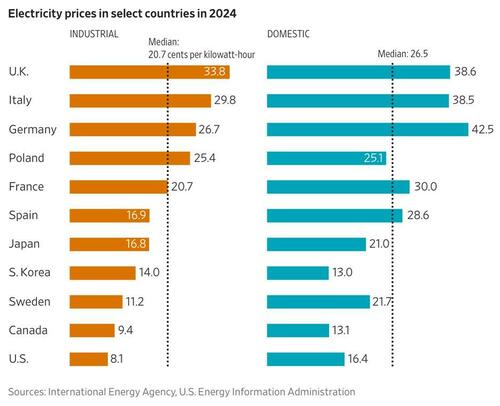
“Germany now has the highest domestic electricity prices in the developed world, while the U.K. has the highest industrial electricity rates, according to a basket of 28 major economies analyzed by the International Energy Agency. Italy isn’t far behind. Average electricity prices for heavy industries in the European Union remain roughly twice those in the U.S. and 50% above China.”
Maybe burning all bridges - and blowing up subsea pipelines - to cheap Russian conventional energy was not the best idea.
In any case, absent huge changes, Europe has permanently excluded itself from the entire data center and AI industry boom. Why are all the data centers in the western world being built mostly in the US? Just look at the chart above. A massive cost to data center operators is the extremely electrical demand of their server racks and their cooling systems. They can pay over 25 c/kWh in some European countries, or they can come over here and pay as low as 8 c/kWh. The difference is an immediate deal breaker.
In some cases, it’s not even the prices turning off the data centers: European infrastructure industry just can’t handle it. “Jerome Evans, the CEO of a German data-center operator, sought to expand his two data centers in Frankfurt, Germany’s internet crossroads. The local power provider told him he would have to wait a decade, until 2035, for the energy to power them.”
The examples showcasing the results of Europe’s energy infrastructure choices are endless:
“‘We are hemorrhaging industry,’ said Dieter Helm, an economic professor at Oxford University who has advised U.K. governments on energy policy. British chemical company Ineos said in October it would close two plants in western Germany because of high energy costs. In recent days, Exxon-Mobil said it would close its chemical plant in Scotland and threatened to exit Europe’s chemicals industry, saying green policies made it uncompetitive.”
Meanwhile, the unpredictability of solar and wind is hurting everything everywhere. The costs of construction and operation are obscured by carbon taxes and government subsidies, and power finds its way to the grid on cloudy or windless days anyways, so what’s the issue? Those powerless days where panels and mills are sitting idle require power to be purchased, at a premium, from nearby countries. When this occurs for weeks at a time, prices can skyrocket for everyone.
As highlighted earlier, the problems are also only just starting, and the question of what to do with the impending wave of “renewable waste” will demand an answer.
Europe pursued the grand energy transition using the “or” strategy, in contrast to the “and” strategy used by the US. Europe has decided to shutdown all of its coal, gas, and nuclear plants while trying to at the same time build as much wind and solar as possible to replace the destroyed capacity. Compare this to countries like the US that instead decided to build more of everything at the same time, and the results become alarmingly clear.
The US took its buildout of nuclear energy a step further with the announcement of nearly a billion dollars for deploying new advanced reactor technology. $400 million will be provided to the Tennessee Valley Authority for developing the BWRX-309 reactor, a joint venture reactor design between GE Vernova and Hitachi. Their reactor is already under construction in Canada at the Darlington site, while the permit to start construction of the second iteration is under review by the NRC.

Another $400 million will go to Holtec to deploy two of their SMR-300 reactors at the Palisades site in Michigan. Both designs receiving Department of Energy funding are smaller reactors with target outputs of about 300 MW electric, compared to the much larger AP1000 reactors built in Georgia that are rated to about 1,100 MW electric. This class of small-but-still-pretty-big reactors focus on minimizing land use and supporting electric grids on a small scale. There’s also a place for them powering larger-scale data centers.

Both reactor projects in Tennessee and Michigan look to be grid connected in the 2030s.
Loading recommendations...