原文
|
|
Preserving
Snow Crystals
... Making your own snowflake fossils ... |
|
It is possible to
preserve newly fallen snow crystals, creating one's own snow crystal fossils.
These preserved replicas can then be examined by microscope any time, in
a comfortable indoor climate. |
|
Superglue Replicas |
 This technique appeared recently in
Popular Science magazine and was attributed to chemist Tryggvi
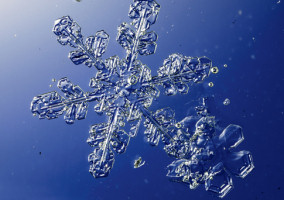
Emilsson. The picture at right is from that article. The
quality of the snowflake in the image is mediocre, but the replica looks
pretty good.
This technique appeared recently in
Popular Science magazine and was attributed to chemist Tryggvi
Emilsson. The picture at right is from that article. The
quality of the snowflake in the image is mediocre, but the replica looks
pretty good.
Here's how you do it:
1) Go outside with some glass microscope slides, cover slips, and
superglue (not the gel kind; it should be thin and watery). Cover
the slides and cover slips until they become as cold as the surrounding
air.
2) Let snow crystals fall onto a cardboard collection board, and
scan around with a magnifier to find an attractive specimen.
Carefully pick the crystal up using a small artist's paintbrush and
place it on one of the slides.
3) Place a drop of cold superglue on the crystal, and drop a
cover slip on top. Be careful not to melt or otherwise damage the
snow crystal in the process.
4) Leave the slide outside or in your freezer for a week or two
until the glue hardens. |
|
Formvar Replicas |
 This preservation technique is described by Schaefer and Day [1].
It is similar to the superglue technique, but involves some different
chemicals.
This preservation technique is described by Schaefer and Day [1].
It is similar to the superglue technique, but involves some different
chemicals.
Dissolve one gram of Formvar (polyvinyl
acetal resin) in 100 milliliters of ethylene dichloride to make about a 1
percent solution of the plastic. According to Mason [3], best
results are obtained when the Formvar solution
is dehydrated by shaking it up with calcium chloride or phosphorus pentoxide to remove the
dissolved water, which otherwise will come out when the solution is chilled and form
spurious ice crystals. Also, it is particularly important to use a solution of the
right strength. If it is too viscous, it will not fill small
crevices on the crystals; if it is too thin, the solution will not form
a thick enough layer. Good replicas of natural snow crystals may be
obtained with a 1-3 percent solution. For crystals less than 0.1 mm in diameter,
such as may be produced in laboratory experiments, a 0.1 percent solution can be used.
Once you have the solution, use it much like the superglue
described above. |
|
Acrylic Replicas |
 Another method uses
clear acrylic spray paint, which is readily available in hardware stores. The spray is
especially effective for replicating windowpane frost and similar ice structures. The
(cold) spray must be applied lightly, since the solvent in the spray can dissolve the ice
if too much liquid is present. The best procedure is to pre-coat the glass slide with
the plastic film, place snow crystals on it, and then spray the surface again until the
surface is moist. The image at right is from Walter Tape [4], and was obtained by spraying
over a crystal that was placed on a glass slide. Another method uses
clear acrylic spray paint, which is readily available in hardware stores. The spray is
especially effective for replicating windowpane frost and similar ice structures. The
(cold) spray must be applied lightly, since the solvent in the spray can dissolve the ice
if too much liquid is present. The best procedure is to pre-coat the glass slide with
the plastic film, place snow crystals on it, and then spray the surface again until the
surface is moist. The image at right is from Walter Tape [4], and was obtained by spraying
over a crystal that was placed on a glass slide.
|
|
[1] V. J. Schaefer and J. A. Day, Peterson
Field Guides: Atmosphere (Houghton Mifflin, 1981).
[2] Resin 15-95E, Monsanto Chemical Corp., Springfield, Mass.
[3] B. J. Mason, The Physics of Clouds (Clarendon Press, 1971).
[4] W. Tape, Atmospheric Halos, Antarctic Research Series, Vol. 64,
(American Geophysical Union, 1994). |
|