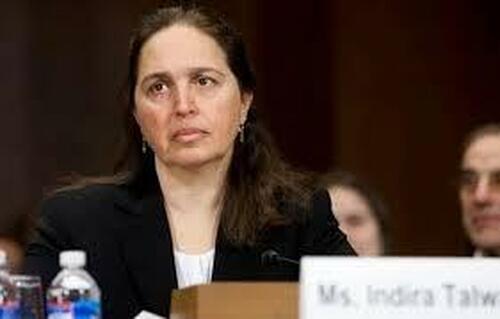
District Court Judge Indira Talwani in Boston has been one of the most active judges in the country in seeking to enjoin the orders of President Donald Trump, including her orders to prevent deportations under previously “paroled” immigrants under the Biden Administration. She previously sought to enjoin the denial of federal funds to Planned Parenthood, an order that the United States Court of Appeals lifted for the First Circuit pending appeal. Now, Judge Talwani is back with a new basis for forcing payments to Planned Parenthood despite Congress barring Medicaid funds under the Big Beautiful Bill.

Planned Parenthood is facing a financial meltdown without the federal funding and is closing offices after the passage of the BBB.
Judge Talwani previously halted the cessation of federal funding on the basis that the action was an effort to punish Planned Parenthood for offering abortion services.
She wrote the law likely violates the Constitution’s “bill of attainder clause,” which prohibits Congress and state legislatures from imposing punishments on individuals or specific entities without trial. As lead counsel in the Foretich case (one of the few successful modern bill of attainder cases), I was highly skeptical of the chances of Talwani’s earlier opinion being upheld.
In the new 45-page opinion, Judge Talwani now says that the ban contained in the One Big Beautiful Bill Act “does not furnish states with clear notice as to the meaning and application of [the provision’s] criteria” for denying funding.
However, the law applies to any health care provider providing abortions as of October 1 and receives more than $800,000 in Medicaid payments in a year. The Justice Department argued that “The elected Branches determined that taxpayer funds should not be used to subsidize certain entities that practice abortion – conduct that many Americans find morally abhorrent.”
The opinion, in my view, is flawed and (again) stretches existing precedent to the breaking point. Congress clearly has the power to place this condition on federal funding and was clear on the application of that condition.
Section 71113 was enacted on July 4, 2025, and provides that “[n]o Federal funds that are . . . provided to carry out a State [Medicaid plan] . . . shall be used to make payments to a prohibited entity for items and services furnished during the 1-year period beginning on the date of the enactment of this Act[.]” Pub. L. No. 119-21, § 71113(a), 139 Stat. 72, 300-01 (July 4, 2025).
The Centers for Medicare and Medicaid Services (CMS) further provided the following notice and guidance:
States must ensure their managed care programs comply with section 71113 and applicable requirements under 42 CFR Part 438. States and their actuaries should evaluate whether implementation of section 71113 necessitates adjustments to Medicaid capitation rate development or constitutes a material adjustment requiring an amended rate certification. Additionally, states should review any [state directed payments (“SDPs”)] to determine whether revisions are required and how such SDPs are accounted for in capitation rate development and rate certifications.States must also ensure that all Medicaid managed care contracts comply with all applicable federal and state laws, including Section 71113 of WFTC legislation.[8] To ensure clarity, states should assess if their managed care contracts should be revised to detail the requirements of section 71113. For example, states may wish to specify in their managed care contracts that payments to prohibited entities are not allowable expenditures of Federal funds under section 71113(a), and that any expenditures to such entities made by [covered organizations] are not eligible for [federal financial participation].
The CMS told the states that if it “has already claimed or has drawn down FFP on or after July 4, 2025 for payments to entities identified as prohibited entities as of October 1, 2025, it should promptly withdraw or correct the claim, or return FFP, as required by applicable statutory and regulatory requirements.”
In my view, the court tries too hard (as it did on the attainder opinion) to protect this funding. We will have to see if the First Circuit and the Supreme Court agree with that assessment.
Here is the opinion: Planned Parenthood decision
Loading recommendations...