Even after the latest US-China trade truce, the superpower race for technological dominance remains red hot - and will only intensify through the end of the decade.
The battle is over who controls the technologies that will dominate the 2030s: AI chatbots, advanced chips, drones, humanoid robots, clean tech, EVs, satellites, reusable space rockets, hypersonic weapons, next-gen grid power generation, and the critical minerals that make all of it possible.
The latest comments from U.S. Trade Representative Jamieson Greer reveal that the Trump administration is pushing for a stable trade environment with Beijing, which makes perfect sense heading into the midterm election cycle.
"I don't think anyone wants to have a full-on economic conflict with China and we're not having that," Greer said Thursday at the American Growth Summit in Washington.
Greer continued, "In fact, President Trump has had the opportunity to use all the leverage we have against China — and we've had a lot, right — whether it comes to software, semiconductors or all kinds of things. A lot of allies are interested in taking coordinated action, but the decision right now is we want to have stability in this relationship."
"For this moment in time, we want to make sure that China is buying the kinds of things from us we should be selling them: aircraft, chemicals, medical devices and agricultural products," he said. "We can buy things from them that are not sensitive."
Greer added, "We have to get our own house in order. We need to make sure that we are on a good path to reindustrialization, including for critical minerals."
Being only a trade truce, the real superpower battle continues to rage behind the scenes.
The latest Goldman Sachs Top of Mind, one of the firm's flagship research publications edited by Allison Nathan, offers clients a broad framework of why the geopolitical race for technological dominance remains as intense as ever.
Mark Kennedy, Founding Director, Wahba Initiative for Strategic Competition at New York University's Development Research Institute, told Goldman's Ashley Rhodes, "It is entirely possible that neither the U.S. nor China emerges as the outright victor in the tech race. I can envision a world in which the U.S. leads in developing the most advanced technologies, while China leads in global installations."
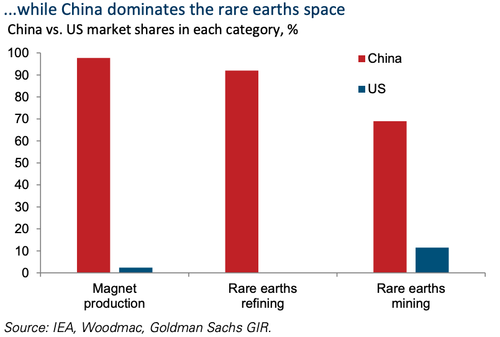
On the rare-earth mineral front, it's very clear that while the U.S. is still playing catch-up, China remains years ahead in both mining and refining.

But not all is lost: the U.S. is well ahead on the semiconductors.

Rhodes asked Kennedy:
Who is currently "winning" the tech race?
Kennedy responded:
It's important to understand that there are four key arenas in this race: technological innovation, practical application of the technology, installation of the digital plumbing or infrastructure underpinning the technology, and technological self-sufficiency. The U.S. is currently leading in most advanced technologies, including semiconductors, AI frameworks, cloud infrastructure, and quantum computing, as well as in attracting global talent. However, China is ahead in areas such as quantum communications, hypersonics, and batteries.
China is also making rapid strides to catch up to and, in some cases, overtake the U.S. in technological application. For example, China deploys robotics in manufacturing on a scale twelve times greater than the U.S. when adjusted for differences in employee income. And while U.S. regulations often limit applications like drone deliveries to your door, China is proactively testing and deploying advanced physical AI and robotics like uncrewed taxis and vertical takeoff vehicles, accelerating their practical adoption.
China is also dominating on the global installations front. It has established a strong presence in the Global South, surpassing the U.S. and other Western nations in building essential digital networks there. And China has made significant strides toward achieving technological self-sufficiency through its dual circulation strategy aimed at reducing its reliance on the West while increasing Western dependence on China. Recent Chinese government measures, such as restricting domestic purchases of Western chips and offering incentives for using domestic alternatives, underscore this push for technological independence. At the same time, China's vast overproduction capacity in batteries and critical minerals has further increased Western dependence on China's supply chains. The U.S. has been ambivalent at best as it relates to this aspect of the tech race and remains reliant on China in many ways. So, on net, while the U.S. leads in the development of the technology itself, China is rapidly closing the gap — or even leading — in application, infrastructure installations, and tech self-sufficiency.
Reindustrialization in the U.S. should reverse this...

The U.S. and allies lead on chips.

Dominates in data centers.

But again, not in rare earths.

China leads in nuclear power.

Our takeaway from the Top of Mind note: the U.S. still leads in innovation, software, and frontier AI models, while China dominates in application, infrastructure, critical minerals, and manufacturing scale. The U.S. is the brain of the global economy, while China is the manufacturing powerhouse. The Trump administration is now trying to preserve America's innovation edge while single-handedly rebuilding its industrial base. All of this continues to point toward a deeply bifurcated world by the 2030s.
The full note can be read in the usual place by ZeroHedge Pro subs. It's epic and packed with additional conversations from leading experts, offering even more visibility into the superpower race ahead of the 2030s.
Loading recommendations...