Authored by Tamuz Itai via The Epoch Times,
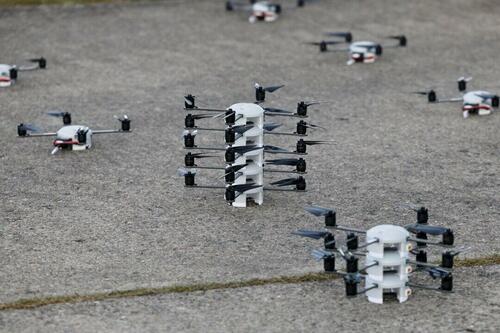
On June 1, 2025, 117 quadcopters—total cost under $120,000—flew from hidden launchers inside Russia and crippled 10 strategic bombers across five air bases in a single morning.
Operation Spiderweb, as Ukraine called it.

It was a public demonstration of a new form of conflict: When the price of precision falls far enough, scale becomes inevitable, and scale forces autonomy. That autonomy, in turn, moves the battlefield faster than human minds can reliably follow. We seem to be entering the era of machine-speed warfare.
Quiet Arrival
For decades, militaries and the defense industrial base followed a rule: Better always meant more expensive. A modern fighter costs $100–120 million; its predecessor cost half that. The pattern held from tanks to submarines. Drones broke the pattern. A competent kamikaze drone now costs $400–$1,000 and can reliably kill a $5–10 million tank. A long-range one-way drone costs perhaps $30,000 and can sink a frigate. The cost curve of creating a precision threat has collapsed; the cost of defending against it has not.
Once the economics flip, quantity becomes quality all of its own. Ukraine says it already has the ability to produce drones at a rate of 4 million per year. Russia, Iran, and China are racing to match or surpass those numbers. When you are fielding not dozens but thousands of armed aircraft simultaneously, no human staff can micromanage them. You must delegate.
Delegation quickly becomes autonomy. Collision avoidance, target recognition, route replanning, reaction to jamming—these decisions migrate from human operators to software running on the drone itself. The more drones you have, the less you can afford to keep a human in the loop for every micro-decision. The battlefield begins to run at machine time.
High-Frequency Warfare
The closest civilian analogy is high-frequency trading, where humans merely set strategy, risk limits, and circuit-breakers. After that, algorithms trade at microsecond speeds with no realistic possibility of human intervention. Modern drone swarms are evolving into the military equivalent. Ukraine already retrains its targeting models weekly using fresh combat footage; Russia and China are likely doing the same. An 8 percent improvement in a computer-vision model on Tuesday can translate into battlefield dominance by Thursday.
That speed is terrifying. Machines do not get tired, do not hesitate, and do not ask whether escalation is politically wise. They simply execute. In a noisy, deceptive environment, small errors can compound rapidly. The cost in our case is not just money, but lives.
Control Theory
In a nutshell, the core idea is: a system measures something, decides what that measurement means, and reacts. Then it measures again and adjusts. Take, for example, a thermostat.
Every drone is a feedback control system: measure → decide → act → measure again. The enemy’s entire job is to break that loop—jam the measurement, spoof the decision, or block the action. When hundreds of such loops are running in parallel, all under deliberate attack, the default state is instability unless the loops were deliberately designed to be extraordinarily robust.
This is why purely technological answers are probably insufficient. Advantage also lies in strategy and doctrine—in the rules, restraints, and architectures nations choose to build into their systems from the beginning.
Robust Versus Loose
Not all autonomous systems are created equal. Some states and actors design robust systems: conservative rules of engagement baked into code, multiple verification layers before lethal action, and strong de-escalation biases under uncertainty. Others design loose systems: faster reaction times, higher tolerance for collateral damage, and a willingness to treat ambiguity as an opportunity rather than a red flag.
On current evidence, robust systems are winning the cost-exchange war. Ukraine, fighting with strict rules of engagement and heavy reliance on human oversight, has consistently achieved better loss ratios than Russia despite being vastly outnumbered in almost every traditional category. Restraint, paradoxically, forces greater precision, faster learning cycles, and more effective active defenses—all of which can compound into strategic advantage.
Loose systems look terrifying on paper, but in practice they bleed money, invite sanctions, and generate atrocity footage that fuels the other side’s alliances and recruitment. Every war crime committed by a loose actor is a strategic gift to the robust one.
The Flash-War Risk
Tom Clancy understood the danger of misinterpretation under time pressure. In “The Sum of All Fears” (1991), the plot hinges on a false-flag nuclear attack, masterminded by a third party, designed to make the United States and the Soviet Union blame each other and stumble into war. Today, we do not need a nuclear weapon to create the same cascade. Two hundred spoofed drones launched from a fishing boat, carrying the electronic signature of a great power, could do it in 20 minutes.
The battlefield is already producing miniature versions of this story dozens of times per day: A drone drifts across a sensitive line because of wind or jamming, an opposing swarm interprets it as a probe, automated defenses react, and within seconds both sides have taken irreversible actions that no political leader ordered. By the time a human sees the trend, the adversary’s intent seems to be clear, and escalation unavoidable.
The Real Race
The technological race is real, but it is not the only race. Free countries cannot and should not copy the loose model. But they can build systems that are simultaneously fast, open, and disciplined. That means, for instance:
treating drones as consumable ammunition, not exquisite platforms
supporting innovation and startups
shortening feedback loops to weeks, not decades
encoding clear, shared rules of engagement into software from day one
investing heavily in active defenses (lasers, jammers, and cheap interceptors
creating pre-agreed crisis mechanisms—digital hotlines, shared telemetry standards, forensic rapid-response teams
Ukraine has shown that a motivated society can out-innovate a much larger adversary even when heavily outnumbered. The $800 quadcopter has already rewritten the rules of war. The next question is whether we can rewrite our systems fast enough to win and keep the machines on a leash.
Views expressed in this article are opinions of the author and do not necessarily reflect the views of The Epoch Times or ZeroHedge.
Loading recommendations...