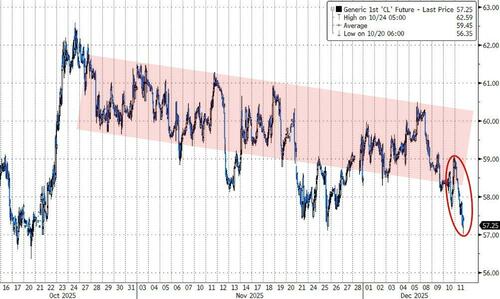
Oil prices are lower this morning despite a less-hawkish-than-feared Fed cut and a double-whammy of relative optimism from OPEC and the IEA...

IEA Trims Oil Glut Forecast as Supply Surge Halts
OilPrice.com's Tsvetana Paraskova reports that the oil market still faces record oversupply next year, according to the monthly report by the International Energy Agency (IEA), but the glut estimate is now trimmed by about 230,000 barrels per day compared to the November forecast.
The market is headed to as much as 3.84 million barrels per day (bpd) of supply exceeding demand in 2026, the IEA said on Thursday in its closely-watched report for December.

While this still is a considerable glut, it’s lower than the 4.09 million bpd implied oversupply expected in the November report.
In today’s report, the IEA said that the projected global oil surplus in the fourth quarter of 2025 has narrowed since last month’s report, “as the relentless surge in global oil supply came to an abrupt halt.”
Total global oil supply dipped by 610,000 bpd in November compared to October and by a whopping 1.5 million bpd from September’s all-time high, the IEA noted.
OPEC+ accounted for 80% of the decline over October and November, reflecting significant unplanned outages in Kuwait and Kazakhstan, while oil output from sanctions-hit Russia and Venezuela plunged.
Russia’s total oil exports are estimated to have plummeted by about 400,000 bpd in November to 6.9 million bpd, as buyers assessed the implications and risks associated with more stringent sanctions.
Buyers, especially in Russia’s second-biggest crude oil customer, India, are steering clear of any Rosneft and Lukoil-related cargoes, for fear of running afoul of the U.S. Administration while India and the United States are still locked in difficult trade negotiations.
The IEA noted in its report the apparent disconnect between the current global oil surplus and inventories near decade lows at key pricing hubs.
Despite record volumes of oil piling up on water, benchmark crude oil prices eased only marginally in November, because “in stark contrast to the broader picture, crude and refined product stocks in key pricing hubs have seen only marginal builds,” the agency said.
OPEC Holds Firm on Bullish Oil Demand Outlook for 2026
As Charles Kennedy reports at OilPrice.com, global oil demand will rise by about 1.4 million barrels per day (bpd) next year, supported by solid economic growth, OPEC said in its monthly report ton Thursday, keeping its demand forecasts unchanged from last month.
Unlike other forecasters, investment banks, and analysts, OPEC continues to expect robust demand growth in 2026 that will be higher than the estimated increase for 2025 of about 1.3 million bpd, forecasts in the cartel’s Monthly Oil Market Report (MOMR) showed on Thursday.

Figures about the balance of supply and demand in OPEC’s report also suggest that the cartel expects a balanced market next year.
Demand for crude from the OPEC+ producers is expected at 43.0 million bpd in 2026, up by 60,000 bpd compared to the projection for 2025, OPEC said.
At the same time, crude oil production by the countries in the OPEC+ pact averaged 43.06 million bpd in November, a rise by 43,000 bpd from October, compared to the available secondary sources in OPEC’s report.
After December, OPEC+ producers will be pausing their targeted monthly production increases during the first quarter of 2026.
OPEC expects rival non-OPEC+ oil supply to grow by about 600,000 bpd next year, versus growth of some 1 million bpd expected for 2025.
The rise in non-OPEC+ output is expected to be driven by offshore start-ups across Latin America and the Gulf of Mexico, increased NGLs production in the U.S., Argentina’s tight oil production, and the scaling of oil sands projects in Canada. Latin America is projected to lead non-OPEC+ growth, accounting for about two-thirds of the total, followed by Canada and the U.S.
This projection, while not new for OPEC, reiterates the cartel’s view that U.S. oil production growth will slow down next year.
Signals have started to emerge in the shale patch and from industry executives that WTI crude prices below the $60 per barrel mark will put the brakes on America’s shale growth.
Loading recommendations...