Authored by J.Ricardo Martins via journal-neo.su,
Europe’s long-standing security framework is undergoing profound strain, increasingly overshadowed by economic instruments that shape geopolitical influence.

This analysis examines how geoeconomic logics are reshaping Europe’s strategic posture and challenging the foundations of its traditional security order.
The Unraveling: How Europe Lost Control of Its Own Security Architecture
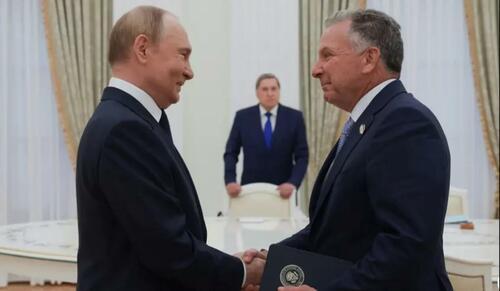
The photograph of Steve Witkoff with Vladimir Putin in Moscow is not merely another episode in the long chronicle of American informal diplomacy. It is a symbol of something far more consequential: the definitive erosion of the Euro-Atlantic security architecture that has anchored Europe since 1945. Europe now finds itself a spectator to a negotiation that directly concerns its future but in which it has no meaningful voice.
For decades, European leaders assumed that their security environment was guaranteed through three pillars: American military supremacy, NATO cohesion, and a Russia that could be simultaneously contained and marginalised. The war in Ukraine temporarily sustained this illusion. The European Union interpreted Russia’s invasion of Ukraine as validation of the post-1991 Atlantic order, proof that Europe needed more NATO, more American leadership, more defence spending, and more ideological alignment with Washington.
Europe’s tragedy is not that it is being excluded from the negotiations shaping its own future, but that it does not yet fully grasp the depth of its exclusion
But as the conflict entered its later stages, and as new political dynamics emerged in Washington, a deeper reality became visible: Europe’s vision of security was not aligned with America’s long-term strategic trajectory.
Washington seeks to contain China; Europe seeks to contain Russia. Washington looked to the Indo-Pacific; Europe clung to its Eastern frontier. Washington viewed Russia as a potential co-player in global resource extraction, Arctic development, and strategic balancing; Europe continued to frame Russia as a permanent existential enemy.
The result is a form of strategic misalignment, with Europe still operating inside an architecture that Washington no longer fully believes in.
The American Pivot, the European Panic
Donald Trump’s return to the international stage accelerated this divergence dramatically. Trump’s strategic re-imagination of Russia, as an asset rather than an adversary placed Europe in a state of near-panic. His willingness to undermine NATO commitments, his explicit distrust of European leaders, and his understanding of geopolitics as business diplomacy all contribute to Europe’s strategic anxiety.
Trump’s humiliation of Europe is deliberate. By sending Witkoff, an adviser with no diplomatic obligations, to Moscow repeatedly while ignoring Kyiv, Trump signals that the centre of gravity has moved. The peace process will not be mediated through Brussels, Berlin, or Paris; it will be mediated through a Washington–Moscow axis, bypassing European institutions entirely.
Europe’s refusal to speak with Moscow is interpreted in the Kremlin not as principled resistance but as strategic self-sabotage. And Washington, sensing opportunity, is willing to exploit this fracture.
As many analysts warned—both sympathetic and critical—Europe is discovering too late that its security cannot be maintained through moral rhetoric, sanctions, or rearmament without industrial foundations. Europe wants to contain Russia, but it no longer has the political, military, or economic tools to do so.
The Dealmakers: How Trump, Putin, and Business Networks Are Writing Europe Out of Its Own Future
Shadow Diplomacy as the New Geopolitics
Witkoff’s shuttle diplomacy represents a structural shift: diplomacy is no longer the domain of foreign ministries but of political families, corporate intermediaries, and resource-based alliances. This is why Kushner’s presence in Moscow matters profoundly. The December talks were not simply high-level negotiations; they were the emergence of a new system of geopolitical conduct, in which trust between individual power networks outweighs institutional protocols.
The Trump–Putin paradigm is built on three principles: (i) commercial logic over ideological confrontation; (ii) resource extraction as the foundation of geopolitical stability; and (iii) bilateral trust over multilateral institutions.
This is profoundly humiliating for Europe, which traditionally sought legitimacy via multilateralism. For Washington and Moscow, however, Europe’s exclusion is not an oversight but a feature. The old European security architecture depended on Europe’s centrality. The new one does not.
The Economic Heart of the New Architecture
The emerging Washington–Moscow understanding is grounded in four economic pillars:
– Arctic and Northern Sea Route Resource Extraction: Joint participation in Arctic minerals, hydrocarbons, and rare earths is central. The US is far behind Russia in icebreaker capacity and Arctic infrastructure, and cooperation is a pragmatic solution.
– Energy Corridors and Post-War Reconstruction: American investors eye Russian energy as an undervalued frontier market. Simultaneously, reconstruction of Ukraine (potentially funded by frozen Russian assets) creates massive opportunities for US construction and energy firms.
– Reintegrating Russian hydrocarbons into global markets: This is a long-term American objective, both to stabilise global energy prices and to manage China’s growing leverage over Russia.
– Replacing NATO’s military logic with economic interdependence: This is the core of Trump’s thinking: build a Washington–Moscow axis rooted in profitability, thereby reducing the incentive for armed confrontation.
Why Europeans Are Desperate
Because Europe has tied its industrial base to sanctions, decarbonisation, and American military dependency, it is now structurally weaker than both Washington and Moscow in the emerging configuration.
Europe is discovering three painful truths:
– It cannot defend itself without the US. NATO’s European pillars lack ammunition, industrial capacity, and high-end military technology.
– Sanctions have weakened Europe more than Russia. Energy-intensive industries in Germany, Austria, and Italy are relocating to the US. Deindustrialisation is underway in Europe.
– The peace negotiations will not include Europe as a co-author. Europe will receive the final document, but not be invited to shape it.
This is why European strategists are furious: the security architecture that defined the continent is being rewritten over their heads.
After Ukraine: What the New European Security Order Might Look Like
Will NATO survive as Europe’s central pillar?
NATO will not disappear. It remains too deeply institutionalised, too symbolically powerful for Europeans, and too useful for Washington’s basing structures and arms exports. But it will be downgraded, transformed from the core of the European security order into a secondary framework, increasingly dependent on: US political will, a fragmented European defence sector, reduced American enthusiasm for European commitments, and a US–Russia modus vivendi that Europe does not control.
Under a Trump presidency, NATO has become a transactional umbrella, not a strategic alliance. Its credibility will depend entirely on the personal relationship between Trump and Putin—and Europe hates this because it strips the continent of agency.
The Impact of the War and the Coming Peace on Europe’s Architectural Future
The conflict in Ukraine revealed Europe’s structural vulnerabilities: lack of ammunition, lack of production capacity, overreliance on sanctions, and strategic incoherence. The peace will reveal something even more uncomfortable: Europe cannot enforce the consequences of the settlement on its own.
If the US and Russia craft the final settlement, Europe must either accept it or refuse and confront the consequences alone. Neither Paris nor Berlin is prepared for the latter scenario.
Ukraine, tragically, will be the ultimate pressure point. Its sovereignty will be negotiated by outsiders. Europe knows this but cannot alter it.
Can Europe Hold the Architecture Without the US?
The honest answer is no, not in the short or medium term. Europe lacks nuclear deterrence autonomy, military-industrial depth, cohesive political will, strategic consensus, energy security, technological parity with the US, and the capacity to contain Russia without American leadership.
The idea of European strategic autonomy remains aspirational rhetoric. The EU has military instruments, but not a military. It has ambitions, but not the industrial base to sustain them.
The Asian Century and the Decline of Europe
The more Washington and Moscow converge economically, the more Europe’s global relevance declines. The Russia–China axis strengthens, India emerges as a balancing pole, and the BRICS expand their economic and political weight. Europe becomes a peninsula of a Eurasian supercontinent that it does not control, increasingly marginal to global power centres.
Whether Asia can provide stability depends on the trust networks forming between Beijing, Moscow, New Delhi, Riyadh, and Tehran. Europe is not part of those networks.
Conclusion: A Continent in Suspension
Europe’s tragedy is not that it is being excluded from the negotiations shaping its own future, but that it does not yet fully grasp the depth of its exclusion.
The Moscow meetings are not a negotiation between equals; it is a negotiation between systems of power. Trump and Putin understand one another because they speak the language of transactional geopolitics. Europe speaks the language of norms, laws, and bureaucratic procedures—in a world that is no longer governed by them.
A new European security architecture is being drafted, and it is not being drafted in Brussels. It is being drafted in Washington and Moscow.
Europe must confront a stark question: Can a continent that has lost strategic agency recover it before the next geopolitical cycle closes?
Loading recommendations...