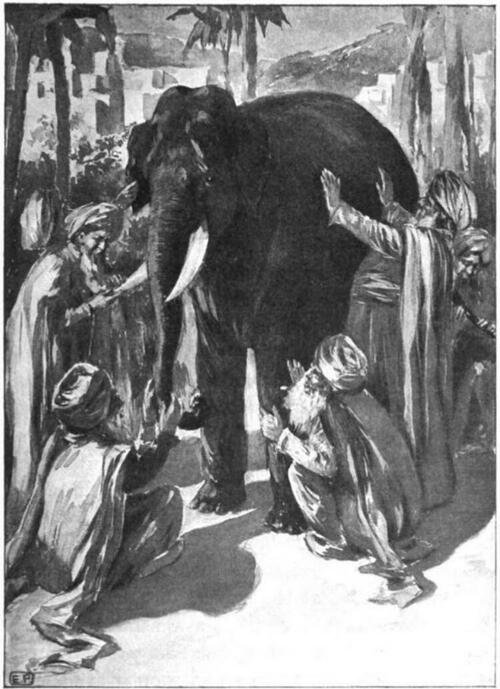
In a famous Indian parable, five blind men are brought to an elephant. Each feels a different part of the animal, and they come to radically different views of what an elephant is. It depended on which parts they touched, from tusk to tail.

The controversy over the shooting of Renee Nicole Good, 37, is a type of political elephant parable.
People focus on only certain parts of the story to support what they want the case to mean.
Critics and supporters of the responsible officer have slowed down videotapes that last, in critical part, for only a few seconds.
The only difference is that, in this modern parable, many are just willfully blind, choosing not to see beyond their own rage.
This week, Minneapolis Mayor Jacob Frey (D) became the personification of rage, spewing profanities about ICE while declaring, shortly after the shooting, that the ICE officer was a murderer.
After immediately declaring the officer’s guilt, Frey spent day two lambasting the federal government for rushing to conclusions and demanding that his people play a role in the investigation.
As for his unhinged, profane diatribe, Frey mocked critics if he “offended their Disney princess ears.”
Frey fulfilled the parable most clearly in his use of statistics. He declared that fifty percent of shootings in the city this year were committed by ICE. He then later admitted that, since it was only Jan. 9, there had been only two shootings. Indeed, he could have argued that ICE was responsible for 100 percent of the shootings in the city on Jan. 7.
Again, the trick is to examine the smallest part of the animal and extrapolate to draw sweeping conclusions.
The recently released videotape from the responsible officer also shows how people will focus on insular elements rather than the “totality of the circumstances,” the standard for such cases established by the Supreme Court.
For example, many supporters of the officer are citing the obstruction and taunting by Good and her wife, who were reportedly working with an anti-ICE group. At one point, Becca Good dares the officer to do something as they blocked the road, telling the officer “Do you want to come at us? I say go and get yourself some lunch, big boy.”
For critics, they have focused on Renee Good’s last words: “That’s fine dude, I’m not mad at you, I’m not mad at any of you.” Whether Good was being peaceful or passive-aggressive, others are clearly very, very mad. They are using her statement to push protesters to the brink of violence.
Democratic leaders declared ICE to be “terrorists” and called for mass protests in the very same city that burned in 2020 after the George Floyd riots. Right on cue, one Black Lives Matter leader suggested that the prosecution of officers in the George Floyd case only occurred because protesters burned down the city. She told protesters to ignore pleas not to do it again. “Let me tell you this. We need justice and we need it now.”
Protesters in other cities chanted “Kristi Noem will hang” and “Save a Life, Kill an ICE.”
In the same presser where he condemned federal officials for jumping to conclusions, Frey not only reaffirmed that Good had been murdered but added that the officer was not actually injured as claimed. “The ICE agent walked away with a hip injury that he might as well have gotten from closing a refrigerator door with his hips,” he said. “He was not injured. Give me a break. No, he was not ran over. He walked out of there with a hop in his step.”
Few of us have been in Frey’s kitchen, but the latest videotape seems to show something more intense than an encounter with his fridge. The video shows the agent being hit by the vehicle as Good ignores orders to get out of the car, as Becca Good is screaming, “drive, drive, drive.”
Reasonable people can disagree on whether the officer should have discharged his weapon. Flight alone is not grounds for the use of lethal force. However, Good’s actions could also be interpreted as an intentional endangerment of the officer.
At a minimum, it was clearly reckless, as another officer was trying to reach into the vehicle and Good refused to yield to the effort to place her into custody. The Goods forced the confrontation, and Renee Good then escalated the level of danger by speeding toward an officer.
This is why the legal standard requires you to take in the entire elephant, not just insular parts.
While there may still be countervailing facts emerging from the investigation, the governing legal standard clearly favors the officer. It is Good’s actions, not her motivations, that are critical to determining whether excessive force was used. The officer’s cellphone video shows he had a fraction of a second to decide and fired after being struck by the car. (The same officer had been seriously hurt previously after being dragged by a car.)
The Justice Department’s guidances incorporate the standards outlined in past Supreme Court decisions, such as Graham v. Connor (1989). Again, individual elements can be viewed in isolation as favoring or disfavoring the use of force, including the severity of the crime at issue (in this case likely a misdemeanor) and whether the suspect was “attempting to evade arrest by flight.” The guidelines stress that “[t]he ‘reasonableness’ of a particular use of force must be judged from the perspective of a reasonable officer on the scene, rather than with the 20/20 vision of hindsight.”
This tragedy shows that people watching the same videotapes can come to diametrically opposed conclusions. Take the speed of the vehicle. Some have noted that the car was traveling less than 10 miles per hour before it collided with another vehicle. However, the speed after the shooting of Good is immaterial. The relevant question is the distance and speed with reference to the officer. It was clearly speeding up and immediately struck the officer before Good was shot.
The same is true of those who note how the wheels appear to be turning toward or away from the officer. The fact is, Good struck the officer. That does not mean she intended to do so, but that does not matter. From the officer’s perspective, Good was ignoring orders while speeding toward him from just feet away.
There will likely be civil litigation. Democrats have also called for criminal charges. The arguments on both sides of this controversy show, at most, that the issue is debatable. The officer could be viewed as wrong and still be found to have acted within the scope of his discretion in responding to a threat. Any state effort to charge the officer will be removed to federal court, where he will likely have immunity based on this evidence.
The public would be wise to ignore conclusions reached blindly by either side. In an “Age of Rage,” we live in the land of the blind, where the one-eyed man is king. The public must remain clear-eyed and calm as the investigation proceeds in Minneapolis.
Jonathan Turley is a law professor and the author of the forthcoming “Rage and the Republic: The Unfinished Story of the American Revolution.”
Loading recommendations...